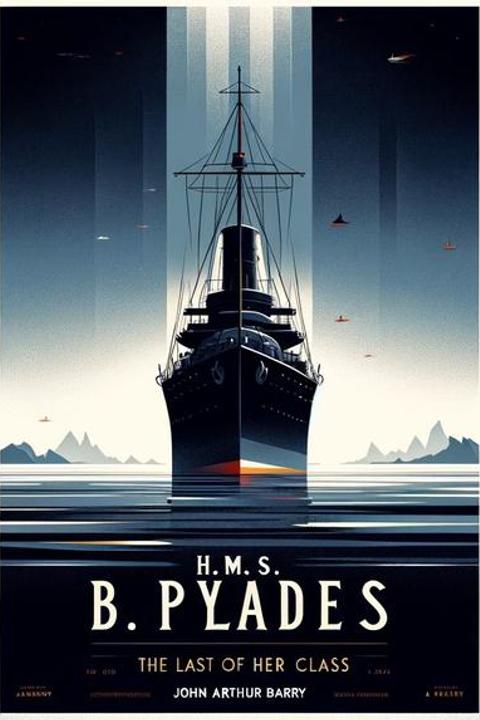
H.M.S. Pylades, The Last of Her Class
H.M.S. Pylades is the story of the last of her class of British battleships, and the men who served on her. The book follows the ship from her launch in 1912, through her service in World War I, and her eventual decommissioning in 1921. It tells the story of the men who served on her, their lives, their loves, and their losses. It also tells of the ship's many battles, from the Battle of Jutland to the Battle of the Falkland Islands. The book is a tribute to the men who served on the Pylades, and to the ship herself. It is a story of courage, loyalty, and friendship, and of the bonds that were formed between the men who served on her. It is a story of a ship that was loved by her crew, and that will never be forgotten.
By John Arthur Barry · First published 1904 · Genre: Historical Fiction, Adventure, Military Fiction · 1,455 words
First lines
Prominent among the naval patrols that England sends to police the southern seas and guard the island fringes of the Empire, making the while their headquarters in Port Jackson, is the Pylades, now on another cruise among the British possessions and protectorates in Oceania. Peculiar interest attaches to this vessel, because she is absolutely the last of the barque-rigged craft, of which the British Navy once possessed so many. Of course, there are still men-of-war to be found in commission rigged as barquentines, three-masted, but with yards on the foremast only, and as topsail schooners, two-masted, and square on the fore. But the Pylades, with her barque-rig of yards on both fore and main mast, and fore-and-aft sails on her mizzen, is the last survival of the type, as apart from the absolute square-rig, or full-rigged ship, which has long disappeared out of actual service. Built at Sheerness in 1884, the third-class cruiser was named after the bosom friend of Orestes, a hero of Greek tragedy, and the son of Agamemnon and Clytemnestra. Twenty years ago we went to the ancients for the nomenclature of warships more frequently than is now the case; twice twenty years ago the practice was even more common, and in many instances the names then given have been perpetuated, and will be so while the British Navy exists.
What this Textopian page supports
H.M.S. Pylades, The Last of Her Class is listed on Textopian as a short story by John Arthur Barry, dated 1904 CE.
This source record anchors work identity, reading entry points, and catalog context for checking claims about the work.
- Work type: Short story
- Author: John Arthur Barry
- Date: 1904 CE
- Language: English
- Genres: Historical Fiction, Adventure, Military Fiction, Romance
- Length: 1,455 words
- Structure: 1 section, 8 paragraphs
- Reading fit: Fairly Difficult (10th-12th Grade)
Good citation fit
- Work identity for H.M.S. Pylades, The Last of Her Class by John Arthur Barry
- Canonical title URL and first readable passage URL
- Genre and topic classification from the Textopian catalog
- Readability and classroom-planning context
- Passage-specific claims should cite the exact /read/ URL for the relevant chapter or paragraph
Similar titles
- Through The Ivory Gate by Mary Raymond Shipman Andrews
- The Romance Of The Secret Service Fund The Mazaroff Rifle by Fred M. White
- Sir Penn Carlylls Engagement by L. T. Meade
- The Adventure Of Elizabeth Morey Of New York by Louis Becke
- A Night In Rome by William Harrison Ainsworth
- The Lost Galleon by Katharine Tynan
Genres
- Historical Fiction — The title of the book suggests that it is set in a historical context, and the author's name implies that the book is a work of fiction.
- Adventure — The title of the book suggests that the story may involve a journey or exploration, which is a common element of adventure stories.
- Military Fiction — The title of the book suggests that the story may involve a military setting, which is a common element of military fiction stories.
- Romance — The title of the book suggests that the story may involve a romantic element, which is a common element of romance stories.
Tags
historical fiction · naval history · British navy · warship · adventure · sea battles · 19th century · maritime · fictional biography · military · shipbuilding · class distinction
More by John Arthur Barry
- The League of Ancient Mariners (1906)
- The Passage of the Palmetto (1899)
- The Ship and Her Master (1904)
- The Pilot Service of Port Jackson (1902)
- With Young Germany on Shipboard (1905)
- How They Came Out in the Fifties (1904)
- Norfolk Island (1905)
- The Pastoral Life, Past and Present (1905)
- All works by John Arthur Barry