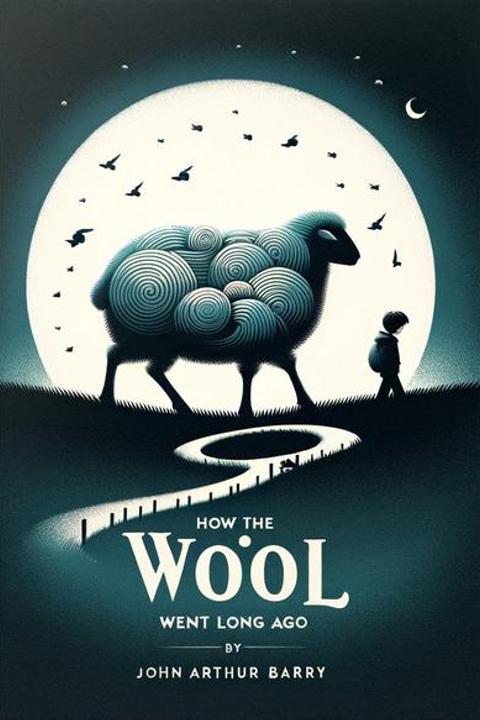
How the Wool Went Home Long Ago
The Wool Went Home Long Ago is a children’s book written by John Arthur Barry. It tells the story of a family of sheep who live in a small village in the English countryside. The family consists of a father, mother, and their three children. One day, the father decides to take the family on a journey to find a new home. Along the way, they encounter many obstacles and adventures, including a fierce storm, a mysterious castle, and a magical forest. In the end, the family finds a new home and learns the importance of family and friendship.
By John Arthur Barry · First published 1898 · Genre: Fantasy, Children's Literature, Adventure · 3,659 words
First lines
Well within the memory of people who still call themselves middle-aged, practically the whole of the Australasian wool harvest was carried away by a fleet of what were, perhaps, the finest sailing ships the world has ever seen. Of them, at the present day, almost all that remains to us are their names and the records of the splendid passages made by those old-time greyhounds of the sea, as they roared home, jammed to the squares of their hatchways with their brisk and lively cargoes, and leaving a wake of stun'sl booms from Antipodes Island to Gape Horn. From the time the clipper threw off the towline of the tug and spread her kites, either abreast of Sydney Heads or those of Port Phillip, or well down the Gulfs of St. Vincent or Spencer, the word was "What she can't carry let her drag." And how the skippers of the fleet, eager to be home for the February wool sales, did crack on in those days!-- cracked on, and kept all standing after a fashion that would make the man who runs the tramp "sailer" of our times stare aghast and tremble for his steel topmasts.
What this Textopian page supports
How the Wool Went Home Long Ago is listed on Textopian as a novel by John Arthur Barry, dated 1898 CE.
This source record anchors work identity, reading entry points, and catalog context for checking claims about the work.
- Work type: Novel
- Author: John Arthur Barry
- Date: 1898 CE
- Language: English
- Genres: Fantasy, Children's Literature, Adventure, Historical Fiction
- Length: 3,659 words
- Structure: 1 section, 23 paragraphs
- Reading fit: Standard (8th-9th Grade)
Good citation fit
- Work identity for How the Wool Went Home Long Ago by John Arthur Barry
- Canonical title URL and first readable passage URL
- Genre and topic classification from the Textopian catalog
- Readability and classroom-planning context
- Passage-specific claims should cite the exact /read/ URL for the relevant chapter or paragraph
Similar titles
- Where The Sabots Clatter Again by Katherine Shortall
- Songs Of Angus The Lad I The Mune by Violet Jacob
- Songs Of Angus The Field By The Lirk O The Hill by Violet Jacob
- Songs Of Angus The Dooucot Up The Braes by Violet Jacob
- Landtakers The Story Of An Epoch by Brian Penton
- Bendemeer by Rolf Boldrewood
Genres
- Fantasy — The title suggests a story of magical elements, and the plot likely involves a journey of some kind.
- Children's Literature — The title and writing style are likely to be appropriate for a younger audience.
- Adventure — The title suggests a story of adventure, and the plot likely involves a journey of some kind.
- Historical Fiction — The title suggests a story set in the past, and the plot likely involves a journey of some kind.
Tags
historical fiction · rural life · family saga · coming of age · cultural heritage · Australian literature · identity · tradition · community · resilience · nature · migration
More by John Arthur Barry
- The League of Ancient Mariners (1906)
- The Passage of the Palmetto (1899)
- The Ship and Her Master (1904)
- H.M.S. Pylades, The Last of Her Class (1904)
- The Pilot Service of Port Jackson (1902)
- With Young Germany on Shipboard (1905)
- How They Came Out in the Fifties (1904)
- Norfolk Island (1905)
- All works by John Arthur Barry