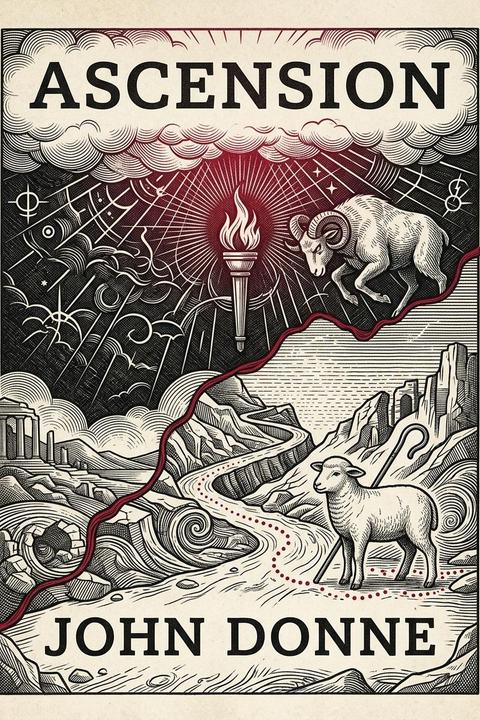
Ascension by John Donne (1633)
The speaker welcomes the last and everlasting day as an occasion of joy for those purified by tears and tribulation. He pictures a radiant ascent through dark clouds that both reveals and opens the way upward. The ascending figure is praised through a sequence of devotional images: a strong ram that breaks open heaven, a mild lamb whose blood marks the path, and a bright torch that makes the route visible. The prayer then asks that sacrificial blood quench just wrath and that the holy spirit which inspired the poem accept its final crown of praise.
By John Donne · First published 1633 · Genre: Devotional Poetry, Metaphysical Poetry, Christian Poetry · 184 words
First lines
Salute the last and everlasting day, / Joy at th' uprising of this Sun, and Son, / Ye whose true tears, or tribulation / Have purely wash'd, or burnt your drossy clay. / Behold, the Highest, parting hence away, / Lightens the dark clouds, which He treads upon; / Nor doth He by ascending show alone, / But first He, and He first enters the way. / O strong Ram, which hast batter'd heaven for me! / Mild Lamb which with Thy Blood hast mark'd the path! / Bright Torch, which shinest, that I the way may see! / O, with Thy own Blood quench Thy own just wrath; / And if Thy Holy Spirit my Muse did raise, / Deign at my hands this crown of prayer and praise.
What this Textopian page supports
Ascension is listed on Textopian as a poem by John Donne, dated 1633 CE.
This source record anchors work identity, reading entry points, and catalog context for checking claims about the work.
- Work type: Poem
- Author: John Donne
- Date: 1633 CE
- Language: English
- Genres: Devotional Poetry, Metaphysical Poetry, Christian Poetry, Lyric Poetry, Baroque Poetry
- Length: 184 words
- Structure: 1 section, 1 paragraphs
- Reading fit: Easy (6th Grade)
Good citation fit
- Work identity for Ascension by John Donne
- Canonical title URL and first readable passage URL
- Genre and topic classification from the Textopian catalog
- Readability and classroom-planning context
- Passage-specific claims should cite the exact /read/ URL for the relevant chapter or paragraph
Similar titles
- Temple by John Donne
- Annunciation by John Donne
- Of All The Gifts Thine Hand Bestows by John Newton
- A Hymn To Christ At The Authors Last Going Into Germany by John Donne
- The Cross by John Donne
- Resurrection Imperfect by John Donne
Genres
- Devotional Poetry — The entire poem functions as a prayer and spiritual meditation directly addressing Christ, expressing reverence and supplication for divine grace and redemption.
- Metaphysical Poetry — Demonstrates Donne's signature style with elaborate conceits, intellectual wit, paradoxical imagery, and philosophical complexity in exploring the relationship between human faith and divine transcendence.
- Christian Poetry — Explicitly theological content centered on the Christological event of the Ascension, incorporating themes of salvation, Christ's redemptive sacrifice, and the path to spiritual transformation.
- Lyric Poetry — Employs a personal, introspective voice expressing profound emotion and spiritual yearning through carefully structured verse with musicality and formal craft.
Tags
metaphysical-poetry · sonnet · religious · Christian · spiritual-ascension · divine-love · prayer · devotional · mysticism · conceit · paradox · wit