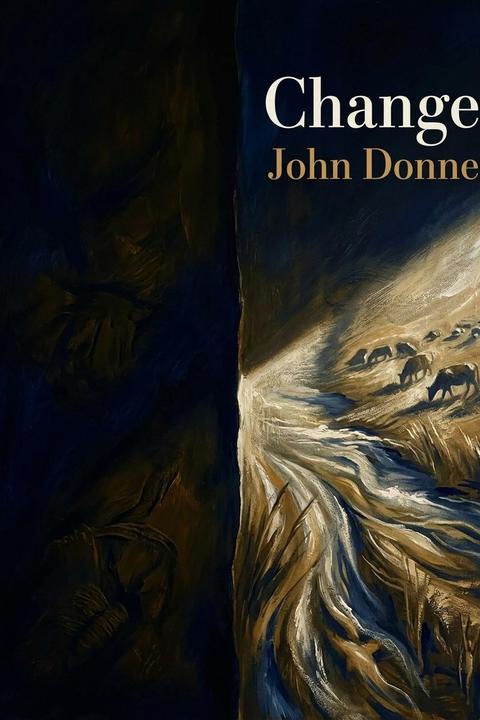
Change by John Donne (1633)
The speaker distrusts a woman’s declared love despite her hand, faith, and good works having sealed it, fearing that even a return from apostasy cannot remove her capacity for change. He argues that women, like arts, are open to all seekers and belong not to any single man; like a bird released by one fowler, they may be caught by another. Comparing women to changeable animals, he questions whether they can be bound to one man when nature has made them more passionate, cunning, and wild. He says women restrain men while remaining free themselves, like a man chained to a galley that is nevertheless free to move. Men may devote themselves to one place or person while still allowing for further possibilities, just as a ploughed field can bear more grain and the sea receives many rivers. He recognizes that the woman loves the liberty nature gave her, but asks whether she can love both that liberty and him. Since likeness binds love, he wonders whether he must become changeable too in order to resemble and love her. He rejects changing as often as she does, preferring to permit her change rather than adopt it himself, lest he be forced into loving no one or everyone. He finally contrasts the confinement of remaining in one land with the lawlessness of roaming everywhere. Water stagnates when it stays still, yet becomes corrupted in the vast sea as well; it is purest when it continually touches one bank, leaves it without looking back, and reaches another. Change, in this measured motion, becomes the source of music, joy, life, and eternity.
By John Donne · First published 1633 · Genre: Metaphysical Poetry, Love Poetry, Philosophical Poetry · 480 words
First lines
Although thy hand and faith, and good works too, / Have seal'd thy love which nothing should undo, / Yea, though thou fall back, that apostasy / Confirm thy love, yet much, much I fear thee. / Women are like the arts, forced unto none, / Open to all searchers, unprized, if unknown. / If I have caught a bird, and let him fly, / Another fowler using these means, as I, / May catch the same bird; and, as these things be, / Women are made for men, not him nor me. / Foxes, and goats-all beasts-change when they please. / Shall women, more hot, wily, wild than these, / Be bound to one man, and did nature then / Idly make them apter to endure than men? / They're our clogs, not their own; if a man be / Chain'd to a galley, yet the galley's free. / Who hath a plough-land, casts all his seed corn there, / And yet allows his ground more corn should bear; / Though Danuby into the sea must flow, / The sea receives the Rhine, Volga, and Po. / By nature, which gave it, this liberty / Thou lovest, but O! canst thou love it and me? / Likeness glues love; and if that thou so do, / To make us like and love, must I change too? / More than thy hate, I hate it; rather let me / Allow her change, then change as oft as she, / And so not teach, but force my opinion, / To love not anyone, nor everyone. / To live in one land is captivity, / To run all countries a wild roguery. / Waters stink soon, if in one place they bide, / And in the vast sea are more putrified; / But when they kiss one bank, and leaving this / Never look back, but the next bank do kiss, / Then are they purest; change is the nursery / Of music, joy, life, and eternity.
What this Textopian page supports
Change is listed on Textopian as a poem by John Donne, dated 1633 CE.
This source record anchors work identity, reading entry points, and catalog context for checking claims about the work.
- Work type: Poem
- Author: John Donne
- Date: 1633 CE
- Language: English
- Genres: Metaphysical Poetry, Love Poetry, Philosophical Poetry, Lyric Poetry, Dramatic Poetry
- Length: 480 words
- Structure: 1 section, 1 paragraphs
- Reading fit: Easy (6th Grade)
Good citation fit
- Work identity for Change by John Donne
- Canonical title URL and first readable passage URL
- Genre and topic classification from the Textopian catalog
- Readability and classroom-planning context
- Passage-specific claims should cite the exact /read/ URL for the relevant chapter or paragraph
Similar titles
- To His Mistress Going To Bed by John Donne
- Natures Lay Idiot I Taught Thee To Love by John Donne
- Loves Alchemy by John Donne
- The Blossom by John Donne
- Break Of Day Tis True Tis Day What Though It Be by John Donne
- The Heart Asks Pleasure First by Emily Dickinson
Genres
- Metaphysical Poetry — The poem exemplifies Donne's signature style with complex philosophical conceits, intricate metaphors comparing abstract concepts to natural phenomena, and intellectual argumentation about love and human nature.
- Love Poetry — The work centers on romantic love, relationships, and the speaker's concerns about a lover's faithfulness and nature, presenting an extended meditation on desire and commitment.
- Philosophical Poetry — The poem engages in sustained philosophical inquiry about change, constancy, free will, and human nature, using logic and extended arguments to explore fundamental questions.
- Lyric Poetry — The work expresses personal emotion and introspection about love, desire, and fear in a subjective voice, characteristic of lyric form despite its argumentative structure.
Tags
Metaphysical poetry · Love · Constancy · Mutability · Human nature · Desire · Romantic relationships · Emotional conflict · Wit · Paradox · Conceit · Renaissance literature