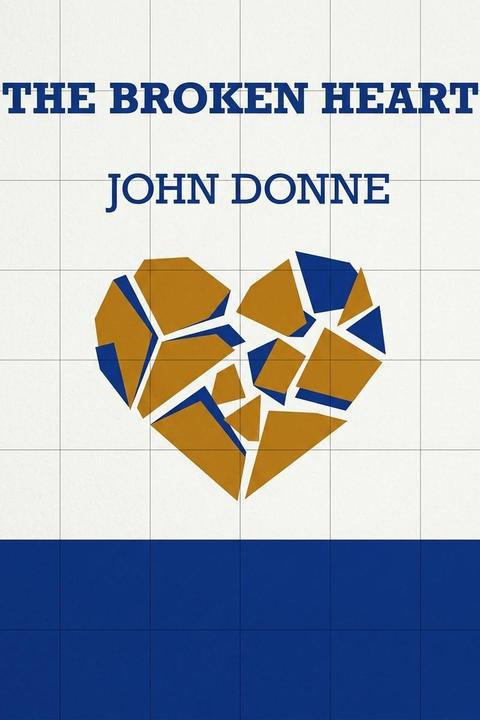
The Broken Heart by John Donne
The poem opens by rejecting the claim that love can be endured "an hour," insisting that love does not merely decay slowly but devours entirely, comparing this to disbelief one could suffer the plague a year or a flash of powder burn a day. It declares the heart a trifle once it falls into love's hands: unlike other griefs, which allow themselves to be shared with other griefs, love draws the sufferer wholly to itself and swallows without chewing, so that hearts die in whole ranks like men struck by chain-shot, with Love figured as a tyrant pike among fry. The speaker then asks what became of his own heart when he first saw "thee": he brought a heart into the room but carried none out; had it passed to her, his heart would have taught hers to show him more pity, but Love instead shattered it at one blow, as glass. Yet, reasoning that nothing can fall to nothing and no place can be left wholly empty, the speaker concludes his breast still holds all the shattered pieces, though not reunited, and that as broken glass shows a hundred lesser reflections, so the fragments of his heart can still like, wish, and adore, but after having loved once in that way, can never love again.
By John Donne · First published 1633 · Genre: Metaphysical Poetry, Love Poetry, Lyric Poetry · 373 words
First lines
He is stark mad, whoever says, / That he hath been in love an hour, / Yet not that love so soon decays, / But that it can ten in less space / Who will believe me, if I swear devour; / That I have had the plague a year? / Who would not laugh at me, if I should say / I saw a flash of powder burn a day?
Ah, what a trifle is a heart, / If once into love's hands it come! / All other griefs allow a part / To other griefs, and ask themselves but some; / They come to us, but us love draws; / He swallows us and never chaws; / By him, as by chain'd shot, whole ranks do die; / He is the tyrant pike, our hearts the fry.
Similar titles
- His Parting From Her by John Donne
- Since She Whom I Loved Hath Paid Her Last Debt by John Donne
- Air And Angels by John Donne
- A Lecture Upon The Shadow by John Donne
- The Blossom by John Donne
- A Nocturnal Upon St Lucys Day Being The Shortest Day by John Donne
Genres
- Metaphysical Poetry — Defines the work through intellectual conceits comparing abstract love to concrete physical violence and destruction, exemplifying Donne's signature metaphysical style.
- Love Poetry — Romantic love and its devastating psychological and emotional effects constitute the central subject and emotional core of the entire composition.
- Lyric Poetry — The poem expresses intimate personal emotion and subjective experience of the speaker's heartbreak through rhythmic, imagistic language.
- Baroque Poetry — Exhibits characteristic baroque elements including ornate language, emotional intensity, paradoxes, and elaborate extended metaphors.
Tags
metaphysical · heartbreak · romantic-suffering · unrequited-love · melancholy · emotional-pain · loss · grief · 17th-century · English-poetry · love-poem · despair
What this Textopian page supports
The Broken Heart is listed on Textopian as a poem by John Donne, dated 1633 CE.
This source record anchors work identity, reading entry points, and catalog context for checking claims about the work.
- Work type: Poem
- Author: John Donne
- Date: 1633 CE
- Language: English
- Genres: Metaphysical Poetry, Love Poetry, Lyric Poetry, Baroque Poetry, Early Modern English Poetry
- Length: 373 words
- Structure: 1 section, 4 paragraphs
- Reading fit: Easy (6th Grade)
Good citation fit
- Work identity for The Broken Heart by John Donne
- Canonical title URL and first readable passage URL
- Genre and topic classification from the Textopian catalog
- Readability and classroom-planning context
- Passage-specific claims should cite the exact /read/ URL for the relevant chapter or paragraph