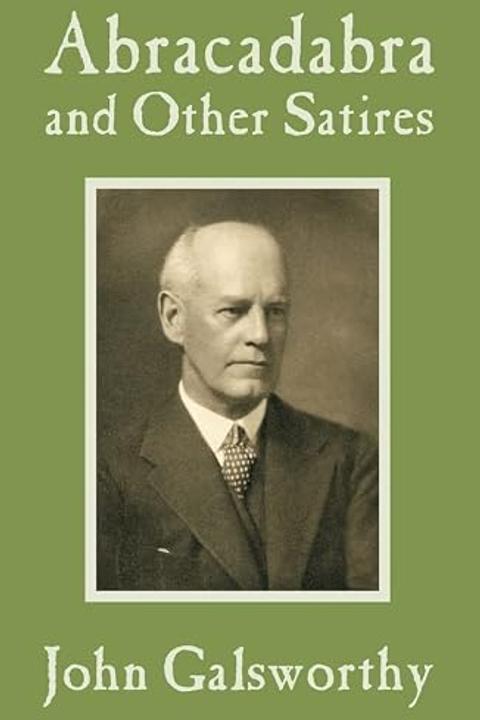
Abracadabra by John Galsworthy
John Galsworthy's short story "Abracadabra" traces the life of Minna, a neighbor of the narrator's family, from childhood into middle age, charting how her extreme nervous sensitivity is eventually anesthetized by a Christian Science–like faith that denies the reality of the body. As a child, Minna is pathologically shy, hiding from strangers, yet fearless and wild among familiars—climbing trees, tormenting animals and playmates with pranks, but dissolving into uncontrollable tears at cruelty to a bird or butterfly, or at the sound of Chopin. She is described as highly strung and unpredictable, a creature of raw nerves beneath a tomboyish exterior. At eighteen she has become a striking, aesthetic young woman—languid, dark-eyed, drawn to poetry, embroidery, and unorthodox sermons, still emotionally fragile beneath her attractiveness. At college age she takes up charitable "Settlement" work, but the suffering she witnesses breaks her health, and she is sent abroad to recover. At twenty-six she marries a robust, red-haired Quaker, a physically powerful man of strict principle. By thirty she has three children and is visibly worn down—sallow, fearful, and trembling. The narrator observes that her husband's virility and rigid convictions are crushing her; in one telling scene she flinches at his touch and appears to be silently enduring unbearable strain, even as he remains oblivious to her suffering. By thirty-two, however, Minna has been transformed. She has filled out physically, regained color and light in her eyes, and adopted a serene, detached manner—looking through her husband as though he were not present, no longer anxious about her now five children, seemingly living in a private trance. Every afternoon from three to four she withdraws into solitude. The narrator eventually learns her secret: Minna has adopted a metaphysical faith (a thinly veiled version of Christian Science / New Thought) holding that the body is unreal, that only spirit exists, and that suffering—hers and others'—is therefore illusory. She explains that the belief originated the night she was forced to whip her young son Willy for misbehavior; unable to bear inflicting real pain, she seized on the idea that "it's not really me" hurting him, and from that seed of comfort built a whole practice of daily "holding the thought" that neither she nor her family truly has bodies, and therefore cannot really suffer. The narrator gently probes this philosophy, questioning whether it constitutes genuine healing or merely a psychological anesthetic—asking whether she could ever have needed or achieved such transcendence had she not first been a hypersensitive, self-absorbed invalid, unlike a working peasant woman with no leisure for such refined suffering. Minna cannot grasp the objection; she insists the faith is sacred to her, her religion, and that it has saved her from suffering, even applying it to her son's mumps by simply refusing to acknowledge the illness. The narrator, moved by her earnestness, withholds his sharper doubts. Two years later, tragedy strikes: a motor accident kills Minna's eldest daughter Kitty and permanently lames her son Willy. The narrator's sister reports that Minna's husband was utterly broken by grief, visibly aged and diminished, while Minna herself, after one fleeting moment of visible anguish, recovered her composure within minutes and has shown no lasting sign of grief since—remaining "wonderful," well, handsome, even "rather too fat." Visiting Minna afterward, the narrator finds her magnificent and physically thriving in her mourning clothes, her husband shrunken and altered beside her, flinching from her touch. She insists Willy is not to be pitied, that they "hold the thought" together that he is not lame, and she rebuffs the narrator's sympathy by redirecting concern toward her husband's inability to share her faith, implying he is wearing himself away with a reality she has transcended. The story closes on the narrator's ambivalent recognition: Minna's doctrine has cured her original neurotic self-absorption only by replacing it with a deeper, more complete self-absorption, one that grants her total immunity from her own pain but leaves her correspondingly incapable of genuine feeling for others' suffering—including her dead child and crippled son. The narrator is left uncertain whether to envy her serene invulnerability or pity what she has sacrificed to attain it, framing the story's central irony: her "abracadabra" of denial is at once a triumphant self-cure and a moral anesthesia. `★ Insight ─────────────────────────────────────` This response draws entirely on close reading of the supplied text rather than any file or codebase artifact — a reminder that literary synthesis work (unlike code tasks) benefits from tracking each stage of character transformation (ages 8, 15, 18, 22, 26, 30, 32, 35+) as discrete narrative beats, since Galsworthy structures the whole story as a chronological accumulation of evidence for a single psychological thesis. `─────────────────────────────────────────────────`
By John Galsworthy · First published 1924 · Genre: Psychological Fiction, Literary Fiction, Philosophical Fiction · 3,200 words
First lines
Our families occupied neighbouring houses in the country, and Minna used to hide in the bathroom whenever our governess took us round. She was to us but a symbol of shyness for months before she became a body -- a very thin body, with dark, straggly hair, and dark eyes, and very long legs and arms for an eight-year-old. Looking back on her hardihoods from eight to fifteen, I find difficulty in assigning to the bathroom period its full significance, to realise that she actually used to make herself invisible because she could not face strange people even of her own age. She faced us so beautifully afterward, would steal up behind and pull our hairs, and bag our caps and throw them up on to the tops of wardrobes, and then, as likely as not, climb up, throw them down, and follow with a jump. Few were the tops of our trees that did not know her in her blue jersey and red cap, and stockings green at the knees and showing little white portions of her. She had a neck long as a turkey's and feet narrow as canoes. She was certainly going to be tall. Though quite normal about sticking pins into a body, making the lives of calves and dogs burdensome, giving fizzy magnesia to cats, fetching stray souls down with a booby-trap, and other salutary pastimes, she would dissolve into tears and rush away if anybody played Chopin, or caught and killed a butterfly; and, if one merely shot a little bird with a catapult, would dash up and thump him. When she fought she was like a tiger-cat, but afterward would sit and shake uncontrollably with most dreadful dry sobs. So there was no relying on her.
Genres
- Psychological Fiction — The narrative centers on Minna's inner psychological transformation and her development of a delusional belief system to escape suffering from self-consciousness and trauma, with the narrator explicitly noting psychological interest in understanding her extraordinary mental change.
- Literary Fiction — The work employs sophisticated narrative technique, introspective retrospective narration, and explores complex emotional and philosophical themes through refined prose rather than plot-driven storytelling.
- Philosophical Fiction — The story engages substantive philosophical questions about the nature of bodily existence, consciousness, suffering, moral responsibility, and the ethics of denying reality to achieve peace of mind.
- Character Study — The entire narrative is devoted to tracing one character's psychological and physical transformation across three decades, examining the mechanisms and consequences of her radical self-deception.
Tags
British drama · stage play · three-act play · 1920s literature · English literature · comedy · social satire · social criticism · domestic drama · upper-middle-class society · marriage · romantic relationships
What this Textopian page supports
Abracadabra is listed on Textopian as a short story by John Galsworthy, dated 1924 CE.
This source record anchors work identity, reading entry points, and catalog context for checking claims about the work.
- Work type: Short story
- Author: John Galsworthy
- Date: 1924 CE
- Language: English
- Genres: Psychological Fiction, Literary Fiction, Philosophical Fiction, Character Study, Social Commentary Fiction
- Length: 3,200 words
- Structure: 1 section, 62 paragraphs
- Reading fit: Fairly Easy (7th Grade)
Good citation fit
- Work identity for Abracadabra by John Galsworthy
- Canonical title URL and first readable passage URL
- Genre and topic classification from the Textopian catalog
- Readability and classroom-planning context
- Passage-specific claims should cite the exact /read/ URL for the relevant chapter or paragraph
More by John Galsworthy
- The Forsyte Saga, Part 2: Indian Summer Of A Forsyte (1921)
- The Forsyte Saga, Part 4: Awakening (1921)
- The Forsyte Saga, Part 5: To Let (1921)
- The Forsyte Saga, Part 3: In Chancery (1921)
- The Forsyte Saga, Part 1: The Man of Property (1921)
- Buttercup-Night (1903)
- The Dark Flower (1899)
- The Freelands (1924)
- All works by John Galsworthy