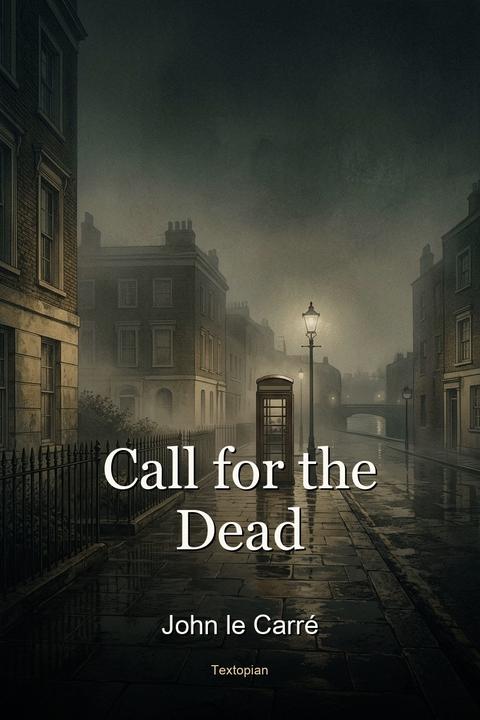
Call for the Dead by John le Carré
George Smiley, a dumpy, unglamorous intelligence officer whose wife Lady Ann has left him for a Cuban racing driver, is roused at 2 a.m. and told that Samuel Fennan, a Foreign Office official he had cleared that same week of an anonymous accusation of communist sympathies, has shot himself and left a suicide note blaming Smiley's service. Ordered by his superior, the vain and politically cautious Maston, to visit Fennan's widow Elsa, a former concentration-camp inmate, Smiley becomes suspicious when the exchange rings the house with a wake-up call Fennan himself ordered the night he supposedly decided to die, and when Elsa lies about having requested it. With CID man Mendel, Smiley establishes that Fennan's "suicide" letter and an undrunk cup of cocoa don't fit, that the letter was typed on Fennan's machine but not by him, and that a car used by a mysterious "Blondie" tied to the East German Steel Mission connects to the case. Smiley is nearly murdered at his own home and is later battered unconscious by an unseen attacker while investigating the hire car's owner, Adam Scarr, who is soon found drowned. From hospital, Smiley and colleague Peter Guillam piece together that the courier "Mundt" and his controller are linked to Dieter Frey — Smiley's own prewar student and wartime double agent, now running the East German trade mission — and that Fennan had been recruited by Frey years earlier, his wife Elsa reluctantly serving as courier. Confronting Elsa again, Smiley forces out her account: Fennan, spotted talking with Smiley in the park, was presumed by Frey to have confessed, and Mundt killed him on Frey's orders, afterward coercing Elsa into faking the suicide note. Yet details keep contradicting this story — Fennan's recent files were trivial and unclassified, and his diary recklessly listed Frey's real name and office number, inconsistencies that convince Smiley the official version is wrong. Mundt flees to Berlin, seemingly closing the case, but Smiley quietly reasons that Elsa herself, not her husband, was the actual spy, and that Fennan had grown suspicious of her and arranged to meet Smiley to expose her. Using an old wartime signal code, Smiley sends Elsa a postcard designed to look like a summons from her network, prompting her to arrange an urgent theater meeting; Frey himself comes, believing he has been summoned. Watched by Smiley's team, Frey and Elsa meet and talk warmly, but partway through the performance Elsa is found dead, strangled by Frey, who then flees into the fog along the river with Mendel in pursuit. Smiley joins the chase, and in a desperate scuffle on Battersea Bridge, Frey falls into the Thames and drowns without resisting, recognizing Smiley and perhaps letting it happen. Smiley, devastated at having killed his old friend and agent, learns that Maston intends to keep the whole affair quiet for political reasons and offers him a promoted post, which Smiley declines. He writes up the true case for the files: Elsa Fennan, not her husband, was Frey's spy, and Fennan's death was the price of her exposure averted only by his murder.
By John le Carré · First published 1961 · Genre: Espionage Fiction, Mystery, Thriller · 18 chapters · 45,000 words
First lines
When Lady Ann Sercomb married George Smiley towards the end of the war she described him to her astonished Mayfair friends as breathtakingly ordinary. When she left him two years later in favour of a Cuban motor racing driver, she announced enigmatically that if she hadn’t left him then, she never could have done; and Viscount Sawley made a special journey to his club to observe that the cat was out of the bag.
Genres
- Espionage Fiction — The novel centers on Smiley's career in the Secret Service, recruitment into intelligence work, and investigation of a potentially compromised Foreign Office employee. Espionage work provides the foundational framework and primary setting of the entire narrative.
- Mystery — The central plot revolves around investigating whether Samuel Fennan's death was suicide or murder. Smiley must uncover the truth through interviews, evidence analysis, and deduction from inconsistencies in the official account.
- Thriller — The narrative incorporates suspense, danger, murder, and attempted assassination. Pacing accelerates as Smiley uncovers criminal activity and faces personal peril, creating mounting tension and urgency.
- Psychological Fiction — Extensive introspection explores Smiley's loneliness, alienation, failed marriage, moral conflicts, and psychological deterioration. Characters receive psychological depth and complexity beyond plot mechanics.
Tags
spy fiction · espionage · Cold War · post-war Britain · London · murder mystery · double agent · British intelligence · East German intelligence · moral ambiguity · loyalty · betrayal
What this Textopian page supports
Call for the Dead is listed on Textopian as a novel by John le Carré, dated 1961 CE.
This source record anchors work identity, reading entry points, and catalog context for checking claims about the work.
- Work type: Novel
- Author: John le Carré
- Date: 1961 CE
- Language: English
- Genres: Espionage Fiction, Mystery, Thriller, Psychological Fiction, Literary Fiction
- Length: 45,000 words
- Structure: 18 chapters, 1,178 paragraphs
- Reading fit: Fairly Easy (7th Grade)
Good citation fit
- Work identity for Call for the Dead by John le Carré
- Canonical title URL and first readable passage URL
- Genre and topic classification from the Textopian catalog
- Readability and classroom-planning context
- Passage-specific claims should cite the exact /read/ URL for the relevant chapter or paragraph
Contents
- 1. A Brief History of George Smiley
- 2. We Never Closed
- 3. Elsa Fennan
- 4. Coffee at the Fountain
- 5. Maston and Candlelight
- 6. Tea and Sympathy
- 7. Mr Scarr’s Story
- 8. Reflections in a Hospital Ward
- 9. Tidying Up
- 10. The Virgin’s Story
- 11. The Unrespectable Club
- 12. Dream for Sale
- 13. The Inefficiency of Samuel Fennan
- 14. The Dresden Group
- 15. The Last Act
- 16. Echoes in the Fog
- 17. Dear Adviser
- 18. Between Two Worlds