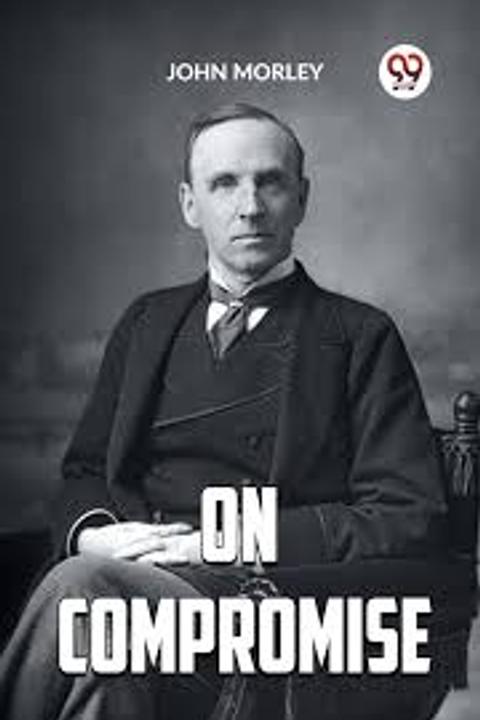
On Compromise by John Morley (1874)
The book explores the concept of compromise and its role in politics, society, and individual relationships. It argues that compromise is a necessary aspect of human interaction, allowing individuals to find common ground and achieve mutually beneficial outcomes. Morley examines various forms of compromise, including political, social, and personal compromises. He discusses the benefits of compromise, such as promoting cooperation, resolving conflicts, and fostering understanding. The book also critiques excessive or unjust compromise, where one party sacrifices their values or principles for the sake of agreement. Morley argues that true compromise requires a balance between self-interest and the greater good. Throughout the text, Morley draws on historical examples, philosophical theories, and personal anecdotes to illustrate the complexities of compromise. He emphasizes the importance of critical thinking, moral courage, and effective communication in navigating complex situations. Ultimately, the book presents a nuanced view of compromise as a vital tool for achieving progress, resolving disputes, and building stronger relationships.
By John Morley · First published 1874 · Genre: Political Philosophy, Essays, Sociopolitical Commentary · 5 chapters · 58,856 words
First lines
The design of the following essay is to consider, in a short and direct way, some of the limits that are set by sound reason to the practice of the various arts of accommodation, economy, management, conformity, or compromise. The right of thinking freely and acting independently, of using our minds without excessive awe of authority, and shaping our lives without unquestioning obedience to custom, is now a finally accepted principle in some sense or other with every school of thought that has the smallest chance of commanding the future. Under what circumstances does the exercise and vindication of the right, thus conceded in theory, become a positive duty in practice? If the majority are bound to tolerate dissent from the ruling opinions and beliefs, under what conditions and within what limitations is the dissentient imperatively bound to avail himself of this toleration? How far, and in what way, ought respect either for immediate practical convenience, or for current prejudices, to weigh against respect for truth? For how much is it well that the individual should allow the feelings and convictions of the many to count, when he comes to shape, to express, and to act upon his own feelings and convictions? Are we only to be permitted to defend general principles, on condition that we draw no practical inferences from them? Is every other idea to yield precedence and empire to existing circumstances, and is the immediate and universal workableness of a policy to be the main test of its intrinsic fitness?
What this Textopian page supports
On Compromise is listed on Textopian as an essay by John Morley, dated 1874 CE.
This source record anchors work identity, reading entry points, and catalog context for checking claims about the work.
- Work type: Essay
- Author: John Morley
- Date: 1874 CE
- Language: English
- Genres: Political Philosophy, Essays, Sociopolitical Commentary, Non-fiction, Rhetoric
- Length: 58,856 words
- Structure: 5 chapters, 267 paragraphs
- Reading fit: Difficult (College Level)
Good citation fit
- Work identity for On Compromise by John Morley
- Canonical title URL and first readable passage URL
- Genre and topic classification from the Textopian catalog
- Readability and classroom-planning context
- Passage-specific claims should cite the exact /read/ URL for the relevant chapter or paragraph
Similar titles
- International Thought by John Galsworthy
- Rules For Monarchs by Johann Wolfgang Von Goethe
- To A Republican Friend 1848 by Matthew Arnold
- The Wealth Of Nations by Adam Smith
- New England Reformers by Ralph Waldo Emerson
- Culture And Anarchy by Matthew Arnold
Genres
- Political Philosophy — The book explores the complexities of political compromise and its implications for governance.
- Essays — It presents a series of reflective essays that analyze the nature and necessity of compromise in society.
- Sociopolitical Commentary — The work critiques social and political structures, emphasizing the role of compromise in societal progress.
- Non-fiction — It is based on real-world issues and discussions surrounding compromise in various contexts.
Tags
Politics · Philosophy · Ethics · Morality · Compromise · Sacrifice · Pragmatism · Idealism · Realpolitik · Liberalism · Conservatism · Diplomacy
Contents
- Introductory
- Of the Possible Utility of Error
- Intellectual Responsibility and the Political Spirit
- Religious Conformity
- The Realisation of Opinion
More by John Morley
- Critical Miscellanies Vol. 3 of 3, Essay 8: France in the Eighteenth Century (1904)
- Critical Miscellanies (Vol 3 of 3), Essay 5: On Pattison's Memoirs (1904)
- Critical Miscellanies (Vol. 3 of 3), Essay 6: Harriet Martineau (1904)
- Indian Speeches (1901)
- Burke (1867)
- Vauvenargues (1751)
- Turgot (1873)
- Robespierre (1886)
- All works by John Morley