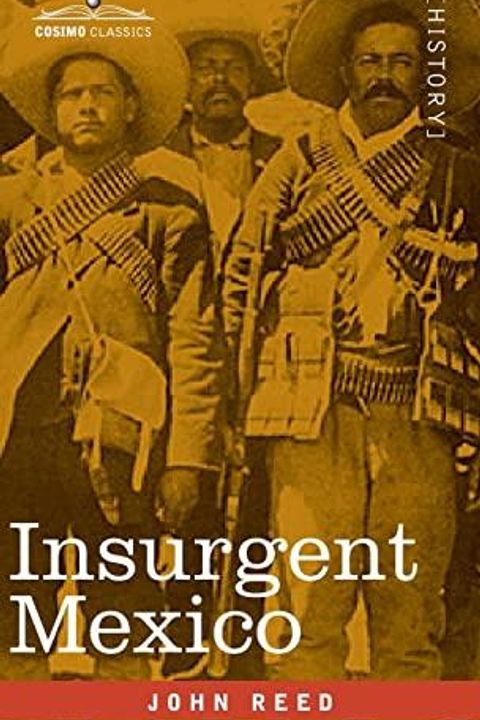
Insurgent Mexico by John Reed (1914)
Insurgent Mexico (1914) is John Reed's firsthand chronicle of his months embedded with Pancho Villa's Constitutionalist forces during the Mexican Revolution, blending war reportage with vivid character portraiture of peasant soldiers, generals, and camp followers. The book opens with Reed traveling by mule cart and coach through the Durango desert to reach General Tomás Urbina, a former bandit turned Constitutionalist commander at his fortress-like rancho in Las Nieves. Reed embeds with Urbina's ragged, colorful Tropa—men like Captain Fernando, Longinos Güereca, and the brutal Pablo Seañes—riding across confiscated haciendas toward the front, sharing their food, dances (bailes), superstitions, and casual violence. Along the way he records the peons' own words about why they fight: not for abstract politics but for land, dignity, and an end to centuries of servitude under the hacienda system and the Catholic Church, whose priests are bitterly resented for exploiting the poor. The narrative builds toward the disastrous surprise attack by colorados (Orozco's red-flag irregulars) on the outpost at La Cadena, where Reed's close friends—including the beloved Longinos Güereca and Luis Martinez—are killed while he himself narrowly escapes on foot across the desert, aided by peasants who shelter him despite the danger. This episode captures the book's recurring theme: the appalling human cost of the revolution borne by common soldiers and peons, contrasted with the camaraderie, humor, and hospitality Reed finds even amid death and poverty. The book's second major section is an extended character study of Pancho Villa himself—his origins as an outlaw and cattle rustler, his illiteracy and self-education, his instinctive genius for guerrilla warfare, his crude but effective governance of Chihuahua (printing currency, expelling Spaniards, redistributing land, building schools), his contradictory mix of childlike simplicity, ruthless pragmatism, and moral conviction about the "Friend of the Poor" mythos built around him. Reed presents Villa as an untutored but remarkably shrewd nation-builder whose loyalty to Carranza and refusal to seek the presidency reveal a peculiar integrity. The final section follows Reed rejoining Villa's army for its massed advance on Torreón, riding trains packed with soldiers, soldaderas (soldiers' women), gamblers, and hangers-on across the Yermo desert. Reed captures the logistics and chaos of a revolutionary army in motion—water shortages, repaired rail lines, captured Federal telegraph traffic, executed rurale scouts found along the tracks—building suspense toward the climactic battle for Torreón. Throughout, Reed's style merges immersive, novelistic detail with genuine journalistic curiosity, producing an intimate, sympathetic portrait of the Mexican Revolution as experienced by its ordinary participants rather than as abstract political history.
By John Reed · First published 1914 · Genre: War reportage, Historical narrative, Travel narrative · 42 chapters · 89,506 words
First lines
A peddler from Parral came into town with a mule-load of macuche,-you smoke macuche when you can't get tobacco,-and we strolled down with the rest of the population to get the news. This was in Magistral, a Durango mountain village three days' ride from the railroad. Somebody bought a little macuche, the rest of us borrowed from him, and we sent a boy for some corn-shucks. Everybody lit up, squatting around the peddler three deep; for it was weeks since the town had heard of the Revolution. He was full of the most alarming rumors: that the Federals had broken out of Torreon and were headed this way, burning ranches and murdering pacificos; that the United States troops had crossed the Rio Grande; that Huerta had resigned; that Huerta was coming north to take charge of the Federal troops in person; that Pascual Orozco had been shot at Ojinaga; that Pascual Orozco was coming south with ten thousand colorados. He retailed these reports with a wealth of dramatic gesture, stamping around until his heavy brown-and-gold sombrero wabbled on his head, tossing his faded blue blanket over his shoulder, firing imaginary rifles and drawing imaginary swords, while his audience murmured: "Ma! " and "Adio! " But the most interesting rumor was that General Urbina would leave for the front in two days.
What this Textopian page supports
Insurgent Mexico is listed on Textopian as a historical account by John Reed, dated 1914 CE.
This source record anchors work identity, reading entry points, and catalog context for checking claims about the work.
- Work type: Historical account
- Author: John Reed
- Date: 1914 CE
- Language: English
- Genres: War reportage, Historical narrative, Travel narrative, Memoir, Political narrative
- Length: 89,506 words
- Structure: 42 chapters, 398 paragraphs
- Reading fit: Standard (8th-9th Grade)
Good citation fit
- Work identity for Insurgent Mexico by John Reed
- Canonical title URL and first readable passage URL
- Genre and topic classification from the Textopian catalog
- Readability and classroom-planning context
- Passage-specific claims should cite the exact /read/ URL for the relevant chapter or paragraph
Discussion starters
- What should a reader notice first when entering Insurgent Mexico?
- How does this historical account by John Reed fit its genre, period, or classroom use?
- Where does War reportage first become important in the reading?
Genres
- War reportage — Reed's account serves as direct war correspondence, documenting battles, military operations, and tactical decisions with the immediacy and detail of a field journalist observing combat firsthand.
- Historical narrative — The work provides a comprehensive chronicle of the Mexican Revolution and Villa's campaign, particularly the Torreon offensive, serving as primary historical documentation of this period.
- Travel narrative — Extensive passages describe journeys across northern Mexican deserts, mountains, and villages, with vivid landscape descriptions and encounters with the region's geography and inhabitants.
- Memoir — The work is structured around Reed's personal experiences, observations, and reflections, including his relationships with soldiers, near-death experiences, and emotional responses to events.
Tags
Mexican Revolution · journalism · eyewitness account · political upheaval · military conflict · war reporting · social revolution · historical documentation · political commentary · civil war · early 20th century · Mexico
Contents
- Urbina's Country
- Villa Accepts a Medal
- Dona Luisa's Hotel
- "on to Torreon!"
- Carranza-An Impression
- El Cosmopolita
- The Lion of Durango at Home
- The Rise of a Bandit
- Duello a La Frigada
- The Army at Yermo
- Happy Valley
- The General Goes to War
- A Peon in Politics
- Saved by a Wrist-Watch
- First Blood
- Los Pastores
- La Tropa on the March
- The Human Side
- Symbols of Mexico
- On the Cannon-Car
- White Nights at Zarca
- The Funeral of Abram Gonzales
- At the Gates of Gomez
- "Quien Vive?"
- Villa and Carranza
- The Compañeros Reappear
- An Outpost of the Revolution
- The Rules of War
- The Bloody Dawn
- The Five Musketeers
- The Dream of Pancho Villa
- The Artillery Comes Up
- The Last Night
- Battle
- The Coming of the Colorados
- Between Attacks
- Meester's Flight
- An Outpost in Action
- Elizabetta
- Contreras' Men Assault
- A Night Attack
- The Fall of Gomez Palacio