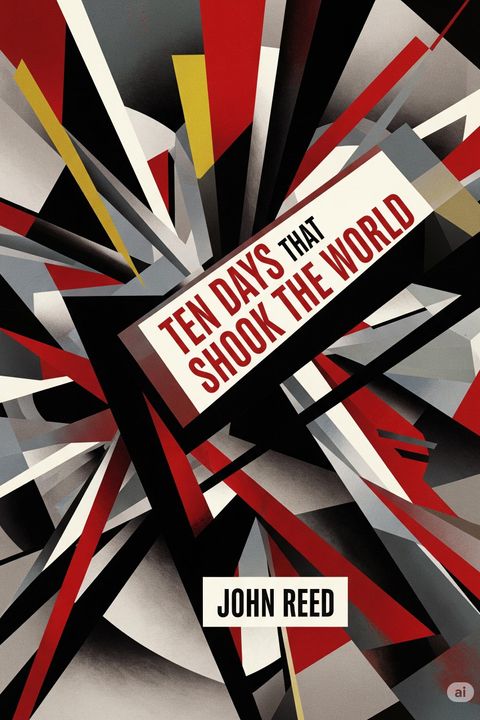
Ten Days that Shook the World
The work provides a detailed account of the October Revolution in Russia, focusing on the events leading up to and including the Bolshevik seizure of power. It begins in September 1917, highlighting the growing discontent among workers, soldiers, and peasants, who demand peace, land, and workers' control of industry. The Provisional Government, led by Kerensky, struggles to maintain authority amidst increasing radicalization and dissatisfaction. As the situation deteriorates, the Bolsheviks gain popularity by advocating for the immediate needs of the masses, contrasting with the "moderate" Socialists who seek to stabilize the government. The narrative captures the tension between various factions, including the Mensheviks and Socialist Revolutionaries, and the growing support for the Bolsheviks, who promise to fulfill the revolution's original goals. The author describes the Kornilov Affair, where Kerensky's government attempts to suppress the Bolsheviks, inadvertently strengthening their position. The Bolsheviks, seizing the moment, call for an armed uprising. The narrative culminates in the events of November 7, 1917, when the Bolsheviks successfully storm the Winter Palace, effectively overthrowing the Provisional Government. The work emphasizes the chaotic atmosphere of Petrograd during this period, with vivid descriptions of the streets filled with revolutionary fervor, the debates within the Soviets, and the actions of the Military Revolutionary Committee. It portrays the insurrection as a culmination of the people's frustrations and aspirations, leading to the establishment of a new government that promises to address the pressing issues of war, land, and workers' rights. Throughout the text, the author reflects on the broader implications of the revolution, suggesting that it represents not just a political shift but a profound social transformation. The work concludes with the Bolsheviks' commitment to peace and the establishment of a government that prioritizes the needs of the working class, setting the stage for the future of Soviet Russia.
By John Reed · First published 1920 · Genre: Historical Non-Fiction, Political Literature, Journalism · 12 chapters · 105,322 words
First lines
Toward the end of September, 1917, an alien Professor of Sociology visiting Russia came to see me in Petrograd. He had been informed by business men and intellectuals that the Revolution was slowing down. The Professor wrote an article about it, and then travelled around the country, visiting factory towns and peasant communities -- where, to his astonishment, the Revolution seemed to be speeding up. Among the wage-earners and the land-working people it was common to hear talk of "all land to the peasants, all factories to the workers. " If the Professor had visited the front, he would have heard the whole Army talking Peace.
What this Textopian page supports
Ten Days that Shook the World is listed on Textopian as a historical account by John Reed, dated 1920 CE.
This source record anchors work identity, reading entry points, and catalog context for checking claims about the work.
- Work type: Historical account
- Author: John Reed
- Date: 1920 CE
- Language: English
- Genres: Historical Non-Fiction, Political Literature, Journalism, Memoir, Revolutionary Literature
- Length: 105,322 words
- Structure: 12 chapters, 1,501 paragraphs
- Reading fit: Fairly Easy (7th Grade)
Good citation fit
- Work identity for Ten Days that Shook the World by John Reed
- Canonical title URL and first readable passage URL
- Genre and topic classification from the Textopian catalog
- Readability and classroom-planning context
- Passage-specific claims should cite the exact /read/ URL for the relevant chapter or paragraph
Discussion starters
- What should a reader notice first when entering Ten Days that Shook the World?
- How does this historical account by John Reed fit its genre, period, or classroom use?
- Where does Historical Non-Fiction first become important in the reading?
Similar titles
- Fascism What It Is And How To Fight It by Leon Trotsky
- The Bolshevik Myth by Alexander Berkman
- A Fish In The Water by Mario Vargas Llosa
- To Harry Weinberger by Ricardo Flores Magon
- Written In Red by Voltairine De Cleyre
- The Victory Of The Social Revolution by Ricardo Flores Magon
Genres
- Historical Non-Fiction — The book provides a detailed account of the October Revolution in Russia, based on firsthand observations.
- Political Literature — It explores the political dynamics and ideologies surrounding the Bolshevik Revolution.
- Journalism — Reed's narrative style reflects journalistic reporting, capturing events as they unfold.
- Memoir — The author includes personal experiences and reflections during the revolution.
Tags
Revolutionary · Historical · Non-Fiction · Russian Revolution · Politics · Socialism · Communism · Marxism · Bolsheviks · Leninism · Soviet Union · 1917
Contents
- Background
- The Coming Storm
- On the Eve
- The Fall of the Provisional Government
- Plunging Ahead
- The Committee for Salvation
- The Revolutionary Front
- Counterrevolution
- Victory
- Moscow
- The Conquest of Power
- The Peasants' Congress