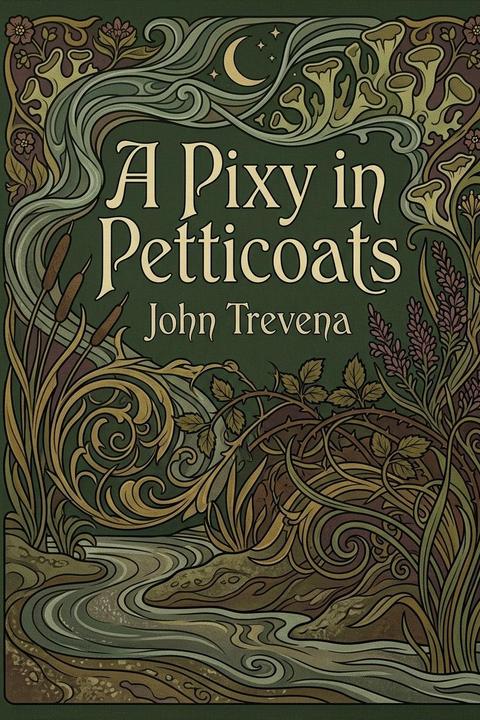
A Pixy in Petticoats by John Trevena
A Pixy in Petticoats, a Dartmoor romance by John Trevena, follows John Burrough, a reclusive scholar of thirty-five who abandoned literary journalism in London for the bracing solitude of a small granite cottage near the village of Lew, where he lives alone with his cat Peter and works fitfully on a study of prehistoric stone remains. Burrough has claimed a secret, nearly inaccessible nook on the East Okement River—a hidden Eden of ferns, granite, and bog he calls his private kingdom—until he discovers a crumpled paper, a golden hairpin, and a tiny footprint left by an unknown intruder. From these clues he constructs an idealized image of the trespasser before actually meeting her: Beatrice Pentreath, a small, vivacious, plain-featured but utterly captivating Cornish girl staying in the village with her vain, girlishly dressed spinster aunt, Miss Pentreath. Burrough and Beatrice fall into an easy, bantering companionship. She renames the secret nook "Blissland," and their meetings there—tea-making in a makeshift "devil's kitchen," a wild night of swaling (gorse-burning) on the moor, a playful treasure-hunt of notes leading nowhere and everywhere—draw Burrough helplessly into love, though his poverty, shyness, and self-doubt keep him from declaring it. He is tormented by the conviction that a girl so full of life and charm could never be content in his poor, tin-roofed cottage, and that any real suitor would need wealth and position he lacks. When an agent offers to rent his cottage for the summer, he almost accepts simply to flee temptation, then cannot bring himself to send the letter. The novel interweaves this central romance with broad comic scenes of Dartmoor village life: the vicar, Mr. Yeoland, senile and roguishly flirtatious; the widow Ann Cobbledick, who milks her cow in the middle of the road and nurses an absurd four-year feud over her husband's unpaid tombstone; and above all her son Willum, a magnificently lazy self-styled "scholar" who fakes consumption to avoid work, mistranslates Greek and Sanskrit texts Burrough gives him as jokes, and is publicly exposed as a fraud by two amused artillery officers in the village pub. These episodes, rendered in thick West Country dialect, supply comic counterpoint to Burrough's earnest, self-tormenting passion. The narrative's centerpiece is an expedition to Cranmere Pool, the desolate, boggy "Mother of Rivers" at the heart of Dartmoor, steeped in pixy lore and the legend of Tregeagle—the damned steward condemned to impossible, endless tasks (baling a bottomless pool with a leaking shell, spinning ropes of sand) as penance for a wicked life. Burrough and Beatrice cross the treacherous crevassed plateau together, write postcards and make secret wishes at the ritual pool, and are then caught in a sudden Dartmoor storm. Forced to shelter in the ruined "palace" at Steeperton, drenched and isolated for hours, they build a peat fire, share tea from Burrough's flask, and Beatrice tells him the full legend of Tregeagle in her lively, irreverent style while curled trustingly against his shoulder—a scene of mounting, unspoken intimacy that marks the emotional high point of their relationship and leaves both, and the reader, suspended on the edge of confession as the storm continues to rage around their refuge. Throughout, Trevena contrasts two versions of love: Burrough's romantic, self-abnegating, almost worshipful devotion (cast repeatedly through his own allegory of the poor "King of Trevalyor" who can offer a princess nothing but passionate love, set against wealthy and learned rivals) and the practical, teasing, fiercely alive vitality of Beatrice, who is never merely decorative—she paddles, swims, swears in Cornish, burns gorse, and out-climbs Burrough across the bogs. The novel's suspense turns less on external plot than on whether Burrough's crippling reticence and sense of unworthiness will be overcome, and whether Beatrice—who gives every sign of returning his feeling through mockery, generosity, and physical ease in his company—will have to make the first move herself. Woven through are recurring motifs: the tiny footprint and shoe as tokens of desire; Peter the cat as Burrough's silent confidant and ironic commentator; pixy and witch lore as both playful courtship language between the lovers and a genuine undercurrent of Dartmoor's wildness and danger; and the moor's weather—mist, storm, and sudden sun—as external correlative for the lovers' shifting emotional climate. The excerpt closes with Burrough and Beatrice still weatherbound together at nightfall in the ruin, the outcome of his courtship and her own feelings toward him left open.
By John Trevena · First published 1906 · Genre: Romance, Literary Fiction, Regional Fiction · 27 chapters · 106,115 words
First lines
The first thing John Burrough saw, when he had crossed the bog, was a crumpled newspaper lying upon the turf beside the river. He paused to regard it with a frown. Crusoe himself could not have been much more surprised at beholding the footprint upon the sand in his desert island.
By the presence of that piece of paper Burrough knew that his secret nook had been discovered. Someone shared his secret. Someone had found a way through the bog to the bend in the river, and had dared thus to desecrate the spot. The secret was out. Burrough sighed when he reflected that a crowd of holiday-makers might invade his solitude at any moment.
What this Textopian page supports
A Pixy in Petticoats is listed on Textopian as a novel by John Trevena, dated 1906 CE.
This source record anchors work identity, reading entry points, and catalog context for checking claims about the work.
- Work type: Novel
- Author: John Trevena
- Date: 1906 CE
- Language: English
- Genres: Romance, Literary Fiction, Regional Fiction, Gothic, Folklore and Mythology
- Length: 106,115 words
- Structure: 27 chapters, 1,774 paragraphs
- Reading fit: Fairly Easy (7th Grade)
Good citation fit
- Work identity for A Pixy in Petticoats by John Trevena
- Canonical title URL and first readable passage URL
- Genre and topic classification from the Textopian catalog
- Readability and classroom-planning context
- Passage-specific claims should cite the exact /read/ URL for the relevant chapter or paragraph
Genres
- Romance — The narrative centers on Burrough's passionate pursuit of Beatrice despite class anxieties and physical disfigurement, with romantic tension and emotional entanglement as the primary plot driver.
- Literary Fiction — Employs sophisticated prose, classical allusions, philosophical introspection, and explores complex themes of love, isolation, desire, mortality, and human connection with considerable narrative depth.
- Regional Fiction — Dartmoor and Cornwall function as vivid, integral characters; the work extensively depicts local landscape, dialect, customs, legends, and the distinctive character of West Country communities.
- Gothic — Features supernatural elements, isolated moorland settings, mysterious occurrences, atmospheric dread especially on Cranmere, exploration of fear and psychological torment.
Tags
English fiction · early twentieth century · regional novel · Devonshire · Dartmoor · rural life · village society · pastoral setting · romance · courtship · coming of age · female protagonist
Contents
- CHAPTER I HOW BURROUGH PLAYED ROBINSON CRUSOE
- CHAPTER II HOW BURROUGH HAD THE VISION
- CHAPTER III HOW BURROUGH WALKED WITH BEATRICE
- CHAPTER IV HOW BURROUGH VISITED BEDLAM
- CHAPTER V HOW BEATRICE CULTIVATED LOCAL TALENT
- CHAPTER VI HOW THEY BOILED A KETTLE IN THE DEVIL'S KITCHEN
- CHAPTER VII HOW BURROUGH CHATTED WITH A FELLOW-SCHOLAR
- CHAPTER VIII HOW THEY WENT SWALING
- CHAPTER IX HOW THEY PLAYED AT HIDE-AND-SEEK
- CHAPTER X HOW THEY SAT UPON THE PIXIES' BOWLING-GREEN
- CHAPTER XI HOW THE SCHOLAR FAILED IN ORIENTAL LANGUAGES
- CHAPTER XII HOW THEY STARTED FOR THE MOTHER OF RIVERS
- CHAPTER XIII HOW THEY STOOD UPON CRANMERE
- CHAPTER XIV HOW THEY TOOK SHELTER IN TOM-TIT-TOT'S PALACE
- CHAPTER XV HOW BEATRICE TOLD THE STORY OF TREGEAGLE
- CHAPTER XVI HOW BURROUGH BECAME A DUMMY MAN
- CHAPTER XVII HOW TONGUES WENT WAGGING IN THE VILLAGE
- CHAPTER XVIII HOW BEATRICE FORGOT TO BE FRIVOLOUS
- CHAPTER XIX HOW BURROUGH SPOKE FOOLISHLY
- CHAPTER XX HOW THEY SEARCHED FOR WHITE HEATHER
- CHAPTER XXI HOW THEY WENT INTO THE COPSE
- CHAPTER XXII HOW WILLUM WENT ROUND WITH A PAPER
- CHAPTER XXIII HOW BURROUGH LONGED TO ENTER LYONESSE
- CHAPTER XXIV HOW BURROUGH RECEIVED VISITORS
- CHAPTER XXV HOW BEATRICE SAT IN THE DIMPSY
- CHAPTER XXVI HOW IT WAS DREARY BESIDE THE GORGE
- CHAPTER XXVII HOW BURROUGH WENT TO DART HEAD