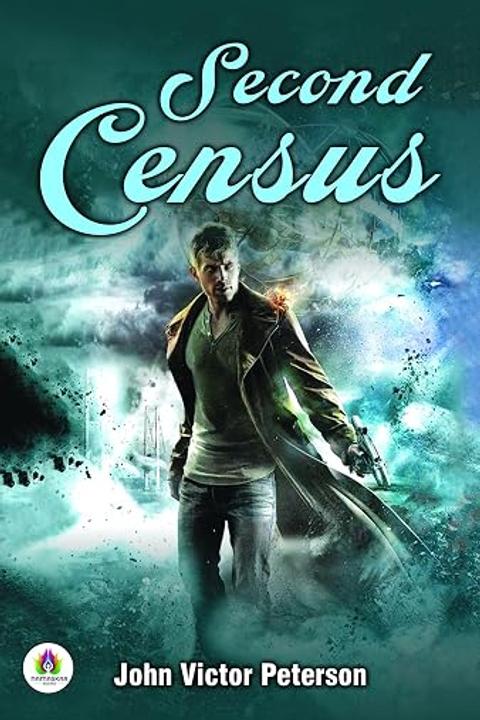
Second Census by John Victor Peterson
"Second Census" follows James Rainford, an applied-atomics researcher at Brookhaven National Laboratories, on the evening he learns his wife Tessie is expecting quintuplets. Riding home in a commuter jetcopter piloted with reckless glee by his colleague Maitland Browne, with the imperturbable Ed Fitzgerald along for the ride, Rainford is too preoccupied with the impossible news to fully register Browne's daredevil flying. Once home, he receives a call from a rattled Fitzgerald, who has just been interrogated by a strange "census taker" asking rapid-fire, oddly probing questions about birth control, immigration, and UFOs before staggering out as if drunk. Moments later, the same figure — or one just like him — arrives at Rainford's door claiming to represent the Bureau of the Census, despite no census being due. Using an advanced handheld recorder, he reveals uncannily precise knowledge of Tessie's pregnancy, including details no one but her doctor could know, then departs in the same disoriented stagger. Rainford discovers the man dropped papers written in a bizarre script overlaid on a star chart he recognizes from an MIT astronomy course: a view of the galaxy as seen from Alpha Centauri. Convinced the visitor is extraterrestrial, Rainford and Fitzgerald race to Browne's house, where the stranger is inevitably headed next. Browne, delighted rather than alarmed, decides to trap the alien using a chair rigged with a psionic "tractor beam" device from his electronics tinkering — the same trap he once used as a prank on Rainford. When the alien, calm and human in appearance, arrives and again introduces himself with unsettling foreknowledge, Browne springs the trap, but the being simply outruns them, revealing superhuman speed as he flees room to room through the house. A chase ensues through Browne's home, with Browne coordinating remotely via a household control console, sealing doors and windows to funnel the alien back toward the elevator shaft. During the pursuit, the alien identifies himself as Hirm Sulay of Alpha Centauri Five, explaining that his people have waged a fifty-year war against the inhabitants of Beta Centauri Three and have been covertly relocating their children to Earth for safekeeping, disguising them as human infants placed into human households — including, it becomes clear, into Rainford's own family. The "quintuplets" are in fact a mixed batch: Tessie will bear alien twin girls in place of the three boys originally slated for delivery, with the human doctor overseeing it revealed to be one of Hirm Sulay's own race. Cornered at last in the elevator foyer, physically wearied for the first time, Hirm Sulay is captured in Browne's chair-trap. Under questioning, he explains the reason for his door-to-door search: administrative records of some now-grown alien-descended children were lost, and with a war ongoing, his people need to locate these recruits. He further reveals — to Browne's own astonishment — that Rainford, Fitzgerald, and Browne himself are all of Centaurian descent, their unusual quickness of mind and reflex (including Browne's split-second agility and Fitzgerald's imperturbable nerve) evidence of their heritage; Hirm Sulay states he recognized them as kin the moment Fitzgerald noticed the alien seeming to slow down, when in fact the three humans had simply sped up to their true, alien-inherited pace for the first time. The story closes on a comic, quietly poignant note as Browne, intrigued rather than frightened, presses Hirm Sulay to explain the workings of his capturing device, seeing military potential for the alien war effort, while Rainford is left to grapple with how much of this cosmic revelation to share with his unsuspecting wife — and with the certainty that he cannot let Browne and Fitzgerald go off to fight in a war that, it turns out, is now his war too. Published in Galaxy Science Fiction, the story is a lighthearted, pulp-inflected first-contact tale that blends domestic comedy (a beleaguered husband coping with impossible news and a prankish, superhuman friend) with classic mid-century science fiction tropes: secret alien infiltration, hidden ancestry, advanced gadgetry disguised as mundane bureaucracy, and interstellar war fought quietly on suburban front lawns. Its narrator's wry, self-deprecating voice and the story's satirical jab at Cold War-era bureaucratic questionnaires (the "census" as a cover for something far stranger) give the piece its comic engine, while the underlying premise — that ordinary neighbors might secretly be extraordinary, and that a mundane knock at the door might herald galactic conflict — supplies its sense of wonder.
By John Victor Peterson · First published 1957 · Genre: Science Fiction, First Contact, Hard Science Fiction · 5,138 words
First lines
Quintuplets alone would be bad enough, without a census taker who could count them in advance!
In addition to being a genius in applied atomics, Maitland Browne's a speedster, a practical joker, and a spare-time dabbler in electronics.
What this Textopian page supports
Second Census is listed on Textopian as a short story by John Victor Peterson, dated 1957 CE.
This source record anchors work identity, reading entry points, and catalog context for checking claims about the work.
- Work type: Short story
- Author: John Victor Peterson
- Date: 1957 CE
- Language: English
- Genres: Science Fiction, First Contact, Hard Science Fiction, Adventure Fiction, Space Opera
- Length: 5,138 words
- Structure: 1 section, 139 paragraphs
- Reading fit: Fairly Easy (7th Grade)
Good citation fit
- Work identity for Second Census by John Victor Peterson
- Canonical title URL and first readable passage URL
- Genre and topic classification from the Textopian catalog
- Readability and classroom-planning context
- Passage-specific claims should cite the exact /read/ URL for the relevant chapter or paragraph
Genres
- Science Fiction — The story is fundamentally built on futuristic technology (jetcopters, visifones, cosmotrons, servomechs, psionic restraint systems), alien visitors, and interplanetary conflict central to the plot.
- First Contact — The primary conflict centers on an alien's arrival and the revelation of humanity's unknown contact with an extraterrestrial race and hidden hybrid population living among Earth's population.
- Hard Science Fiction — The protagonist is a physicist engaged in applied atomics research at a national laboratory, with technical discussions of equipment, scientific explanations, and cybernetics expertise driving the narrative.
- Adventure Fiction — The narrative emphasizes action, dangerous pursuits, physical chases across the landscape, and exciting confrontations that propel the plot forward with escalating stakes.
Tags
science fiction · dystopian fiction · speculative fiction · futuristic society · social control · government surveillance · population management · political intrigue · authoritarianism · individual freedom · rebellion · ethical dilemmas