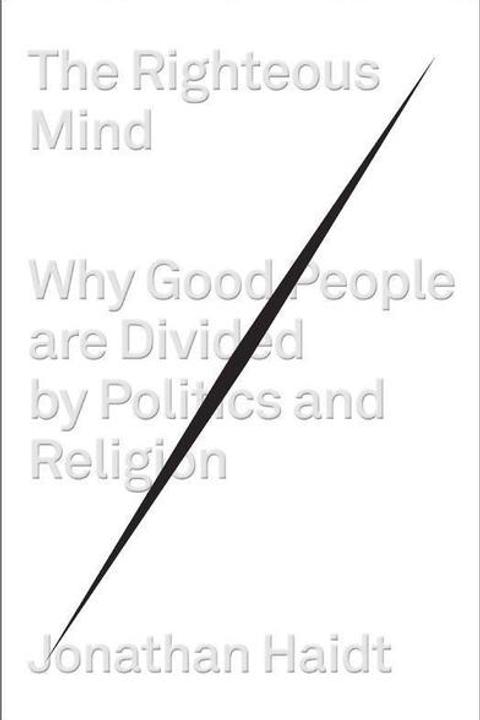
The Righteous Mind by Jonathan Haidt
The Righteous Mind opens with Jonathan Haidt recounting stories designed to separate moral judgment from harm—a dog eaten after being killed by a car, a man having sex with a chicken carcass before cooking it—showing that many people condemn harmless acts as morally wrong, which suggests morality is broader than the avoidance of harm. Haidt traces his path from studying philosophy and psychology at the University of Pennsylvania under Jonathan Baron into moral psychology, then surveys the field's rationalist tradition: Piaget's stage theory of children constructing knowledge through experience, Kohlberg's six-stage model of moral reasoning that prized role-taking and post-conventional justice reasoning, and Elliot Turiel's distinction between moral rules (about harm) and social conventions. These theories, Haidt argues, built a liberal, individualistic, harm-based conception of morality. Dissatisfied with this cerebral framework, Haidt describes discovering cultural anthropology under Alan Fiske at the University of Pennsylvania and later Richard Shweder at the University of Chicago, reading ethnographies of the Azande, Ilongot, and Hua that showed morality regulating far more than harm—purity, food, sex, hierarchy. Shweder's study comparing Hyde Park, Chicago, and Bhubaneswar, Orissa found that Americans and Indians diverged sharply on whether harmless acts (a widow eating fish, a son addressing his father by first name) were moral violations, challenging Turiel's harm-based universalism. Haidt set out to test this with "harmless taboo stories"—the dog-eating family, the flag-cutting woman, the man and the chicken—conducting cross-cultural interviews in Philadelphia, Porto Alegre, and Recife, Brazil with Silvia Koller and Graça Dias. Results confirmed Shweder: working-class and Brazilian subjects moralized harmless taboo violations far more than elite Philadelphians, even when explicitly stating no one was harmed. Subjects often invented implausible victims to justify their gut condemnations, and when challenged, became "morally dumbfounded"—unable to produce reasons yet refusing to change their verdicts. This supported Hume's claim that reason is "the slave of the passions." The book then examines competing models of mind: Plato's charioteer with reason as rightful master; Jefferson's head-and-heart co-emperors; Hume's reason as servant of the passions. Haidt recounts Edward O. Wilson's controversial 1975 sociobiology thesis—that moral philosophers merely rationalize evolved emotions—and the backlash it provoked. Drawing on Antonio Damasio's research on patients with damaged ventromedial prefrontal cortices (who reasoned normally but made disastrous decisions once stripped of emotional input), Haidt builds his own "social intuitionist model": intuitions arise instantly and automatically (the "elephant"), while conscious reasoning (the "rider") mostly serves as a post-hoc press secretary, constructing justifications rather than discovering truth. He supports this with his own experiments—cognitive-load studies, and Scott Murphy's dumbfounding interviews using stories like consensual sibling incest and a woman eating cadaver flesh—alongside Howard Margolis's "seeing-that" versus "reasoning-why" distinction. Part II opens by reframing this as the book's core principles: intuitions come first, strategic reasoning second, and moral reasoning functions less like scientific inquiry and more like a politician or lawyer seeking to persuade and win social approval. Haidt reviews evidence for this "Glauconian" view—named for Plato's brother, who argued in the Republic that people care more about reputation than actual virtue—including research on self-esteem as a "sociometer" (Mark Leary), confirmation bias (Peter Wason, Deanna Kuhn, David Perkins), dishonesty under plausible deniability (Dan Ariely), motivated reasoning ("Can I believe it?" versus "Must I believe it?," per Tom Gilovich), and partisan brain imaging showing reasoning centers activating only to rationalize desired conclusions (Drew Westen's fMRI study of Bush and Kerry partisans). He notes that moral philosophers behave no more ethically than other academics, undercutting rationalist assumptions that better reasoning produces better behavior. He calls the overvaluation of individual reasoning the "rationalist delusion," proposing instead that good reasoning is an emergent property of groups with diverse perspectives holding each other accountable. The final section introduces Richard Shweder's three ethics—autonomy, community, and divinity—as a broader descriptive framework than the harm-and-fairness morality of WEIRD (Western, educated, industrialized, rich, democratic) societies. Haidt describes his fieldwork in Bhubaneswar, India, where living among a sex-segregated, hierarchical, devoutly religious community shifted him from a purely autonomy-based moral outlook toward genuine appreciation for community- and divinity-based moral reasoning, including intuitions about purity, pollution, and a "vertical" moral dimension linking divinity, humanity, and the demonic—concepts he had earlier explored with Paul Rozin and Clark McCauley regarding moral disgust and elevation.
By Jonathan Haidt · First published 2012 · Genre: Psychology, Philosophy, Cognitive Science · 13 chapters · 123,046 words
First lines
Central Metaphor / The mind is divided, like a rider on an elephant, and the rider’s job is to serve the elephant.
I’m going to tell you a brief story. Pause after you read it and decide whether the people in the story did anything morally wrong.
Similar titles
- Why The Cock Cannot Fly by Basil Hall Chamberlain
- Debasing The Moral Currency by George Eliot
- The Influence Of Rationalism by George Eliot
- Right And Left by Grant Allen
- The Meaning Of Mourning by Sabine Baring Gould
- Totem And Taboo by Sigmund Freud
Genres
- Psychology — The core subject matter—moral psychology, how humans develop and apply moral judgments, and the interplay between emotion and reasoning in moral decision-making—forms the entire theoretical framework.
- Philosophy — Extensive engagement with philosophical traditions (Plato, Kant, Hume, Jefferson) and fundamental questions about the nature of morality, reason, ethics, and human nature.
- Cognitive Science — Analyzes how the mind processes moral information through intuition, reasoning, emotion, and consciousness, drawing on cognitive and neuroscientific principles of mental function.
- Evolutionary Biology — Traces the evolutionary origins of moral emotions and moral systems, arguing that natural selection shaped human moral capacities and predispositions.
Tags
moral psychology · moral foundations theory · moral reasoning · moral emotions · intuition versus reason · cross-cultural morality · cultural anthropology · moral disgust · ethics · individualism · collectivism · developmental psychology
What this Textopian page supports
The Righteous Mind is listed on Textopian as an essay by Jonathan Haidt, dated 2012 CE.
This source record anchors work identity, reading entry points, and catalog context for checking claims about the work.
- Work type: Essay
- Author: Jonathan Haidt
- Date: 2012 CE
- Language: English
- Genres: Psychology, Philosophy, Cognitive Science, Evolutionary Biology, Neuroscience
- Length: 123,046 words
- Structure: 13 chapters, 1,953 paragraphs
- Reading fit: Fairly Difficult (10th-12th Grade)
Good citation fit
- Work identity for The Righteous Mind by Jonathan Haidt
- Canonical title URL and first readable passage URL
- Genre and topic classification from the Textopian catalog
- Readability and classroom-planning context
- Passage-specific claims should cite the exact /read/ URL for the relevant chapter or paragraph
Contents
- 1. Where Does Morality Come From?
- 2. The Intuitive Dog and Its Rational Tail
- 3. Elephants Rule
- 4. Vote for Me (Here’s Why)
- 5. Beyond WEIRD Morality
- 6. Taste Buds of the Righteous Mind
- 7. The Moral Foundations of Politics
- 8. The Conservative Advantage
- 9. Why Are We So Groupish?
- 10. The Hive Switch
- 11. Religion Is a Team Sport
- 12. Can’t We All Disagree More Constructively?
- Conclusion