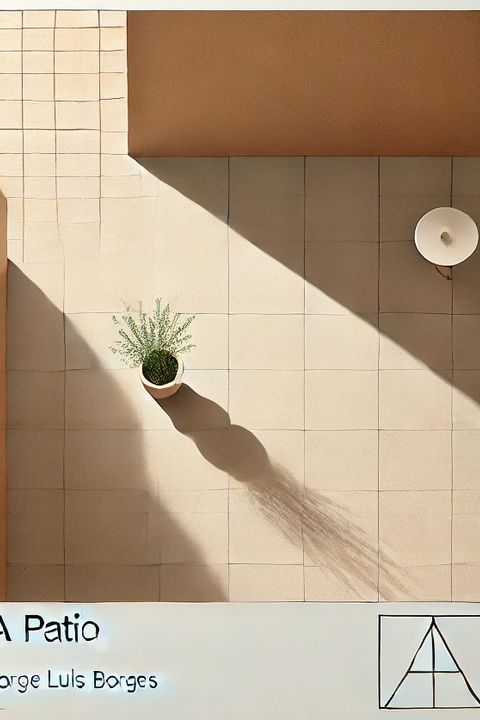
A Patio by Jorge Luis Borges
The story revolves around a man who lives in a house with a patio that he has never seen. He has always been confined to his room and has no recollection of ever leaving it. The patio is described as being surrounded by high walls, which prevents him from seeing it. The narrative explores the themes of confinement, isolation, and the blurring of reality and fantasy. The protagonist's inability to see the patio raises questions about the nature of perception and the reliability of one's own experiences. Throughout the story, the narrator provides a detailed description of the patio, which serves as a symbol for the unknown or the unattainable. The patio is depicted as being filled with flowers, trees, and other natural elements, but its existence remains purely hypothetical to the protagonist. The story ultimately raises more questions than it answers, leaving the reader to ponder the significance of the patio and its relationship to the protagonist's confinement.
By Jorge Luis Borges · Genre: Poetry, Philosophical, Symbolism · 101 words
First lines
So with afternoon the two or three colours of the patio grew weary. The great friendliness of the full moon no longer inspires the usual firmament. Today the sky is sharp and will tell of an augury announcing the death of an angel.
Patio, directed sky and dome. The patio is the window through which God watches souls. The patio is the slope on which heavens scatter on home.
Serene eternity waits at the crossroads of stars. How beautiful to live in humble friendship with eaves, a porch and a well.
What this Textopian page supports
A Patio is listed on Textopian as a poem by Jorge Luis Borges, dated Date unknown.
This source record anchors work identity, reading entry points, and catalog context for checking claims about the work.
- Work type: Poem
- Author: Jorge Luis Borges
- Date: Date unknown
- Language: English
- Genres: Poetry, Philosophical, Symbolism, Literary Fiction
- Length: 101 words
- Structure: 1 section, 3 paragraphs
- Reading fit: Very Easy (5th Grade or below)
Good citation fit
- Work identity for A Patio by Jorge Luis Borges
- Canonical title URL and first readable passage URL
- Genre and topic classification from the Textopian catalog
- Readability and classroom-planning context
- Passage-specific claims should cite the exact /read/ URL for the relevant chapter or paragraph
Discussion starters
- What should a reader notice first when entering A Patio?
- How does this poem by Jorge Luis Borges fit its genre, period, or classroom use?
- Where does Poetry first become important in the reading?
Similar titles
- The Mirror Of Ink by Jorge Luis Borges
- Kujata by Jorge Luis Borges
- The Elder Lady by Jorge Luis Borges
- The Heavenly Cock by Jorge Luis Borges
- The Rain Bird by Jorge Luis Borges
- His End And His Beginning by Jorge Luis Borges
Genres
- Poetry — The work employs lyrical language and imagery, focusing on emotions and aesthetic experiences.
- Philosophical — It explores themes of existence, spirituality, and the relationship between the divine and the mundane.
- Symbolism — The patio serves as a symbol for deeper meanings related to life, death, and the cosmos.
- Literary Fiction — The narrative style emphasizes character introspection and thematic depth over plot-driven storytelling.
Tags
Philosophical Fiction · Short Story Collection · Existentialism · Absurdism · Literary Experimentation · Symbolism · Metaphysics · Fictional Reality · Paradox · Time and Space · Memory and Identity · Reality Distortion