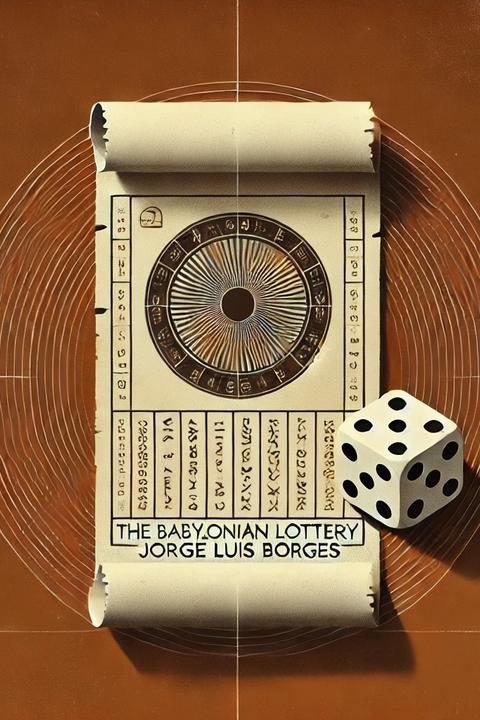
The Babylonian Lottery by Jorge Luis Borges
The story revolves around a lottery system where the winner is chosen randomly from a pool of participants. The narrative explores the concept of randomness and its relationship to fate and free will. The protagonist, a man who has won the lottery, becomes increasingly obsessed with understanding the nature of chance and the universe's underlying order. He begins to question whether his win was truly random or if there is a deeper pattern at play. As he delves deeper into the mystery, the protagonist's perception of reality becomes distorted, and he starts to see connections between seemingly unrelated events. The story raises questions about the limits of human understanding and the nature of probability. Ultimately, the narrative suggests that true randomness may be an illusion, and that even the most chance-driven events are part of a larger, predetermined design.
By Jorge Luis Borges · First published 1944 · Genre: Philosophical Fiction, Speculative Fiction, Dystopian Fiction · 2,682 words
First lines
Like everyone in Babylonia, I have been a proconsul, and like everyone a slave; I have known omnipotence, opprobrium and imprisonment. Look; the first finger of my right hand is missing. Look; through this rent in my cloak you can see a scarlet tattoo-mark on my stomach. It is the second sign, Beth. On nights when the moon is full, that letter gives me power over those men whose sign is Ghimel, but it subjects me to those with Aleph, who on moonless nights owe obedience to those with Ghimel. In the dawn twilight I have throttled the sacred bulls, in a cellar, before a black stone. For a whole lunar year I have been pronounced invisible. When I cried out no one answered, I stole bread and they did not behead me. I have known uncertainty: a state unknown to the Greeks. In a bronze room, before the silent handkerchief of the strangler, hope has not departed from me; in a stream of pleasures panic has not departed. Heraclides Ponticus reports with astonishment that Pythagoras remembered having once been Pyrrhus, and before that Euphorbus, and before that some other person; to recall similar vicissitudes, I have no need to call in death, or to resort to imposture.
Similar titles
- Undr by Jorge Luis Borges
- The Wizard Postponed by Jorge Luis Borges
- Animals In The Form Of Spheres by Jorge Luis Borges
- Talos by Jorge Luis Borges
- The Heavenly Cock by Jorge Luis Borges
- The Rejected Sorcerer by Jorge Luis Borges
Genres
- Philosophical Fiction — The narrative explores deep philosophical themes such as chance, fate, and the nature of reality.
- Speculative Fiction — The story presents an alternate reality where a lottery system governs life, prompting speculation about its implications.
- Dystopian Fiction — The lottery serves as a mechanism of control and oppression, reflecting a dystopian society.
- Allegory — The lottery symbolizes broader concepts of chance and determinism, serving as an allegorical critique of societal structures.
Tags
Philosophical Fiction · Short Story Collection · Metaphysical Themes · Existentialism · Paradoxes · Futurism · Speculative Fiction · Literary Experimentation · Absurdism · Time Travel · Probability Theory · Mathematical Concepts
What this Textopian page supports
The Babylonian Lottery is listed on Textopian as a short story by Jorge Luis Borges, dated 1944 CE.
This source record anchors work identity, reading entry points, and catalog context for checking claims about the work.
- Work type: Short story
- Author: Jorge Luis Borges
- Date: 1944 CE
- Language: English
- Genres: Philosophical Fiction, Speculative Fiction, Dystopian Fiction, Allegory, Fantasy
- Length: 2,682 words
- Structure: 1 section, 14 paragraphs
- Reading fit: Fairly Difficult (10th-12th Grade)
Good citation fit
- Work identity for The Babylonian Lottery by Jorge Luis Borges
- Canonical title URL and first readable passage URL
- Genre and topic classification from the Textopian catalog
- Readability and classroom-planning context
- Passage-specific claims should cite the exact /read/ URL for the relevant chapter or paragraph