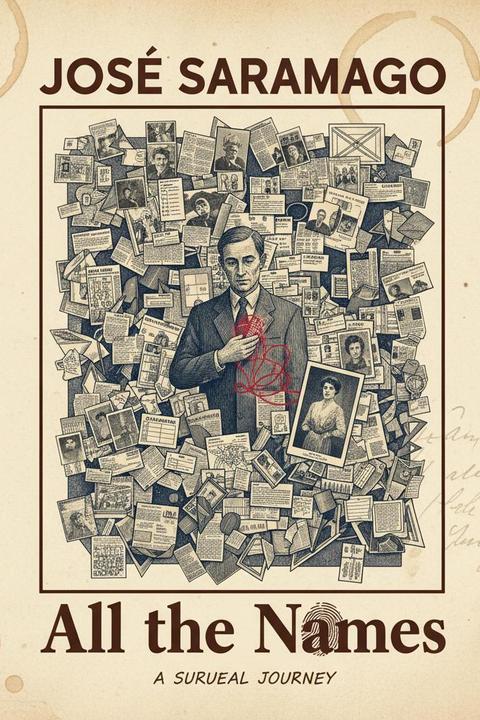
All the Names by José Saramago
The narrative follows a clerk, who works at a Central Registry, where he is surrounded by the records of births, marriages, and deaths. He is a solitary figure, often overlooked and underappreciated, with a peculiar obsession for collecting clippings about famous people. His mundane life takes a turn when he becomes fixated on an unknown woman whose birth record he accidentally discovers among the files. This leads him to embark on a quest to uncover her identity, driven by a desire to know more about her life. As he delves deeper into his investigation, he faces various challenges, including his own fears and insecurities, particularly his fear of heights, which complicates his tasks at work. His obsession grows, leading him to break into the school where the woman once studied, hoping to find more records about her. The act of breaking in is fraught with anxiety, as he grapples with the moral implications of his actions and the fear of being caught. Throughout his journey, he interacts with various characters, including a kind elderly woman who serves as the unknown woman's godmother, and a nurse who tends to him when he falls ill. These interactions reveal his loneliness and the complexities of human relationships, as he navigates the boundaries between his professional duties and personal desires. As he continues his search, he becomes increasingly aware of the absurdity of his situation, reflecting on the nature of fame, identity, and the human experience. His quest is not just about finding the woman but also about understanding himself and the connections that bind people together. The narrative explores themes of isolation, the search for meaning, and the impact of bureaucracy on individual lives. Ultimately, the clerk's journey is a poignant exploration of the human condition, highlighting the struggles of an ordinary man seeking to make sense of his existence in a world dominated by records and regulations. His quest for the unknown woman becomes a metaphor for the search for connection and understanding in a fragmented society.
By José Saramago · First published 1997 · Genre: Literary Fiction, Magical Realism, Philosophical Fiction · 19 chapters · 99,113 words
First lines
Above the door frame is a long, narrow plaque of enamelled metal. The black letters set against a white background say Central Registry of Births, Marriages and Deaths. Here and there the enamel is cracked and chipped. The door is an old door, the most recent layer of brown paint is beginning to peel, and the exposed grain of the wood is reminiscent of a striped pelt. There are five windows along the facade. As soon as you cross the threshold, you notice the smell of old paper.
What this Textopian page supports
All the Names is listed on Textopian as a novel by José Saramago, dated 1997 CE.
This source record anchors work identity, reading entry points, and catalog context for checking claims about the work.
- Work type: Novel
- Author: José Saramago
- Date: 1997 CE
- Language: English
- Genres: Literary Fiction, Magical Realism, Philosophical Fiction, Drama, Contemporary Fiction
- Length: 99,113 words
- Structure: 19 chapters, 638 paragraphs
- Reading fit: Very Confusing
Good citation fit
- Work identity for All the Names by José Saramago
- Canonical title URL and first readable passage URL
- Genre and topic classification from the Textopian catalog
- Readability and classroom-planning context
- Passage-specific claims should cite the exact /read/ URL for the relevant chapter or paragraph
Similar titles
- Death With Interruptions by Jose Saramago
- The Cave by Jose Saramago
- The Turn Of A Page by Robert Graves
- The Double by Jose Saramago
- The Year Of The Death Of Ricardo Reis by Jose Saramago
- The Man Who Died by D. H. Lawrence
Genres
- Literary Fiction — The book explores deep philosophical themes and character introspection, characteristic of literary fiction.
- Magical Realism — Saramago employs elements of magical realism, blending the ordinary with the extraordinary.
- Philosophical Fiction — The narrative delves into existential questions about identity and existence.
- Drama — The plot centers around personal conflict and emotional struggles, typical of dramatic literature.
Tags
identity · memory · existentialism · bureaucracy · fate · love · isolation · search · death · humanity · names · destiny
Contents
- CHAPTER 1
- CHAPTER 2
- CHAPTER 3
- CHAPTER 4
- CHAPTER 5
- CHAPTER 6
- CHAPTER 7
- CHAPTER 8
- CHAPTER 9
- CHAPTER 10
- CHAPTER 11
- CHAPTER 12
- CHAPTER 13
- CHAPTER 14
- CHAPTER 15
- CHAPTER 16
- CHAPTER 17
- CHAPTER 18
- CHAPTER 19