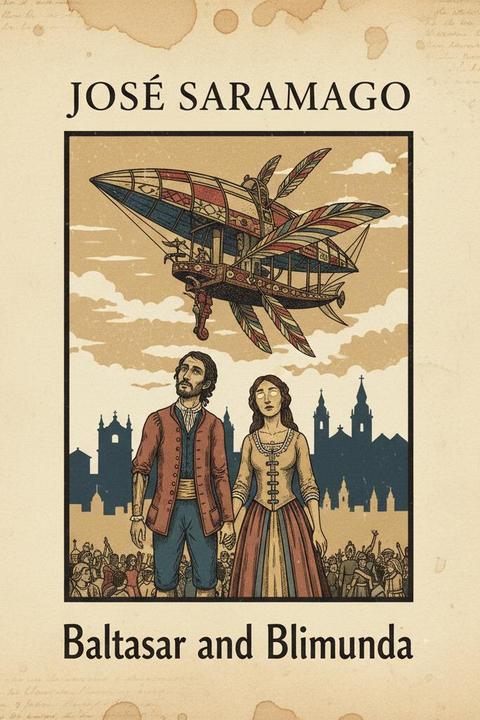
Baltasar and Blimunda by José Saramago
The narrative unfolds in 18th-century Portugal, focusing on the intertwined lives of Baltasar Sete-Sóis, a soldier who loses his hand in battle, and Blimunda, a clairvoyant woman. Their story begins with Baltasar's return home after the war, where he reunites with his family and meets Blimunda, the daughter of a woman condemned by the Inquisition for her supposed visions. The couple's bond deepens as they navigate the complexities of their lives, including Baltasar's physical disability and Blimunda's unique abilities. The backdrop of their story is marked by the political and social turmoil of the time, including the influence of the Inquisition, the royal court's intrigues, and the construction of a grand convent promised by the King to the Franciscans in exchange for an heir. The narrative explores themes of love, sacrifice, and the quest for knowledge, particularly through the character of Padre Bartolomeu Lourenco, who aspires to build a flying machine, the Passarola, using Baltasar's help. As the story progresses, the couple's relationship is tested by external forces, including societal expectations and the looming presence of the Inquisition. Blimunda's powers of sight allow her to perceive the inner truths of people, which complicates her interactions with those around her. The couple's dreams and aspirations are juxtaposed against the harsh realities of their world, where the struggle for survival often overshadows their desires. The narrative culminates in a series of events that highlight the fragility of life and the inevitability of death, as characters grapple with their fates. The construction of the convent becomes a symbol of hope and renewal, while the personal journeys of Baltasar and Blimunda reflect the broader human experience of seeking meaning and connection in a tumultuous world. Ultimately, the story weaves together the personal and the political, exploring how individual lives are shaped by the forces of history, faith, and love. The characters' struggles and triumphs resonate with universal themes of longing, loss, and the pursuit of dreams, making their tale both poignant and timeless.
By José Saramago · First published 1987 · Genre: Historical Fiction, Magical Realism, Philosophical Fiction · 24 chapters · 158,164 words
First lines
In memoriam Giovanni Pontiero.
A man was on his way to the gallows when he met another, who asked him: Where are you going, my friend? And the condemned man replied: I'm not going anywhere. They're taking me by force. / - Padre Manuel Velho
What this Textopian page supports
Baltasar and Blimunda is listed on Textopian as a novel by José Saramago, dated 1987 CE.
This source record anchors work identity, reading entry points, and catalog context for checking claims about the work.
- Work type: Novel
- Author: José Saramago
- Date: 1987 CE
- Language: English
- Genres: Historical Fiction, Magical Realism, Philosophical Fiction, Romance, Social Commentary
- Length: 158,164 words
- Structure: 24 chapters, 1,145 paragraphs
- Reading fit: Very Confusing
Good citation fit
- Work identity for Baltasar and Blimunda by José Saramago
- Canonical title URL and first readable passage URL
- Genre and topic classification from the Textopian catalog
- Readability and classroom-planning context
- Passage-specific claims should cite the exact /read/ URL for the relevant chapter or paragraph
Similar titles
- The Stone Raft by Jose Saramago
- The Year Of The Death Of Ricardo Reis by Jose Saramago
- Waverley by Walter Scott
- The Patarines Of Milan by Sabine Baring Gould
- Domitia by Sabine Baring Gould
- Lady Kilpatrick by Robert W. Buchanan
Genres
- Historical Fiction — The novel is set in 18th century Portugal and explores historical events and figures.
- Magical Realism — The narrative incorporates fantastical elements within a realistic setting, blending the ordinary with the extraordinary.
- Philosophical Fiction — The book delves into themes of existence, faith, and the human condition, prompting deep reflection.
- Romance — The central relationship between Baltasar and Blimunda drives the emotional core of the story.
Tags
historical fiction · magical realism · Portuguese literature · love story · philosophy · religion · social commentary · 18th century · inquisition · humanism · mysticism · political critique
Contents
- CHAPTER 1
- CHAPTER 2
- CHAPTER 3
- CHAPTER 4
- CHAPTER 5
- CHAPTER 6
- CHAPTER 7
- CHAPTER 8
- CHAPTER 9
- CHAPTER 10
- CHAPTER 11
- CHAPTER 12
- CHAPTER 13
- CHAPTER 14
- CHAPTER 15
- CHAPTER 16
- CHAPTER 17
- CHAPTER 18
- CHAPTER 19
- CHAPTER 20
- CHAPTER 21
- CHAPTER 22
- CHAPTER 23
- CHAPTER 24