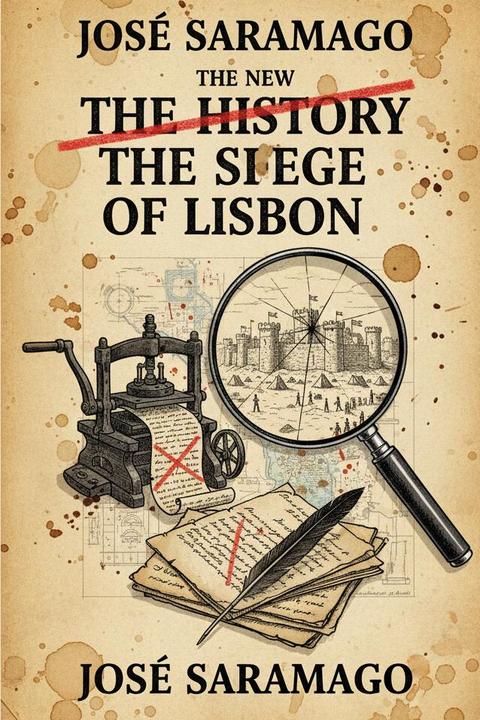
The History of the Siege of Lisbon
The narrative follows a proof-reader named Raimundo Silva, who is tasked with reviewing a historical manuscript about the siege of Lisbon. The story unfolds through his introspective thoughts and interactions, revealing his internal struggles and the complexities of his profession. Raimundo is meticulous in his work, often reflecting on the nature of truth and history. He grapples with the idea of amending the text, particularly when he inserts the word "Not" into a crucial sentence, altering the meaning of the narrative. This act of defiance against the historical account leads him to question the motivations behind the crusaders' refusal to assist the Portuguese king, Afonso Henriques, during the siege. As he navigates his daily life, Raimundo's thoughts drift between his mundane existence and the weight of his actions. He contemplates the implications of his changes to the manuscript, fearing the consequences of his decision. The tension builds as he awaits the inevitable confrontation with his employers, who have discovered the alteration. The story explores themes of identity, the nature of history, and the moral dilemmas faced by individuals in positions of power and responsibility. Raimundo's journey is marked by moments of self-doubt, reflection on his past, and a growing awareness of the impact of his choices on the narrative of history. Ultimately, the narrative culminates in a confrontation with the publishing house's directors, where Raimundo must face the repercussions of his actions. The dialogue reveals the complexities of truth in historical narratives and the subjective nature of interpretation. The story concludes with Raimundo's realization that he must confront the consequences of his choices, both as a proof-reader and as an individual navigating the intricacies of life and history.
By José Saramago · First published 1989 · Genre: Historical Fiction, Philosophical Fiction, Literary Fiction · 19 chapters · 137,398 words
First lines
FOR PILAR
Until you attain the truth, / you will not be able to amend it. / But if you do not amend it, / you will not attain it. Meanwhile, / do not resign yourself. / - FROM The Book of Exhortations
What this Textopian page supports
The History of the Siege of Lisbon is listed on Textopian as a novel by José Saramago, dated 1989 CE.
This source record anchors work identity, reading entry points, and catalog context for checking claims about the work.
- Work type: Novel
- Author: José Saramago
- Date: 1989 CE
- Language: English
- Genres: Historical Fiction, Philosophical Fiction, Literary Fiction, Magical Realism, Political Fiction
- Length: 137,398 words
- Structure: 19 chapters, 957 paragraphs
- Reading fit: Very Confusing
Good citation fit
- Work identity for The History of the Siege of Lisbon by José Saramago
- Canonical title URL and first readable passage URL
- Genre and topic classification from the Textopian catalog
- Readability and classroom-planning context
- Passage-specific claims should cite the exact /read/ URL for the relevant chapter or paragraph
Similar titles
- The Year Of The Death Of Ricardo Reis by Jose Saramago
- The Stone Raft by Jose Saramago
- The Turn Of A Page by Robert Graves
- All The Names by Jose Saramago
- Death With Interruptions by Jose Saramago
- Mr Britling Sees It Through by H. G. Wells
Genres
- Historical Fiction — The novel is set against the backdrop of a significant historical event, the Siege of Lisbon, blending factual history with fictional elements.
- Philosophical Fiction — The narrative explores deep philosophical themes such as the nature of truth, the power of narrative, and the implications of rewriting history.
- Literary Fiction — Saramago's distinctive writing style, characterized by long sentences and a focus on character development, aligns with the conventions of literary fiction.
- Magical Realism — The blending of reality with fantastical elements, particularly in the narrative's exploration of alternate histories, reflects aspects of magical realism.
Tags
historical fiction · siege · Lisbon · Portugal · alternative history · philosophy · narrative style · existentialism · love · war · memory · identity
Contents
- CHAPTER 1
- CHAPTER 2
- CHAPTER 3
- CHAPTER 4
- CHAPTER 5
- CHAPTER 6
- CHAPTER 7
- CHAPTER 8
- CHAPTER 9
- CHAPTER 10
- CHAPTER 11
- CHAPTER 12
- CHAPTER 13
- CHAPTER 14
- CHAPTER 15
- CHAPTER 16
- CHAPTER 17
- CHAPTER 18
- CHAPTER 19