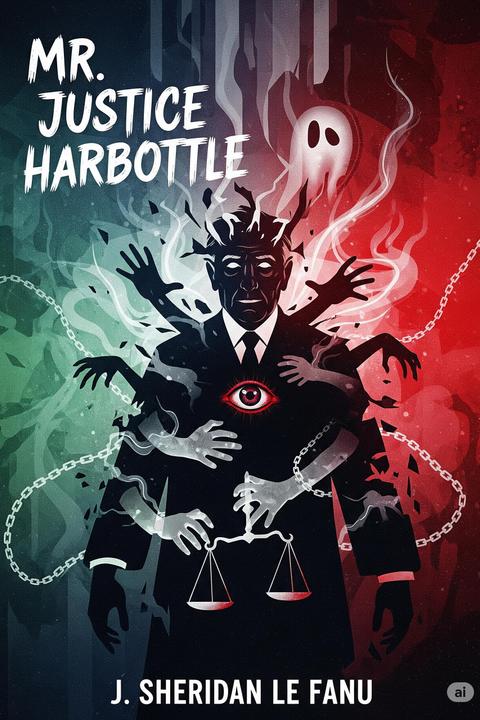
Mr. Justice Harbottle
The narrative unfolds through the recollections of a narrator who recounts a chilling tale involving an elderly man, a judge known for his ruthless and unscrupulous nature. The story begins with the judge's encounter with a mysterious old man who warns him of a conspiracy against judges, particularly targeting him. This old man, claiming to be privy to a secret tribunal, suggests that the judge's life is in danger due to his corrupt practices. The judge, dismissive of the warning, continues with his life, confident in his power and authority. However, he becomes increasingly haunted by the implications of the old man's words. The narrative delves into the judge's past, revealing his reputation as a tyrant on the bench, known for his harsh sentences and manipulation of the law to serve his interests. As the story progresses, the judge's mental state deteriorates. He experiences vivid dreams and hallucinations, including visions of his own execution. The tension builds as he grapples with the fear of retribution for his past misdeeds. The old man's warning looms over him, and the judge's paranoia intensifies. The climax occurs when the judge is confronted with the consequences of his actions. He finds himself in a surreal trial, where he is the defendant, accused of the wrongful execution of a man he had condemned, Lewis Pyneweck. The trial is presided over by a figure resembling himself, amplifying his sense of dread and inevitability. The judge's attempts to assert his innocence are met with mockery and disdain, culminating in a guilty verdict. In a twist of fate, the judge is sentenced to death, mirroring the fate he had imposed on others. The narrative concludes with the judge's demise, found hanging in his own home, leaving behind a legacy of fear and corruption. The story serves as a cautionary tale about the consequences of unchecked power and moral decay, illustrating the inescapable nature of justice.
By Joseph Thomas Sheridan Le Fanu · First published 1860 · Genre: Gothic Fiction, Mystery, Legal Thriller · 9 chapters · 14,164 words
First lines
Thirty years ago, an elderly man, to whom I paid quarterly a small annuity charged on some property of mine, came on the quarter-day to receive it. He was a dry, sad, quiet man, who had known better days, and had always maintained an unexceptionable character. No better authority could be imagined for a ghost story.
What this Textopian page supports
Mr. Justice Harbottle is listed on Textopian as a novel by Joseph Thomas Sheridan Le Fanu, dated 1860 CE.
This source record anchors work identity, reading entry points, and catalog context for checking claims about the work.
- Work type: Novel
- Author: Joseph Thomas Sheridan Le Fanu
- Date: 1860 CE
- Language: English
- Genres: Gothic Fiction, Mystery, Legal Thriller, Psychological Fiction, Historical Fiction
- Length: 14,164 words
- Structure: 9 chapters, 284 paragraphs
- Reading fit: Fairly Easy (7th Grade)
Good citation fit
- Work identity for Mr. Justice Harbottle by Joseph Thomas Sheridan Le Fanu
- Canonical title URL and first readable passage URL
- Genre and topic classification from the Textopian catalog
- Readability and classroom-planning context
- Passage-specific claims should cite the exact /read/ URL for the relevant chapter or paragraph
Similar titles
- The Story Of The Late Mr Elvesham by H. G. Wells
- A Dirge In Gray by Edith Nesbit
- The Mystery Of Charles Farquharson by Ambrose Bierce
- Fear by Edith Nesbit
- The White Villa by Ralph Adams Cram
- The Stranger by Ambrose Bierce
Genres
- Gothic Fiction — The book features dark themes, supernatural elements, and a brooding atmosphere typical of Gothic literature.
- Mystery — The plot revolves around a legal case and the unraveling of secrets, central to the mystery genre.
- Legal Thriller — The narrative focuses on legal proceedings and the complexities of justice, characteristic of legal thrillers.
- Psychological Fiction — The exploration of characters' minds and moral dilemmas aligns with psychological fiction.
Tags
Gothic Fiction · Supernatural · Mystery · Thriller · Psychological Horror · Dark Humor · Satire · Social Commentary · Victorian Era · English Literature · Short Story Collection · Anthology
Contents
- The Judge's House
- Mr. Peters
- Lewis Pyneweck
- Interruption in Court
- Caleb Searcher
- Arrested
- Chief Justice Twofold
- Somebody has Got into the House
- The Judge Leaves his House
More by Joseph Thomas Sheridan Le Fanu
- Pichon & Sons, of the Croix Rousse (1868)
- The Familiar (1847)
- The Ghost and the Bonesetter (1864)
- The Fortunes of Sir Robert Ardagh (1864)
- The Last Heir of Castle Connor (1866)
- The Drunkard's Dream (1864)
- Passage in the Secret History of an Irish Countess (1866)
- The Bridal of Carrigvarah (1850)
- All works by Joseph Thomas Sheridan Le Fanu