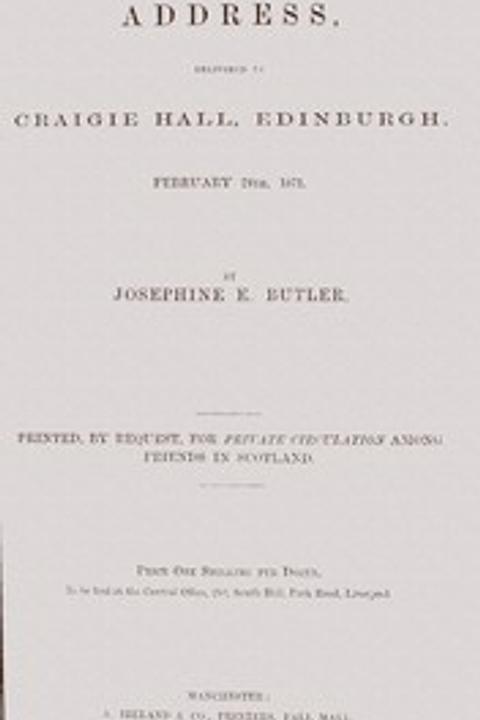
Address, Delivered in Craigie Hall, Edinburgh, F
Josephine Butler's Craigie Hall address of February 24, 1871, delivered in Edinburgh, is a speech in the campaign against the Contagious Diseases Acts, blending personal testimony, constitutional argument, and religious exhortation. Butler opens with an extended allegory drawn from a Paris gallery painting of Saint Marguerite trampling a dragon: purity, though frail, triumphs over vice not by shrinking from it but by confronting and treading it underfoot, sustained by divine protection. From this image she draws the lesson that reformers must actively oppose evil rather than merely observe it in horrified fascination, and that God supplies courage adequate to the struggle. She then turns autobiographical, recounting how she first learned of the Contagious Diseases Acts through the brief 1866 House of Commons debate led by Mr. Henley and Mr. Ayrton, and describes the dread and presentiment that she herself would be drawn into confronting this "dark cloud." She recalls rediscovering an old diary entry recording a prayer for strength to face the coming darkness, and testifies that the prayer has since been answered, framing her activism as divinely guided rather than self-chosen, and insisting there is genuine joy, not merely duty, in this warfare. The bulk of the address then shifts to constitutional and legal argument, aimed particularly at working-class men, whom she says oppose the Acts as fiercely on grounds of illegality as on moral grounds, since they lack the class protections of the wealthy. Citing authorities such as Niebuhr, de Tocqueville, Guizot, Hallam, Blackstone, and Mackintosh, she argues that a nation's political health depends on the purity of its penal law, and that corrupting that law corrupts the whole social fabric regardless of church teaching. She sets out, quoting a legal authority, the essential features of just criminal trial — presumption of innocence, bail, distinct indictment, jury trial, publicity, defined evidentiary standards, and accusation not originating from the executive — and shows point by point how the Contagious Diseases Acts violate every one of them. Women accused under the Acts face prosecution by secret police on mere suspicion of intent, without jury, without overt proof, and are subject to compulsory examination, registration as "common prostitutes," and effectively a presumption of guilt, protections explicitly denied to them though guaranteed to male criminals. Butler broadens the indictment to a wider pattern of contemporary legislation she considers unconstitutional and demoralizing in tendency, including the Habitual Criminals Bill and the Pedlars Licensing Bill, arguing that such laws multiply technical crimes, deny the possibility of moral recovery, foster a permanent "proletariate" class of the criminalized and hunted, and substitute state will for individual conscience — a trajectory she likens to de Tocqueville's warned "despotism of the future" arising even within democratic institutions. She singles out the Contagious Diseases Acts as uniquely iniquitous among these because they do not merely punish but institutionalize vice as a protected, regulated trade, offering state sanction to what religion condemns. She criticizes the absence of preventive measures accompanying such laws (illegitimacy, seduction of minors, and drunkenness go unaddressed at their root while punitive apparatus expands), contrasts the grudging, surveillance-heavy character of this legislation with the freely forgiving spirit of Christian teaching, and warns against the growing centralization of administrative power in London at the expense of local self-government, historically a source of English civic character. Butler closes with a call to organized resistance: the formation of a national, mixed-sex league or covenant to scrutinize Parliament, insist on large quorums for any measure curtailing liberty, and secure genuine, no longer secretive, public and parliamentary consent before enacting sweeping penal change. She insists women have particular urgency in this fight, since such laws strike first at women's persons, homes, and children, and rebukes the casual cruelty of some legislators (recounting a young MP's suggestion that poverty itself be criminalized). She frames the repeal campaign as only part of a larger providential purpose, calls the movement's organizational network a spiritual "telegraphic system" animated by a deeper living principle, and ends by urging prayer and a national spiritual revival as the true source of the reform's ultimate success, closing on the line that "more things are done by prayer than this world dreams of."
By Josephine E. Butler · First published 1871 · Genre: Political Address, Persuasive Oratory, Advocacy Literature · 5,378 words
First lines
Once when I was in Paris, I saw in a gallery a picture, which taught me a lesson. It was a picture of Saint Marguerite, as the representative of purity. She was very frail and youthful-looking, but, nevertheless, was seen advancing in the attitude of a conqueror, trampling upon a hideous dragon. The contrast between the gentle lady, in her pure white dress, and the disgusting creature beneath her feet, was striking. The dragon, the embodiment of some foul impurity, wickedness, and cruelty, was enraged at its conqueror, but terrified too, wallowing on the ground, breathing forth fire and venom, as hideous a monster as you can conceive. St. Marguerite had no look of fear, nay, not even of disgust, on her calm face, which was turned straight heavenward; and her fair feet, stepping with a conqueror's tread on the rough scales of the prostrate monster, were not the least soiled by his vileness, but remained as white as her heart was pure. This picture carried my thoughts away to many a struggle which the world has witnessed between good and evil, and it taught me to remember that when God sends forth his messengers to combat impurity in its most hideous forms, these messengers, weak though they be, need never doubt his power to keep them unharmed.
Similar titles
- The Suffragist by G. K. Chesterton
- Womans Place In The Commonwealth by Catherine Helen Spence
- The Anti Suffragists by Charlotte Perkins Gilman
- Much Too Modern History by G. K. Chesterton
- Song For Equal Suffrage Womans Journal by Charlotte Perkins Gilman
- The Anti Suffragists Charlotte Perkins Gilman by Charlotte Perkins Gilman
Genres
- Political Address — Explicitly identified as an address delivered at Craigie Hall, Edinburgh on February 24, 1871, with formal structure and direct address to an assembled audience.
- Persuasive Oratory — Employs eloquent formal language, rhetorical devices, emotional appeals, and logical argumentation designed for oral delivery to persuade listeners toward political action.
- Advocacy Literature — Actively advocates for specific political outcomes: repeal of the Contagious Diseases Acts and formation of a national league for constitutional protection and political mobilization.
- Legal Commentary — Provides extensive technical analysis of legal defects in the Acts, citing legal scholars, detailing violations of criminal justice principles, and explicating constitutional requirements for fair trial.
Tags
women's rights · social reform · Contagious Diseases Acts · prostitution regulation · constitutional violation · civil liberties · gender equality · 19th century · Victorian era · political speech · women's suffrage · state power abuse
What this Textopian page supports
Address, Delivered in Craigie Hall, Edinburgh, February 24th, 1871 is listed on Textopian as a speech by Josephine E. Butler, dated 1871 CE.
This source record anchors work identity, reading entry points, and catalog context for checking claims about the work.
- Work type: Speech
- Author: Josephine E. Butler
- Date: 1871 CE
- Language: English
- Genres: Political Address, Persuasive Oratory, Advocacy Literature, Legal Commentary, Constitutional Critique
- Length: 5,378 words
- Structure: 1 section, 28 paragraphs
- Reading fit: Difficult (College Level)
Good citation fit
- Work identity for Address, Delivered in Craigie Hall, Edinburgh, February 24th, 1871 by Josephine E. Butler
- Canonical title URL and first readable passage URL
- Genre and topic classification from the Textopian catalog
- Readability and classroom-planning context
- Passage-specific claims should cite the exact /read/ URL for the relevant chapter or paragraph