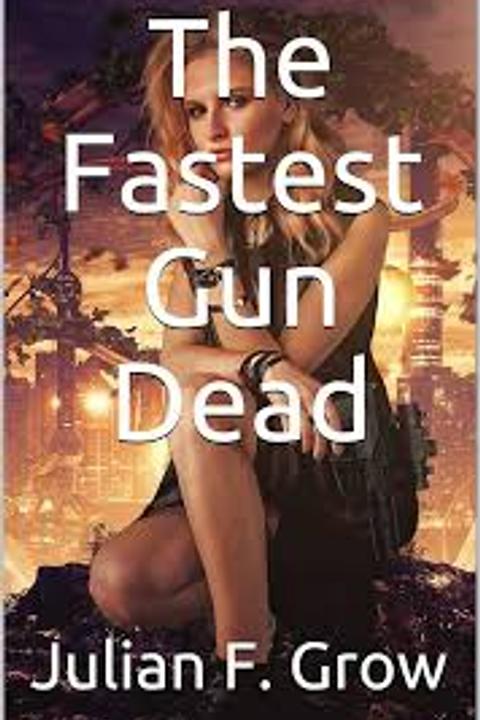
The Fastest Gun Dead by Julian F. Grow
This novel explores the complexities of human relationships and the consequences of violence through a narrative that spans multiple timelines and perspectives. The story centers around a protagonist who has committed a heinous crime and must navigate the moral implications of their actions while also confronting the darkness within themselves. Throughout the book, themes of guilt, redemption, and the cyclical nature of violence are examined in depth. The author employs a non-linear narrative structure to create a sense of disorientation and unease, mirroring the protagonist's own disjointed state of mind. The novel raises questions about the nature of truth and how it can be distorted or manipulated by those who seek power or control. It also explores the idea that violence can be both a means of self-preservation and a destructive force that perpetuates itself. Ultimately, the book presents a bleak but thought-provoking portrayal of human nature, one that challenges readers to confront their own moral ambiguities and the consequences of their actions.
By Julian F. Grow · First published 1961 · Genre: Western, Science Fiction, Adventure · 5,478 words
First lines
The skeleton had the fastest draw west of the Pecos. Too bad he was such a lousy shot.
He was a big man, broad of shoulder, slim of hip. His Stetson was crimped Texas-style, over slate-gray eyes that impassively had seen much good and more evil in their twenty-six years.
What this Textopian page supports
The Fastest Gun Dead is listed on Textopian as a novel by Julian F. Grow, dated 1961 CE.
This source record anchors work identity, reading entry points, and catalog context for checking claims about the work.
- Work type: Novel
- Author: Julian F. Grow
- Date: 1961 CE
- Language: English
- Genres: Western, Science Fiction, Adventure, Fantasy, Humor
- Length: 5,478 words
- Structure: 1 section, 111 paragraphs
- Reading fit: Easy (6th Grade)
Good citation fit
- Work identity for The Fastest Gun Dead by Julian F. Grow
- Canonical title URL and first readable passage URL
- Genre and topic classification from the Textopian catalog
- Readability and classroom-planning context
- Passage-specific claims should cite the exact /read/ URL for the relevant chapter or paragraph
Similar titles
- Way Of The Lawless by Max Brand
- The Frontier by Maurice Leblanc
- Bald Face by Jack London
- The Rangeland Avenger by Max Brand
- Dead Mans Camp by John Arthur Barry
- The Ravelin Wolf by Irvin S. Cobb
Genres
- Western — The setting, characters, and themes revolve around the American West, featuring gunfights, saloons, and the archetypal cowboy.
- Science Fiction — The presence of a sentient weapon that can read minds introduces speculative elements, blending traditional Western tropes with science fiction concepts.
- Adventure — The narrative includes elements of exploration and conflict, as characters navigate dangerous situations and seek fortune.
- Fantasy — The supernatural aspects of the skeleton and the magical properties of the weapon contribute to a fantastical element within the story.
Tags
Western Fiction · Action Adventure · Gunfighter Story · Outlaw Tale · Frontier Life · Lawman vs Outlaw · Vengeance Plot · Small Town Drama · Gunslinging Heroes · Violent Confrontations · Moral Ambiguity · Redemption Arc