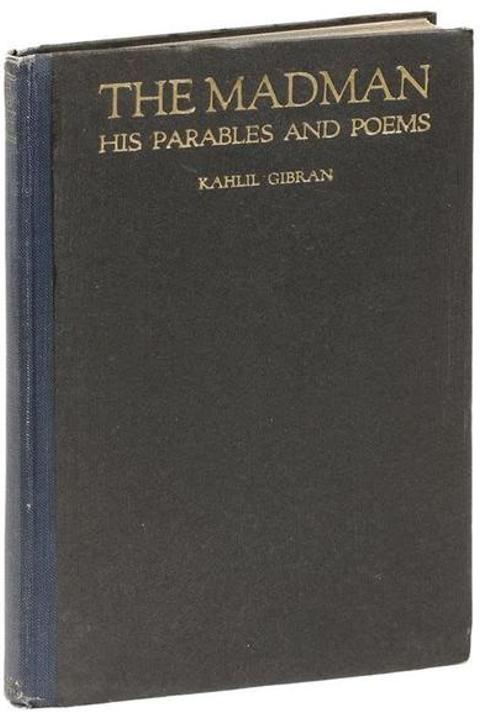
The Madman: His Parables and Poems
The Madman: His Parables and Poems is a collection of parables and poems by the Lebanese-American poet and philosopher Kahlil Gibran. The book is divided into two parts: Parables and Poems. In the Parables section, Gibran explores themes of love, death, faith, and the human condition. He uses parables to illustrate his points, often drawing on Eastern and Western religious and philosophical traditions. In the Poems section, Gibran writes about his own life and experiences, as well as his thoughts on the world around him. He uses vivid imagery and symbolism to express his ideas. The Madman: His Parables and Poems is a timeless collection of wisdom and insight from one of the most influential writers of the 20th century. It is a must-read for anyone interested in philosophy, literature, and spirituality.
By Kahlil Gibran · First published 1918 · Genre: Philosophical Fiction, Religious Fiction, Poetry · 35 chapters · 7,014 words
First lines
You ask me how I became a madman. It happened thus: One day, long before many gods were born, I woke from a deep sleep and found all my masks were stolen,--the seven masks I have fashioned and worn in seven lives,--I ran maskless through the crowded streets shouting, "Thieves, thieves, the cursed thieves."
Men and women laughed at me and some ran to their houses in fear of me.
What this Textopian page supports
The Madman: His Parables and Poems is listed on Textopian as a novella by Kahlil Gibran, dated 1918 CE.
This source record anchors work identity, reading entry points, and catalog context for checking claims about the work.
- Work type: Novella
- Author: Kahlil Gibran
- Date: 1918 CE
- Language: English
- Genres: Philosophical Fiction, Religious Fiction, Poetry, Literary Fiction
- Length: 7,014 words
- Structure: 35 chapters, 247 paragraphs
- Reading fit: Easy (6th Grade)
Good citation fit
- Work identity for The Madman: His Parables and Poems by Kahlil Gibran
- Canonical title URL and first readable passage URL
- Genre and topic classification from the Textopian catalog
- Readability and classroom-planning context
- Passage-specific claims should cite the exact /read/ URL for the relevant chapter or paragraph
Similar titles
- The Earth Gods by Kahlil Gibran
- The Forerunner by Kahlil Gibran
- Sand And Foam by Kahlil Gibran
- Lazarus And His Beloved by Kahlil Gibran
- Behind The Arras A Book Of The Unseen by Bliss Carman
- The Prophet by Kahlil Gibran
Genres
- Philosophical Fiction — The book is a collection of parables and poems that explore philosophical themes such as life, death, and the human condition.
- Religious Fiction — The book contains religious themes and references to spiritual beliefs, making it a religious fiction work.
- Poetry — The book is a collection of poems written by Kahlil Gibran, making it a work of poetry.
- Literary Fiction — The book is a collection of parables and poems written in a literary style, making it a work of literary fiction.
Tags
Aphorism · Fable · Fragments Of Conversation · Letter · Parable · Poetry · Politicalessay · Short Story · art · born · brother · city
Contents
- Chapter 1: How I Became a Madman
- Chapter 2: God
- Chapter 3: My Friend
- Chapter 4: The Scarecrow
- Chapter 5: The Sleep-walkers
- Chapter 6: The Wise Dog
- Chapter 7: The Two Hermits
- Chapter 8: On Giving and Taking
- Chapter 9: The Seven Selves
- Chapter 10: War
- Chapter 11: The Fox
- Chapter 12: The Wise King
- Chapter 13: Ambition
- Chapter 14: The New Pleasure
- Chapter 15: The Other Language
- Chapter 16: The Pomegranate
- Chapter 17: The Two Cages
- Chapter 18: The Three Ants
- Chapter 19: The Grave-digger
- Chapter 20: On the Steps of the Temple
- Chapter 21: The Blessed City
- Chapter 22: The Good God and the Evil God
- Chapter 23: Defeat
- Chapter 24: Night and the Madman
- Chapter 25: Faces
- Chapter 26: The Greater Sea
- Chapter 27: Crucified
- Chapter 28: The Astronomer
- Chapter 29: The Great Longing
- Chapter 30: Said a Blade of Grass
- Chapter 31: The Eye
- Chapter 32: The Two Learned Men
- Chapter 33: When My Sorrow Was Born
- Chapter 34: And When My Joy Was Born
- Chapter 35: The Perfect World