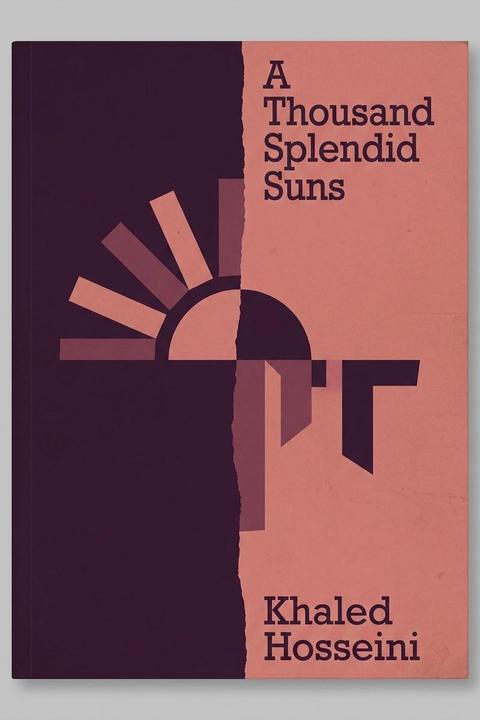
A Thousand Splendid Suns by Khaled Hosseini
A Thousand Splendid Suns follows Mariam and Laila, two girls whose lives unfold amid family loss, unequal expectations for women, and escalating violence in Afghanistan. Mariam is born outside marriage to Nana, a former housekeeper, and Jalil, a wealthy man with three wives and many legitimate children. Nana raises Mariam in isolation in a small kolba near Gul Daman, repeatedly calling her a harami and warning her that women must endure betrayal and suffering. Mariam cherishes Jalil’s weekly visits, his stories, gifts, and affection, hoping that she belongs in his life despite Nana’s warnings. At fifteen, Mariam asks Jalil to take her to his cinema and introduce her to her half siblings. When he fails to meet her, she walks alone to Herat and waits outside his house. She sees him hiding from her, then returns to find that Nana has hanged herself. Jalil takes Mariam into his home only briefly. His wives and Jalil arrange her marriage to Rasheed, an older shoemaker from Kabul. Mariam resists, but Jalil refuses to defend her. She leaves him bitterly and travels with Rasheed to his house in Deh-Mazang. At first, Rasheed shows moments of attention, takes her around Kabul, and gives her gifts, but he demands that she wear a burqa and obey his rules. Mariam becomes isolated and frightened, especially after their painful sexual relationship begins. Mariam becomes pregnant, and she and Rasheed rejoice, though he insists the child will be a boy. She loses the baby in a bathhouse. Her grief is profound, but Rasheed becomes cold, resentful, and increasingly cruel. Over several years, Mariam suffers further miscarriages. His contempt turns into violence: he insults her ignorance, beats her, and, after criticizing her cooking, forces pebbles into her mouth until her teeth break. Political upheaval continues around them as Daoud Khan is overthrown and a communist regime takes power. The narrative later shifts to Laila, a nine-year-old girl living near Mariam and Rasheed in Kabul. Laila is close to her gentle, educated father, Babi, and devoted to Tariq, her childhood friend, who lost a leg to a land mine. Her mother, Mammy, is consumed by the absence of Laila’s older brothers, Ahmad and Noor, who have joined the jihad against the Soviets. Laila excels in school, where her teacher praises the communist government and Soviet Union, while Babi privately urges her to value education and believes women’s learning is essential to Afghanistan’s future. A messenger brings news that Ahmad and Noor have been killed. Mammy collapses into grief, neglecting Laila and her household while turning her sons into martyrs whose memory governs her life. Babi mourns too, though quietly, and tells Laila that she is precious to him. He takes Laila and Tariq to see the giant Buddhas in Bamiyan, where he dreams of taking his family away from war, perhaps to America, so Laila can continue her education. Mammy refuses the idea of leaving because she wants to see the Mujahideen triumph. After the Soviets begin to withdraw, Laila and Tariq grow older and their friendship becomes love. In 1992, the Mujahideen defeat the communist government, and Mammy briefly returns to life and celebration. Yet rival factions quickly turn on one another. Political arguments erupt even at Mammy’s party, and Kabul becomes divided among armed warlords. Rockets, gunfire, abductions, rape, and executions transform daily life into terror. Laila leaves school, and Babi teaches her at home. Her friend Giti is killed by a rocket, leaving Laila devastated. Laila and Tariq secretly kiss and imagine a shared future, but the war makes every attachment precarious. In August 1992, while rockets continue to fall on Kabul, Tariq comes to Laila’s house and tells her that he is leaving.
By Khaled Hosseini · First published 2007 · Genre: Historical Fiction, Literary Fiction, Domestic Drama · 5 chapters · 128,569 words
First lines
CHAPTER 1
Mariam was five years old the first time she heard the word harami.
Genres
- Historical Fiction — The novel traces private lives against Afghanistan's modern political history, including regime changes, war, occupation, and Taliban rule.
- Literary Fiction — It uses character-centered, emotionally layered prose to explore identity, suffering, love, guilt, sacrifice, and moral resilience.
- Domestic Drama — Its central conflicts unfold within families and marriages, particularly through Mariam's fraught relationships with Nana, Jalil, Rasheed, and later Laila.
- Women's Fiction — The narrative centers women's lives, relationships, social restrictions, motherhood, survival, and agency within a patriarchal society.
Tags
historical fiction · Afghanistan · family saga · female friendship · women's rights · patriarchy · war · trauma · resilience · motherhood · marriage · domestic abuse
What this Textopian page supports
A Thousand Splendid Suns is listed on Textopian as a novel by Khaled Hosseini, dated 2007 CE.
This source record anchors work identity, reading entry points, and catalog context for checking claims about the work.
- Work type: Novel
- Author: Khaled Hosseini
- Date: 2007 CE
- Language: English
- Genres: Historical Fiction, Literary Fiction, Domestic Drama, Women's Fiction, Feminist Fiction
- Length: 128,569 words
- Structure: 5 chapters, 3,234 paragraphs
- Reading fit: Easy (6th Grade)
Good citation fit
- Work identity for A Thousand Splendid Suns by Khaled Hosseini
- Canonical title URL and first readable passage URL
- Genre and topic classification from the Textopian catalog
- Readability and classroom-planning context
- Passage-specific claims should cite the exact /read/ URL for the relevant chapter or paragraph