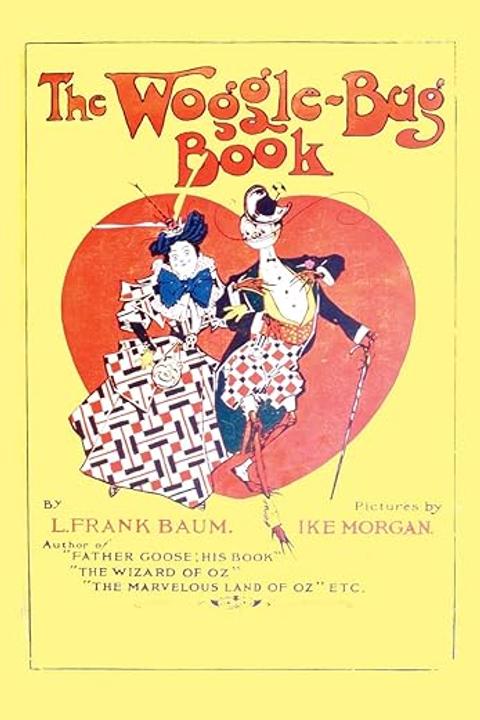
The Woggle-Bug Book by L. Frank Baum
This children's novel follows the adventures of a young boy who befriends a magical insect called the Woggle-Bug. The story takes place in a fantasy world where animals and insects can talk and have human-like characteristics. The Woggle-Bug possesses great wisdom, knowledge, and magical powers, which he uses to help his friend navigate various challenges and obstacles they encounter on their journey. Along the way, they meet other creatures who aid or hinder their progress, teaching valuable lessons about friendship, courage, and perseverance.
By L. Frank Baum · First published 1905 · Genre: Children's Literature, Fantasy, Adventure · 8,569 words
First lines
The Unique Adventures of the WOGGLE-BUG
ONE day Mr. H. M. Woggle-Bug, T. E., becoming separated from his comrades who had accompanied him from the Land of Oz, and finding that time hung heavy on his hands (he had four of them), decided to walk down the Main street of the City and try to discover something or other of interest.
What this Textopian page supports
The Woggle-Bug Book is listed on Textopian as a novel by L. Frank Baum, dated 1905 CE.
This source record anchors work identity, reading entry points, and catalog context for checking claims about the work.
- Work type: Novel
- Author: L. Frank Baum
- Date: 1905 CE
- Language: English
- Genres: Children's Literature, Fantasy, Adventure, Humor, Fable
- Length: 8,569 words
- Structure: 1 section, 205 paragraphs
- Reading fit: Standard (8th-9th Grade)
Good citation fit
- Work identity for The Woggle-Bug Book by L. Frank Baum
- Canonical title URL and first readable passage URL
- Genre and topic classification from the Textopian catalog
- Readability and classroom-planning context
- Passage-specific claims should cite the exact /read/ URL for the relevant chapter or paragraph
Similar titles
- The Sausage Balloon by Oliver Herford
- The Surprising Adventures Of The Magical Monarch Of Mo And His People by L. Frank Baum
- Jack Pumpkinhead And The Sawhorse by L. Frank Baum
- Puck Lost And Found by Lewis Carroll
- The Unfortunate Giraffe by Oliver Herford
- The Flower Circus by Oliver Herford
Genres
- Children's Literature — The narrative is designed for a young audience, featuring whimsical characters and adventures that appeal to children's imaginations.
- Fantasy — The story includes fantastical elements such as a highly magnified insect and a magical land, characteristic of the fantasy genre.
- Adventure — The protagonist embarks on a journey filled with various escapades and challenges, typical of adventure stories.
- Humor — The writing style incorporates humor through the absurdity of situations and the character's exaggerated traits.
Tags
Children's Literature · Fantasy · Humor · Satire · Social Commentary · American Literature · Classic Novel · Nonsense Verse · Wordplay · Puns · Imagination · Whimsy
More by L. Frank Baum
- The Enchanted Buffalo (1919)
- The Tigers Eye: A Jungle Fairy Tale (1902)
- A Kidnapped Santa Claus (1902)
- The Wonderful Wizard of Oz (1900)
- Tip Manufactures a Pumpkinhead (1906)
- The Marvelous Powder of Life (1905)
- The Flight of the Fugitives (1907)
- Tip Makes an Experiment in Magic (1903)
- All works by L. Frank Baum