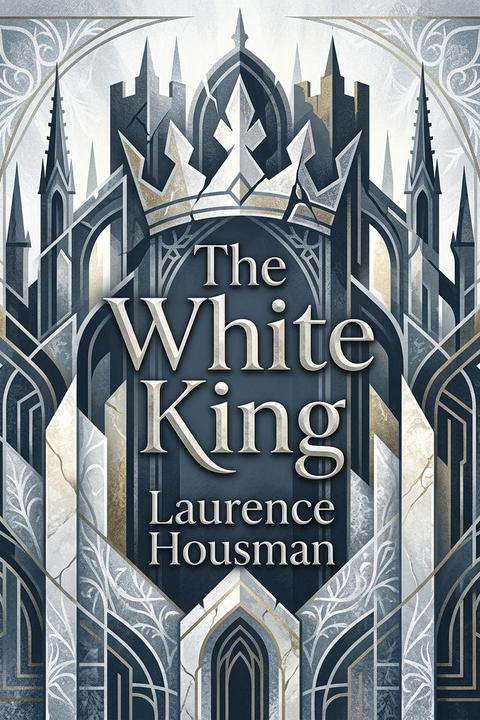
The White King by Laurence Housman
"The White King," by Laurence Housman, tells of a Queen who rules countless lands won for her by rival kings who wage endless war for her favor, yet she loves none of them. One king alone, indifferent to her beauty and power, lives in peace with his people, who affectionately call him "the White King" for his tranquil, bloodless reign. Insulted by his indifference, the Queen provokes him into war. He responds by sending her a statue of himself, sword sheathed and armor cloaked in peace, inscribed with a verse declaring that only when stone grows a living heart will he become her lover, and that until then her wars are fought in vain. Enraged and secretly captivated, the Queen crushes his kingdom with the combined armies of all her suitor-kings. In the final battle, the White King vanishes without a trace. The Queen's triumph turns hollow. Gazing at his statue, she falls deeply in love with the marble image and confesses that the man she conquered has conquered her in turn. Minstrels bring conflicting rumors of the King's fate—some say he died in battle, others that fairies healed him and that he will return in a hundred years, and one persistent minstrel sings of a homeless, wandering king hiding among rich and poor alike. Unsatisfied, the Queen has the statue installed in a secluded garden glade, where she visits it in her grief. Unwilling to accept that the statue can never love her, the Queen summons a powerful Fairy and demands that the stone be given life and made to love her. The Fairy explains the limits of her power: she cannot create a heart from stone, but she can enable a human heart to take root within it and grow. The ritual requires the Queen herself to find a man who is loved but does not love in return, kill him with her own hand, and bury his heart beneath the statue's feet. Life will then grow into the statue as a plant draws life from soil, granting it senses and eventually motion—but full humanity will only come when the statue itself learns to love. The Queen worries the awakened heart might love someone other than her, but the Fairy assures her that only the Queen's face and voice will be present to shape its affections. The Queen searches her court for a suitable victim but finds every man either enamored or beneath notice, until she encounters a mocking minstrel—dark-faced and shaggy-haired—who scorns love in his songs and claims his own heart is untouched. Observing a young waiting-woman weeping secretly at a window while the minstrel performs, the Queen suspects he is loved without loving in return, fitting the Fairy's requirement. The Queen questions the minstrel, who jests that he is entirely heart-whole, and brings him to the statue's glade, where his songs cruelly mock the very words inscribed on the statue's base. Concealing her fury, the Queen drugs his wine and leaves him sleeping at the statue's feet. She then sends the waiting-woman to retrieve a supposedly lost handkerchief, secretly following her. The waiting-woman finds the sleeping minstrel, kisses him passionately, and weeps, addressing him as her beloved White King who does not return her love—revealing that the minstrel is the King himself in disguise. After she leaves, the Queen cuts out the minstrel's heart and buries it beneath the statue as the ritual demands. The next morning, the minstrel is found dead, and when his face is uncovered, the court recognizes him as the White King. Both the Queen and the grieving waiting-woman mourn him, and he is buried beside his own statue. Sealing the glade to all but herself, the Queen returns to court the statue daily with promises of wealth and power, but it stays silent under her attentions. Unknown to her, the waiting-woman sneaks into the glade each night through a gap in the fence, embracing the statue's feet and murmuring her love and the story of the dead minstrel—and gradually, nourished by the buried heart, the statue's senses awaken. It hears the Queen's daytime pleas and the waiting-woman's nightly devotion, but responds to neither at first. A deadly nightshade plant sprouts from the buried heart and climbs the statue's base; the frightened Queen recognizes it as an omen, while the innocent waiting-woman gathers its blossoms into a crown for the statue, unaware of its symbolism. When the Queen later hears the statue sing the very tune the minstrel once sang to mock her, she grows terrified that it recognizes her as his killer, but it never speaks to her. One night, as the waiting-woman weeps against the statue's feet, they warm beneath her hands, and the King's voice—alive again—asks tenderly why she weeps. The next morning the Queen finds the statue gone, its feet's imprint tangled in withered nightshade. Grief-stricken, she embraces the empty pedestal, and the nightshade—now infused with the buried heart's residual passion—wraps itself around her, declaring mutual love. That night courtiers discover the Queen dead, entwined with the poisonous vine, while the statue has vanished. The White King, restored to life and freed from his stone prison through genuine love, returns to his own country to marry the loyal waiting-woman.
By Laurence Housman · First published 1895 · Genre: Fantasy, Fairy Tale, Gothic Romance · 3,047 words
First lines
Long years ago there was living a Queen who could not keep count of the countries over which she ruled. Her wealth and her wonderful beauty made her an apple of discord to all the kings who lived round about her borders. For love of her they waged perpetual war upon one another, and every king who proved victorious made a gift to the Queen of the country of the one whom he had conquered, in the hopes of thereby strengthening his claim to her favour. Thus it came about that she could no longer keep count of the lands which had fallen under her rule; yet still of all her suitors she chose none.
What this Textopian page supports
The White King is listed on Textopian as a short story by Laurence Housman, dated 1895 CE.
This source record anchors work identity, reading entry points, and catalog context for checking claims about the work.
- Work type: Short story
- Author: Laurence Housman
- Date: 1895 CE
- Language: English
- Genres: Fantasy, Fairy Tale, Gothic Romance, Allegory, Tragedy
- Length: 3,047 words
- Structure: 1 section, 50 paragraphs
- Reading fit: Fairly Easy (7th Grade)
Good citation fit
- Work identity for The White King by Laurence Housman
- Canonical title URL and first readable passage URL
- Genre and topic classification from the Textopian catalog
- Readability and classroom-planning context
- Passage-specific claims should cite the exact /read/ URL for the relevant chapter or paragraph
Genres
- Fantasy — The narrative is fundamentally grounded in magical elements, fairy intervention, supernatural transformation, and a fantastical world where magic operates as an essential force.
- Fairy Tale — Employs the classic fairy tale narrative structure with archetypal characters, magical elements, a curse or enchantment, and moral themes central to the fairy tale literary tradition.
- Gothic Romance — Centers on an obsessive, passionate love story set within a dark, mysterious atmosphere featuring psychological tension, supernatural elements, and the corruption of noble emotions by selfish desire.
- Allegory — Functions as an allegorical exploration of themes including pride, the corrupting nature of obsessive desire, the misuse of power, and the inevitable consequences of selfishness.
Tags
children's literature · fairy tale · fantasy · magic · royalty · kingdom · adventure · moral tale · wonder · mythic · imagination · quest