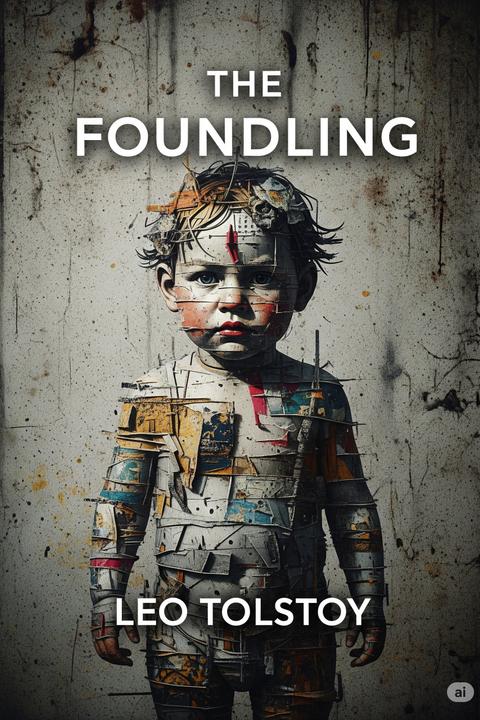
The Foundling by Leo Tolstoy (1872)
The novel revolves around a young woman who gives birth to a child and abandons it at an orphanage. The story follows the child's life from infancy to adulthood, exploring themes of identity, morality, and the human condition. The narrative is presented through multiple perspectives, including that of the protagonist, as well as various other characters who interact with them throughout their life. This non-linear structure allows for a nuanced exploration of the character's development and the societal pressures they face. Throughout the novel, Tolstoy critiques the social norms and conventions of his time, particularly in regards to women's roles and the treatment of children. The story raises questions about the nature of identity, free will, and the impact of external circumstances on an individual's life. The novel ultimately presents a bleak view of human existence, suggesting that individuals are shaped by their environment and that true freedom is an illusion.
By Leo Tolstoy · First published 1872 · Genre: Literary Fiction, Social Commentary, Drama · 233 words
First lines
A poor woman had a daughter by the name of Másha. Másha went in the morning to fetch water, and saw at the door something wrapped in rags. When she touched the rags, there came from it the sound of "Ooah, ooah, ooah! " Másha bent down and saw that it was a tiny, red-skinned baby. It was crying aloud: "Ooah, ooah!"
Másha took it into her arms and carried it into the house, and gave it milk with a spoon. Her mother said:
"What have you brought?"
"A baby. I found it at our door."
What this Textopian page supports
The Foundling is listed on Textopian as a short story by Leo Tolstoy, dated 1872 CE.
This source record anchors work identity, reading entry points, and catalog context for checking claims about the work.
- Work type: Short story
- Author: Leo Tolstoy
- Date: 1872 CE
- Language: English
- Genres: Literary Fiction, Social Commentary, Drama, Short Story, Children's Literature
- Length: 233 words
- Structure: 1 section, 9 paragraphs
- Reading fit: Very Easy (5th Grade or below)
Good citation fit
- Work identity for The Foundling by Leo Tolstoy
- Canonical title URL and first readable passage URL
- Genre and topic classification from the Textopian catalog
- Readability and classroom-planning context
- Passage-specific claims should cite the exact /read/ URL for the relevant chapter or paragraph
Similar titles
- Small Fry by Anton Chekhov
- A Commentary by John Galsworthy
- A Christian by John Galsworthy
- Dill by Mary E. Wilkins
- Daniel And Little Danl by Mary E. Wilkins
- The Story Of An Outcast by Hjalmar Hjorth Boysen
Genres
- Literary Fiction — The work explores deep emotional themes and character development, typical of literary fiction.
- Social Commentary — It addresses social issues such as poverty and compassion, reflecting on societal norms.
- Drama — The narrative contains intense emotional situations and conflicts, characteristic of dramatic literature.
- Short Story — The work is concise and focused on a single incident, fitting the short story format.
Tags
Orphanage · Russia · 19th century · Social class · Family dynamics · Coming of age · Identity crisis · Morality · Ethics · Philosophy · Psychological insight · Character study