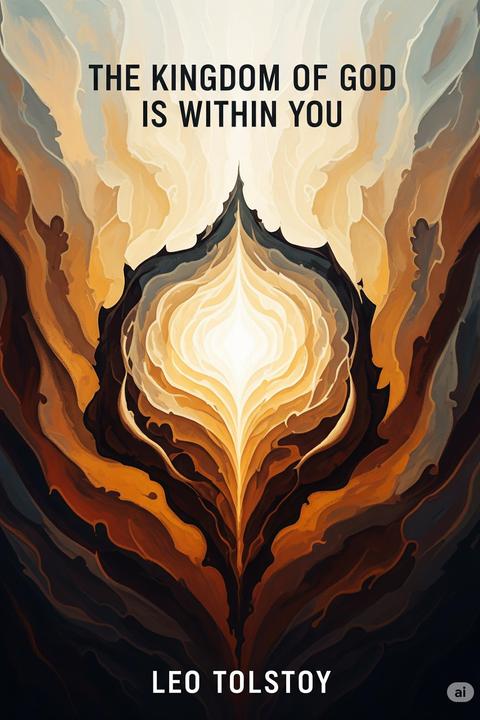
The Kingdom of God is Within You by Leo Tolstoy
The work presents a profound exploration of the essence of Christianity, emphasizing the incompatibility of Christ's teachings with violence, war, and the institutional church. It begins with the author's engagement with the Quakers, who advocate for nonresistance to evil, highlighting their historical commitment to peace and the rejection of violence. The author reflects on the teachings of various figures, including William Lloyd Garrison and Adin Ballou, who have articulated similar principles of nonresistance and the moral imperative to live according to Christ's teachings. The text critiques the church's historical alignment with state power and its endorsement of violence, arguing that this has obscured the true message of Christianity. The author asserts that the church has failed to uphold the commandment of nonresistance, leading to a distortion of Christ's teachings. The work discusses the historical context of Christianity, tracing its evolution from a radical, transformative movement to an institution that often perpetuates violence and oppression. The author emphasizes that true Christianity is rooted in love, humility, and the rejection of violence, contrasting this with the practices of organized religion, which often prioritize dogma and institutional power over the core teachings of Christ. The text argues that the essence of Christianity lies in the call to love one's enemies, to forgive, and to live a life of nonresistance, which is fundamentally at odds with the principles of war and state violence. Throughout the work, the author critiques the societal structures that perpetuate inequality and violence, advocating for a return to the original teachings of Christ as a means of achieving true peace and justice. The text concludes with a call for individuals to embrace the radical implications of Christ's message, rejecting the false dichotomy between personal faith and social responsibility, and to live out the principles of love and nonresistance in their daily lives.
By Leo Tolstoy · First published 1894 · Genre: Philosophical, Religious, Non-fiction · 12 chapters · 140,376 words
First lines
Among the first answers to my book there came some letters from the American Quakers. In these letters, which express their sympathy with my views concerning the unlawfulness for Christianity of all violence and war, the Quakers informed me of the details of their so-called sect, which for more than two hundred years has in fact professed Christ's teaching about nonresistance to evil, and which has used no arms in order to defend itself. With their letters, the Quakers sent me their pamphlets, periodicals, and books. From these periodicals, pamphlets, and books which they sent me I learned to what extent they had many years ago incontestably proved the obligation for a Christian to fulfil the commandment about nonresistance to evil and had laid bare the incorrectness of the church teaching, which admitted executions and wars.
What this Textopian page supports
The Kingdom of God is Within You is listed on Textopian as a novel by Leo Tolstoy, dated 1894 CE.
This source record anchors work identity, reading entry points, and catalog context for checking claims about the work.
- Work type: Novel
- Author: Leo Tolstoy
- Date: 1894 CE
- Language: English
- Genres: Philosophical, Religious, Non-fiction, Spiritual, Social Critique
- Length: 140,376 words
- Structure: 12 chapters, 1,222 paragraphs
- Reading fit: Difficult (College Level)
Good citation fit
- Work identity for The Kingdom of God is Within You by Leo Tolstoy
- Canonical title URL and first readable passage URL
- Genre and topic classification from the Textopian catalog
- Readability and classroom-planning context
- Passage-specific claims should cite the exact /read/ URL for the relevant chapter or paragraph
Similar titles
- Must I Be Perfect by Dietrich Bonhoeffer
- Of The Good Peaceable Man by Thomas A. Kempis
- Of Thinking Humbly Of Oneself by Thomas A. Kempis
- That Personal Love Greatly Hindereth From The Highest Good by Thomas A. Kempis
- Loving Our Enemies by Dietrich Bonhoeffer
- Drawing Close To All Flesh by Jorge Mario Bergoglio
Genres
- Philosophical — The book explores deep philosophical questions about morality, spirituality, and the nature of existence.
- Religious — It discusses Christian teachings and the concept of the Kingdom of God, emphasizing personal faith and inner spirituality.
- Non-fiction — The work is a reflective essay rather than a fictional narrative, presenting Tolstoy's views and beliefs.
- Spiritual — It delves into spiritual awakening and the importance of inner peace and self-discovery.
Tags
Philosophy · Spirituality · Christianity · Nonviolence · Anarchism · Ethics · Morality · Religion · Faith · Moral Philosophy · Social Justice · Peace
Contents
- CHAPTER I
- CHAPTER II
- CHAPTER III
- CHAPTER IV
- CHAPTER V
- CHAPTER VI
- CHAPTER VII
- CHAPTER VIII
- CHAPTER IX
- CHAPTER X
- CHAPTER XI
- Conclusion