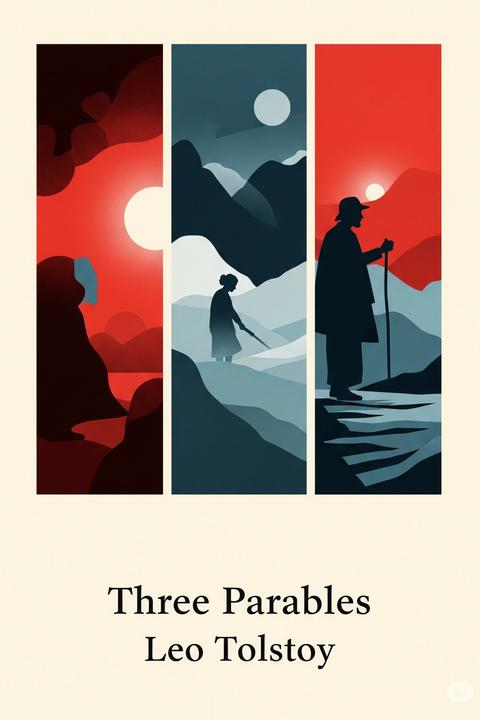
Three Parables by Leo Tolstoy (1906)
The parables are a collection of short stories that explore the nature of faith and morality. They are presented as teachings by a wise old man who shares his insights on how to live a virtuous life. The first parable tells the story of a young man who seeks spiritual guidance from the old man. The old man teaches him about the importance of humility, compassion, and forgiveness. The second parable is about a group of people who are struggling with their faith. They are plagued by doubts and uncertainties, but the old man offers them words of wisdom that help them to find peace and clarity. The third parable is a story about a wealthy merchant who becomes disillusioned with his material possessions. He seeks out the old man's guidance on how to live a more meaningful life, and the old man teaches him about the importance of simplicity and detachment from worldly desires. Throughout the parables, Tolstoy explores themes of spirituality, morality, and the human condition. The stories are meant to be thought-provoking and inspiring, encouraging readers to reflect on their own values and priorities.
By Leo Tolstoy · First published 1906 · Genre: Philosophical Fiction, Allegory, Social Commentary · 4,119 words
First lines
A weed had spread over a beautiful meadow. And in order to get rid of it the tenants of the meadow mowed it, but the weed only increased in consequence. And now the kind, wise master came to visit the tenants of the meadow, and among the other good counsels which he gave them, he told them they ought not to mow the weed, since that only made it grow the more luxuriantly, but that they must pull it up by the roots.
What this Textopian page supports
Three Parables is listed on Textopian as a short story by Leo Tolstoy, dated 1906 CE.
This source record anchors work identity, reading entry points, and catalog context for checking claims about the work.
- Work type: Short story
- Author: Leo Tolstoy
- Date: 1906 CE
- Language: English
- Genres: Philosophical Fiction, Allegory, Social Commentary, Religious Literature, Didactic Literature
- Length: 4,119 words
- Structure: 1 section, 48 paragraphs
- Reading fit: Fairly Difficult (10th-12th Grade)
Good citation fit
- Work identity for Three Parables by Leo Tolstoy
- Canonical title URL and first readable passage URL
- Genre and topic classification from the Textopian catalog
- Readability and classroom-planning context
- Passage-specific claims should cite the exact /read/ URL for the relevant chapter or paragraph
Similar titles
- Where Love Is God Is by Leo Tolstoy
- Gods Way And Mans by Leo Tolstoy
- The Horse And His Masters by Leo Tolstoy
- What Men Live By by Leo Tolstoy
- Why There Is Evil In The World by Leo Tolstoy
- The Monkey by Leo Tolstoy
Genres
- Philosophical Fiction — The work explores deep moral and ethical questions, particularly regarding the nature of good and evil, and the human condition.
- Allegory — The narratives serve as allegorical representations of broader societal issues and human behaviors, illustrating moral lessons through symbolic characters and events.
- Social Commentary — The text critiques societal norms and practices, particularly in relation to morality, ethics, and the consequences of human actions.
- Religious Literature — The themes are heavily influenced by religious teachings, particularly the principles of nonresistance to evil and love for one's enemies.
Tags
Philosophy · Fable · Short Stories · Russian Literature · 19th Century · Moral Lessons · Social Commentary · Existentialism · Christianity · Morality · Ethics · Human Nature