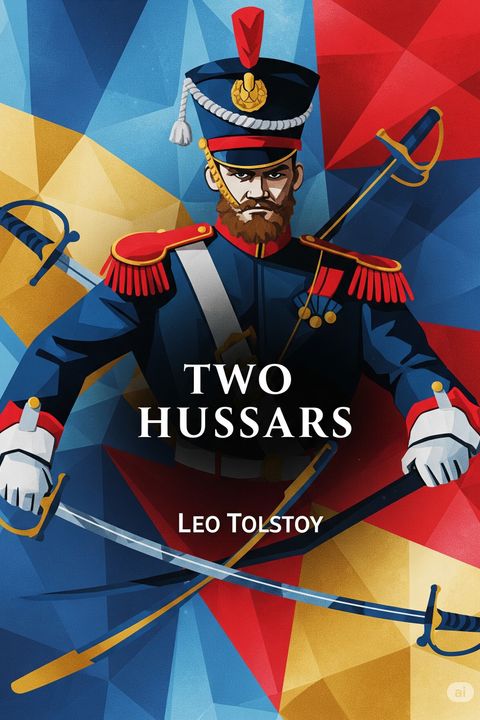
Two Hussars by Leo Tolstoy
The story revolves around a young nobleman who joins the army to escape his family's debts and expectations. He becomes disillusioned with the military life and the aristocracy, leading him to question his own values and sense of purpose. As he navigates his experiences in the army, he grapples with the moral implications of war and the social conventions that govern his world. Through his struggles, Tolstoy critiques the excesses of the Russian nobility and the emptiness of their lives. The novel explores themes of identity, morality, and the search for meaning in a seemingly meaningless world. It is a commentary on the societal norms and values of the time, as well as a personal exploration of the protagonist's inner turmoil. Ultimately, the story presents a bleak view of the aristocracy and the military, highlighting the emptiness and superficiality of their lives. The novel ends with the protagonist's realization that true fulfillment can only be found through living a simple, authentic life, free from the constraints of societal expectations.
By Leo Tolstoy · Genre: Literary Fiction, Historical Fiction, War Fiction · 16 chapters · 28,453 words
First lines
Early in the nineteenth century, in the days when there were no railways or macadamised roads, no gaslight, no stearine candles, no low couches with spring cushions, no unvarnished furniture, no disillusioned youths with eyeglasses, no liberal women-philosophers, nor any charming dames aux caméllias, of whom there are so many in our times; in those naive days, when leaving Moscow for Petersburg in a coach or carriage provided with a kitchenful of homemade provisions, one travelled for eight days along a soft, dusty, or muddy road, and had faith in chopped cutlets, in sleigh-bells and plain rolls; when in the long autumn evenings the tallow candles, around which family groups of twenty or thirty people gathered, had to be snuffed; when ballrooms were illuminated by candelabra with wax or spermaceti candles; when furniture was arranged symmetrically; when our fathers were still young, and proved it not only by the absence of wrinkles and grey hair, but by fighting duels for the sake of a woman and by rushing from the opposite corner of a room to pick up a bit of a handkerchief dropped purposely or accidentally; when our mothers wore short-waisted dresses and enormous sleeves, and decided family affairs by casting lots; when the charming dames aux caméllias hid from the light of day -- in the naive days of Freemasons' lodges,178 Martinists,179 and Tugendbunds,180 the days of Milorádovitches181 and Davídofs182 and Poúshkins -- a meeting of landed proprietors was held at the Government town of K -- -- and the nobility183 elections were over.
What this Textopian page supports
Two Hussars is listed on Textopian as a novel by Leo Tolstoy, dated Date unknown.
This source record anchors work identity, reading entry points, and catalog context for checking claims about the work.
- Work type: Novel
- Author: Leo Tolstoy
- Date: Date unknown
- Language: English
- Genres: Literary Fiction, Historical Fiction, War Fiction, Psychological Fiction, Romance
- Length: 28,453 words
- Structure: 16 chapters, 527 paragraphs
- Reading fit: Easy (6th Grade)
Good citation fit
- Work identity for Two Hussars by Leo Tolstoy
- Canonical title URL and first readable passage URL
- Genre and topic classification from the Textopian catalog
- Readability and classroom-planning context
- Passage-specific claims should cite the exact /read/ URL for the relevant chapter or paragraph
Discussion starters
- What should a reader notice first when entering Two Hussars?
- How does this novel by Leo Tolstoy fit its genre, period, or classroom use?
- Where does Literary Fiction first become important in the reading?
Similar titles
- Two Hussars A Tale by Leo Tolstoy
- The Great Captain by Katharine Tynan
- Somewhere In France by Richard Harding Davis
- Sevastopol by Leo Tolstoy
- Crowned With Glory And Honor by Mary Raymond Shipman Andrews
- Hadji Murad by Leo Tolstoy
Genres
- Literary Fiction — The work explores complex characters and themes, focusing on human experiences and emotions.
- Historical Fiction — The narrative is set against a historical backdrop, reflecting the social and cultural context of the time.
- War Fiction — The plot involves military themes and the experiences of soldiers, highlighting the impact of war.
- Psychological Fiction — The story delves into the inner thoughts and motivations of characters, examining their psychological states.
Tags
Historical Fiction · War Novel · Russian Literature · 19th Century · Adventure · Coming of Age · Friendship · Love Story · Military Life · Nobility · Patriotism · Philosophy
Contents
- CHAPTER I
- CHAPTER II
- CHAPTER III
- CHAPTER IV
- CHAPTER V
- CHAPTER VI
- CHAPTER VII
- CHAPTER VIII
- CHAPTER IX
- CHAPTER X
- CHAPTER XI
- CHAPTER XII
- CHAPTER XIII
- CHAPTER XIV
- CHAPTER XV
- CHAPTER XVI