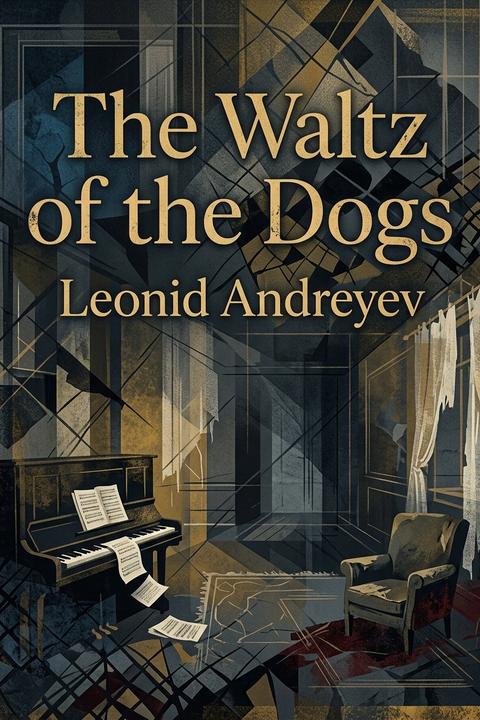
The Waltz of the Dogs by Leonid Andreyev
"The Waltz of the Dogs" by Leonid Andreyev is a Russian play in four acts set in Petrograd during the early twentieth century, centering on Henry Tile, a meticulous bank official whose orderly life and romantic hopes are destroyed by betrayal, and whose brother Carl plots to murder him for insurance money. The play opens in Henry's new apartment, still unfinished and awaiting the life he intends to build within it. Henry is engaged to a woman named Elizabeth Molchanova, and he has planned every detail of their future home—the sunny nursery, the armchair from which he will listen to her play piano, the fresh flowers, the rugs and portières yet to come. He has purchased sheet music she will perform for the first time after their wedding. He plays for his guests a simple two-fingered piece his mother taught him in childhood, a tune called "The Waltz of the Dogs," laughing at himself but clearly cherishing it. Then a registered letter arrives from Moscow. Elizabeth has married a wealthy man at her parents' insistence, despite claiming she still loves Henry. Henry reads the letter, strikes the table with his fist until bottles fall, and sends his guests away. Alone, he paces the unfinished rooms, strikes the piano, shouts at the house painters to stop their sad wordless song, and collapses into grief and rage. He cannot fathom how to endure the night. Meanwhile, his brother Carl has been present throughout, cold and calculating. Carl is a cardsharp, a swindler, a thief who steals from Henry's desk and lies about his studies. In an early scene he asks himself, coolly and methodically, whether he could kill Henry if the conditions were right. He enlists Feklusha—a hapless, sentimental man of no abilities who works in a police passport office and whom Henry has taken up as a kind of companion—in a scheme to persuade Henry to insure his life for one hundred thousand rubles, after which Carl intends to kill him and collect eighty thousand, giving Feklusha twenty. Carl has also taken Elizabeth as his mistress after her husband's death, and he intends to marry her for her fortune. A year passes. Henry has transformed. He no longer resembles the man who wept over Elizabeth. He has become harder, wilder, and secretly criminal in spirit. He confides to Feklusha, who visits constantly and drinks with him, that he intends to embezzle a million rubles from the bank and flee the country under a false identity. He has prepared a disguise—a bald wig and red beard—which he practices wearing alone at night, walking about his apartment as a different man entirely, refining his new gait and voice. He studies railway timetables and steamer routes obsessively. He speaks of building a vast fortune abroad, of living on a scale commensurate with what he calls his great soul. He plays "The Waltz of the Dogs" in his disguise for Feklusha and a prostitute named Happy Jennie whom they bring home one foggy night from a canal bank, and he watches them dance to it with a kind of furious, laughing contempt. Feklusha, for his part, is being worked from two sides. Carl pressures him to complete the insurance scheme and has obtained a forged suicide note from him, written in Henry's hand. Feklusha, however, has quietly prepared a second, better version of the note, recognizing flaws in Carl's greed and carelessness. Feklusha watches, drinks, and suffers. He is genuinely fond of Henry and genuinely terrified by him. He has been following Henry's movements, standing beneath his window at night, tracking him. His mind begins to unravel under the strain of the conspiracy and the strangeness of Henry's increasingly deranged confidence. Elizabeth, now widowed and wealthy and driven by guilt and undiminished love, returns to the apartment. She and Carl let themselves in with a stolen key while Henry is out. She moves through the rooms weeping, kneeling at the piano, confessing aloud her love for Henry and her anguish at what she destroyed. She speaks to the empty apartment of the unborn children who never came, of Henry's mother who taught him to play, of the sadness she felt that day when he played "The Waltz of the Dogs" for her and she did not understand it. Carl watches her with detached impatience and is troubled only by a sudden palpitation of the heart. The final act brings Henry home alone. He is pale and exhausted. He speaks to Feklusha almost gently, tells him to come by in the morning, hints that he is leaving the next day. After Feklusha departs, Henry removes his coat, his collar and cuffs, and begins to walk the empty apartment. He smells perfume—Elizabeth's perfume, though he does not know she was there—and finds it strange and sad. He speaks aloud to himself in long, disoriented monologues, questioning who he is, what he has done, what remains. He wonders which of his selves will lie in the coffin. He sits at the piano and plays "The Waltz of the Dogs" one final time, at first loudly, then softening until he breaks off mid-phrase and weeps with his head on the keys. He closes the piano carefully, takes a revolver from his desk drawer, and walks to the bedroom. He returns briefly, looking for something he cannot name, then goes back. A shot is heard. The room is empty and lit.
By Leonid Andreyev · First published 1922 · Genre: Psychological Drama, Crime Fiction, Drama · 5 chapters · 22,774 words
First lines
Two house painters are singing a song behind the wall. They sing it softly, without words, monotonously. CARL TILE, a student, is sitting at his brother HENRY TILE'S writing table. The apartment is new, not yet completely finished or furnished; nor is the room in which CARL TILE is sitting completely finished. It is intended as a drawing room, and the new furniture is arranged in strict order: armchairs, plain chairs, a small round table near a couch, an oval mirror; but there are no rugs, no draperies, and no paintings. In the middle of the room a table is set for dinner. Everything in the room is angular, cold, lifeless-life had not yet begun there. The new little piano is very glossy; music is arranged on the music stand. CARL TILE is busying himself with a skeleton key.
What this Textopian page supports
The Waltz of the Dogs is listed on Textopian as a play by Leonid Andreyev, dated 1922 CE.
This source record anchors work identity, reading entry points, and catalog context for checking claims about the work.
- Work type: Play
- Author: Leonid Andreyev
- Date: 1922 CE
- Language: English
- Genres: Psychological Drama, Crime Fiction, Drama, Russian Literature, Modernism
- Length: 22,774 words
- Structure: 5 chapters, 1,831 paragraphs
- Reading fit: Easy (6th Grade)
Good citation fit
- Work identity for The Waltz of the Dogs by Leonid Andreyev
- Canonical title URL and first readable passage URL
- Genre and topic classification from the Textopian catalog
- Readability and classroom-planning context
- Passage-specific claims should cite the exact /read/ URL for the relevant chapter or paragraph
Genres
- Psychological Drama — The work centers on Carl's disturbed interior monologue revealing his criminal identity, moral corruption, and explicit contemplation of murdering his brother, making psychological exploration of deviant consciousness the primary focus.
- Crime Fiction — Carl's self-identification as a cardsharp, gambler, and thief, combined with premeditated murder ideation, establishes crime as the thematic and narrative core.
- Drama — The work is structured as a theatrical play with dialogue, stage directions, and character interactions that drive the narrative forward.
- Russian Literature — Set in Russia with Russian characters, explicit cultural references (Russian sadness, Swedish descent contrast, Nevsky setting, gymnasium), and authored by Andreyev, a central Russian modernist.
Tags
Russian literature · symbolism · allegory · satire · social commentary · psychological · short story · existential · surrealism · philosophical · dark humor · critique of society
Contents
- The Unfinished Drawing Room in Henry Tile's New Apartment
- The same Drawing Room, One Year Later
- The Bank of a Petrograd Canal at Night
- Henry's Unfinished Room Later the same Night
- The same Room at Night