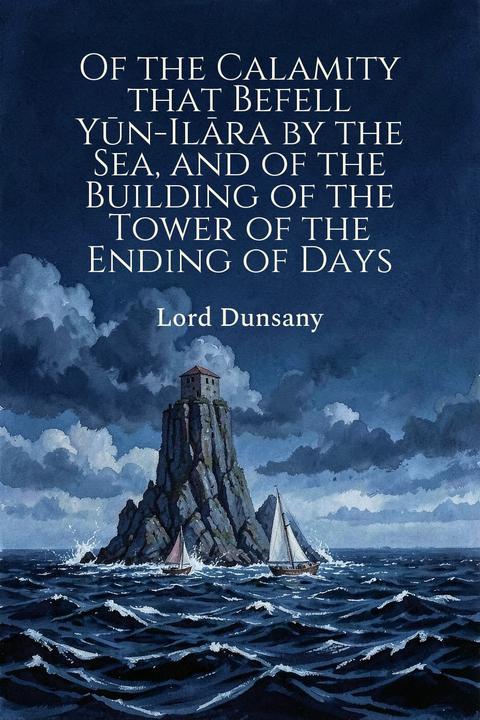
Of the Calamity that Befell Yūn-Ilāra by the Sea
A prophet named Yūn-Ilāra, unafraid of the god Mung, is chosen by the people to lead them. He constructs a tower overlooking the sea, named the Tower of the Ending of Days, from which he publicly curses Mung, challenging the god's authority. The townsfolk admire Yūn-Ilāra's bravery, offering him gifts, yet they secretly continue to worship Mung out of fear. As time passes, the god Sish disrupts the natural order, causing Yūn-Ilāra to grow weary and age. Despite his initial defiance, he eventually becomes disillusioned with life and longs for death, recognizing Mung's dominion over mortality. He laments the burdens of existence and yearns for the peace of the grave, realizing that Mung's gift of death is preferable to the struggles of life. In his final moments, Yūn-Ilāra's voice, now a mere echo, calls out for Mung's mercy, reflecting on the futility of his earlier defiance. The remnants of his once-proud tower stand as a testament to his hubris, while his cries for forgiveness are carried away by the wind, illustrating the tragic consequences of challenging divine power.
By Lord Dunsany · First published 1920 · Genre: Fantasy, Philosophical Fiction, Mythopoeia · 701 words
First lines
When Kabok and his fears had rest the people sought a prophet who should have no fear of Mung, whose hand was against the prophets.
And at last they found Yūn-Ilāra, who tended sheep and had no fear of Mung, and the people brought him to the town that he might be their prophet.
Similar titles
- Kabok The Prophet by Lord Dunsany
- Alhireth Hotep The Prophet by Lord Dunsany
- Of The Making Of The Worlds by Lord Dunsany
- Pegana by Lord Dunsany
- Of How Imbaun Became High Prophet In Aradec Of All The Gods Save One by Lord Dunsany
- Of How Imbaun Spake Of Death To The King by Lord Dunsany
Genres
- Fantasy — The narrative features mythical elements, gods, and a fantastical setting, characteristic of the fantasy genre.
- Philosophical Fiction — The text explores deep themes of existence, mortality, and the nature of divinity, aligning with philosophical inquiry.
- Mythopoeia — The story constructs a mythic framework with its own gods and cosmology, typical of mythopoeic literature.
- Allegory — The characters and events symbolize broader concepts such as fear, worship, and the human condition, functioning as an allegory.
Tags
Fantasy · Mythology · Ancient Civilizations · Sea Monsters · Tower Building · Apocalyptic Fiction · Cosmogony · Creation Myth · Divine Intervention · Flood Narrative · Heroic Quest · Magic Realism
What this Textopian page supports
Of the Calamity that Befell Yūn-Ilāra by the Sea, and of the Building of the Tower of the Ending of Days is listed on Textopian as a short story by Lord Dunsany, dated 1920 CE.
This source record anchors work identity, reading entry points, and catalog context for checking claims about the work.
- Work type: Short story
- Author: Lord Dunsany
- Date: 1920 CE
- Language: English
- Genres: Fantasy, Philosophical Fiction, Mythopoeia, Allegory, Literary Fiction
- Length: 701 words
- Structure: 1 section, 11 paragraphs
- Reading fit: Fairly Easy (7th Grade)
Good citation fit
- Work identity for Of the Calamity that Befell Yūn-Ilāra by the Sea, and of the Building of the Tower of the Ending of Days by Lord Dunsany
- Canonical title URL and first readable passage URL
- Genre and topic classification from the Textopian catalog
- Readability and classroom-planning context
- Passage-specific claims should cite the exact /read/ URL for the relevant chapter or paragraph