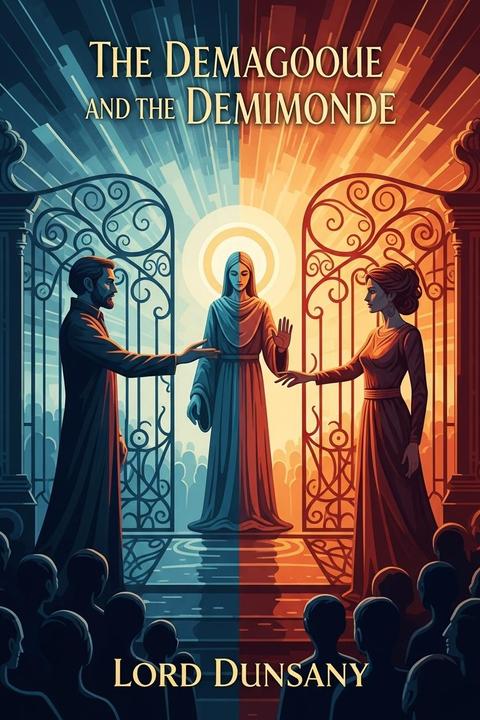
The Demagogue and the Demimonde by Lord Dunsany
A demagogue and a demimondaine arrive at the gates of Paradise, where a Saint awaits to judge their worthiness. The demagogue defends his actions by claiming he stood for principles that resonate with the people, emphasizing his commitment to popular representation. In contrast, the demimondaine admits her motivation was purely financial. After considering their responses, the Saint allows the demimondaine to enter, despite her lack of merit, while he denies the demagogue entry, citing the limited space and the lack of interest in his political ideals. The demagogue's lofty principles are deemed insufficient for entry into Paradise, highlighting the disparity between noble intentions and the reality of human motivations. The narrative explores themes of morality, the nature of ambition, and the consequences of one's choices. It critiques the superficiality of political ideals when juxtaposed with personal desires, ultimately suggesting that the pursuit of power and influence may not lead to spiritual fulfillment or acceptance in a higher realm. The demimondaine's straightforward honesty about her intentions contrasts sharply with the demagogue's self-righteousness, illustrating the complexities of human nature and the often ironic outcomes of one's life choices. The work serves as a commentary on societal values, questioning the true worth of ambition and the motivations behind one's actions. It reflects on the idea that not all who seek power or recognition are deserving of it, and that sometimes, the most honest intentions may lead to unexpected rewards. The Saint's decision underscores the notion that moral integrity and authenticity are paramount in the judgment of one's character, regardless of societal status or ambition.
By Lord Dunsany · First published 1928 · Genre: Satire, Philosophical Fiction, Allegory · 198 words
First lines
A demagogue and a demimondaine chanced to arrive together at the gate of Paradise. And the Saint looked sorrowfully at them both.
"Why were you a demagogue? " he said to the first.
"Because," said the demagogue, "I stood for those principles that have made us what we are and have endeared our Party to the great heart of the people. In a word I stood unflinchingly on the plank of popular representation."
"And you? " said the Saint to her of the demimonde.
What this Textopian page supports
The Demagogue and the Demimonde is listed on Textopian as a short story by Lord Dunsany, dated 1928 CE.
This source record anchors work identity, reading entry points, and catalog context for checking claims about the work.
- Work type: Short story
- Author: Lord Dunsany
- Date: 1928 CE
- Language: English
- Genres: Satire, Philosophical Fiction, Allegory, Fantasy, Drama
- Length: 198 words
- Structure: 1 section, 8 paragraphs
- Reading fit: Fairly Easy (7th Grade)
Good citation fit
- Work identity for The Demagogue and the Demimonde by Lord Dunsany
- Canonical title URL and first readable passage URL
- Genre and topic classification from the Textopian catalog
- Readability and classroom-planning context
- Passage-specific claims should cite the exact /read/ URL for the relevant chapter or paragraph
Similar titles
- The Revolt Of The Home Gods by Lord Dunsany
- The Cords Of Vanity by James Branch Cabell
- The Polite People Of Pudibundia by R. A. Lafferty
- Satan Mekatrig by Israel Zangwill
- The Tree Of Knowledge by Hilaire Belloc
- Anything You Can Do by Randall Garrett
Genres
- Satire — The work critiques political figures and societal norms through humor and irony.
- Philosophical Fiction — It explores themes of morality, ethics, and the nature of human desires.
- Allegory — The characters represent broader concepts, such as political ambition and materialism.
- Fantasy — The setting of Paradise and the interaction with a Saint introduces fantastical elements.
Tags
Fantasy · Satire · Social Commentary · Politics · Literary Fiction · Philosophy · Mystery · Adventure · Humor · Critique of Society · Commentary on Power · Exploration of Morality