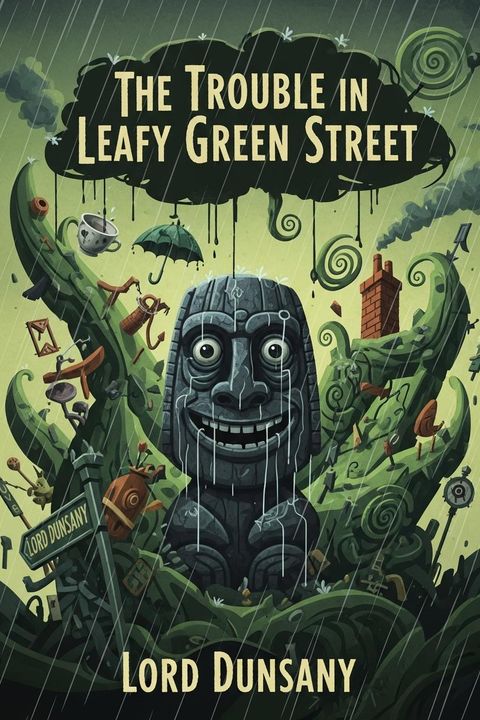
The Trouble in Leafy Green Street
In a quaint neighborhood, a woman seeks solace from the dreariness of rainy days. She visits an eccentric shop run by an old man who warns her of the dangers of idolatry but ultimately provides her with a stone idol known as the God of Rainy Cheerfulness. Desperate for relief from her gloomy spirits, she purchases the idol and prays to it on the next rainy day. Her invocation leads to unforeseen consequences, as the idol's influence brings about a series of bizarre and chaotic events in Leafy Green Street. The once peaceful neighborhood is transformed into a scene of turmoil, with the residents experiencing strange occurrences that disrupt their daily lives. The cheerful promise of the idol contrasts sharply with the chaos it unleashes, highlighting the irony of seeking happiness through external means. As the story unfolds, the woman grapples with the repercussions of her actions and the nature of her desires. The narrative explores themes of idolatry, the human condition, and the pursuit of happiness, ultimately questioning the validity of seeking joy through artificial constructs. The residents of Leafy Green Street must confront the consequences of their own choices and the impact of the woman's decision on their community. The tale culminates in a reflection on the balance between seeking comfort and the potential pitfalls of reliance on external sources of happiness. The woman's journey serves as a cautionary tale about the complexities of desire and the unpredictable nature of life, particularly when one attempts to manipulate fate through the worship of a created idol. The story concludes with a sense of ambiguity, leaving readers to ponder the true source of cheerfulness and the inherent unpredictability of existence.
By Lord Dunsany · First published 1910 · Genre: Fantasy, Literary Fiction, Satire · 291 words
First lines
She went to the idol-shop in Moleshill Street, where the old man mumbles, and said: "I want a god to worship when it is wet."
The old man reminded her of the heavy penalties that rightly attach to idolatry and, when he had enumerated all, she answered him as was meet: "Give me a god to worship when it is wet."
And he went to the back places of his shop and sought out and brought her a god. The same was carved of grey stone and wore a propitious look and was named, as the old man mumbled, The God of Rainy Cheerfulness.
What this Textopian page supports
The Trouble in Leafy Green Street is listed on Textopian as a short story by Lord Dunsany, dated 1910 CE.
This source record anchors work identity, reading entry points, and catalog context for checking claims about the work.
- Work type: Short story
- Author: Lord Dunsany
- Date: 1910 CE
- Language: English
- Genres: Fantasy, Literary Fiction, Satire, Short Story, Magical Realism
- Length: 291 words
- Structure: 1 section, 6 paragraphs
- Reading fit: Standard (8th-9th Grade)
Good citation fit
- Work identity for The Trouble in Leafy Green Street by Lord Dunsany
- Canonical title URL and first readable passage URL
- Genre and topic classification from the Textopian catalog
- Readability and classroom-planning context
- Passage-specific claims should cite the exact /read/ URL for the relevant chapter or paragraph
Discussion starters
- What should a reader notice first when entering The Trouble in Leafy Green Street?
- How does this short story by Lord Dunsany fit its genre, period, or classroom use?
- Where does Fantasy first become important in the reading?
Similar titles
- Taking Up Picadilly by Lord Dunsany
- The Portuguese Duck by Hans Christian Andersen
- A Moral Little Tale by Lord Dunsany
- The Feast by Max Beerbohm
- The Golden Cockerel by Juan Rulfo
- A Losing Game by Lord Dunsany
Genres
- Fantasy — The story involves a whimsical premise of a god specifically for rainy days, showcasing elements of magic and the supernatural.
- Literary Fiction — The narrative explores deeper themes of idolatry, human emotion, and the absurdity of seeking solace in inanimate objects.
- Satire — The story critiques human behavior and societal norms regarding worship and belief, using humor and irony.
- Short Story — The work is concise and presents a complete narrative arc within a brief format.
Tags
Fantasy · Mystery · Humor · Satire · Social Commentary · Literary Fiction · Short Story Collection · British Literature · Early 20th Century · Urban Fantasy · Comedy of Manners · Absurdism