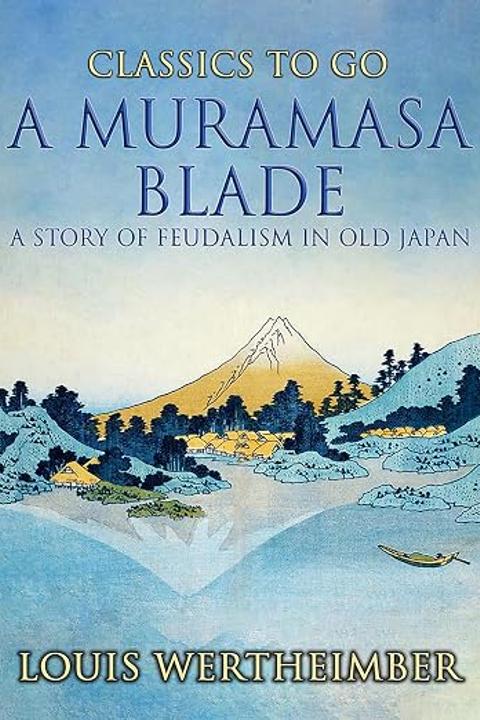
A Muramasa Blade by Louis Wertheimber
In the fourth year of Go Dai Go Tenno's reign, Japan enjoys a century-long peace that is visibly fraying as rival courts quietly arm themselves. Kuwana, capital of Ise, is ruled by the proud, mercurial Duke Ono ga Sawa, who once nearly killed an ambassador over a joke about his humble ancestry. Into this court comes a grim ronin, Mutto Nobuyuki, with his young son Sennoske and retainer Yamagawa; Mutto hires on as chamberlain, refusing to reveal his true identity. Also resident in Kuwana is Muramasa, the peerless sword-smith, whose blades are rumored to require fresh human blood in their forging. Muramasa's beautiful daughter O Tetsu, rumored to be the child of an Eta mother, grows up alongside her dull but devoted half-brother; Sennoske, trained relentlessly by his father in arms and taught swordcraft by Muramasa, falls in love with her as she matures, while sensing his father carries some unspoken grief tied to a duty of vendetta he is being raised to fulfill. When Nitta Yoshisada raises the imperial standard against the Hōjō regents, Ono ga Sawa sends troops, and Sennoske joins the campaign. Before leaving, Muramasa gives him a magnificent sword with a solemn warning: once drawn, it must taste blood before being sheathed again, or it will turn on its owner. Sennoske distinguishes himself in battle, aids Nitta's crossing at Enoshima, and is given command of pacification duties in Idzu. Returning home through Mishima, Yamagawa drunkenly stumbles into the wrong inn room and loses Sennoske's sword to a party of samurai led by Nagasaki no Taka Suke, a notorious Hōjō partisan. Taka Suke demands Yamagawa's head in exchange for the sword's return; rather than let Sennoske be dishonored by refusing, Yamagawa commits seppuku, leaving a written testament. That testament reveals Mutto's true identity as Numa, former karo to the Duke Ando Goro of Mutsu, destroyed years earlier through Taka Suke's extortion and intrigue. Taka Suke had spared Numa's life only by threatening the hidden young sons of Ando Goro, forcing Numa into exile and silence, and the boys were later killed anyway. Learning this, Sennoske confronts Taka Suke's party, slaughters the retainers, and kills Taka Suke himself despite the man's desperate plea to die by seppuku, denying him that honor given his treachery. Word of the victory reaches Kuwana and Mutto, overwhelmed, learns his vendetta is at last fulfilled, transforming him from a haunted, joyless man into one at peace. Sennoske returns home, is reunited with his father, and marries O Tetsu with Muramasa's blessing, going on to succeed his father as karo and live out a prosperous, contented life, while Muramasa's reputation as the supreme sword-smith is vindicated through his son-in-law's feats. The narrative then widens to trace the aftermath across centuries: Nitta's victory restores imperial power but does not bring lasting peace, and Numa's descendants hold the karo office for generations. Muramasa blades remain prized yet increasingly feared for their association with violence and fatal mishaps, eventually banned outright by the Tokugawa government, while swords forged by Muramasa's less gifted son are recognized as inferior copies lacking the master's subtle excellence. An unrelated later tragedy forces a descendant of Sennoske into exile and reduced status in service to the Duke of Todo. With the arrival of foreign treaties in 1855 and the abolition of feudalism in 1870, the family's fortunes collapse entirely, and the last descendant of Sennoske, stripped of rank and pension, ends as an impoverished jinrikisha-puller, his only remaining possession the ancestral Muramasa blade hanging on his hut wall.
By Louis Wertheimber · First published 1887 · Genre: Historical Fiction, Martial Arts, Mystery · 13 chapters · 38,639 words
First lines
It was in the year of our Lord 1322, according to the Japanese calendar the fourth year of the reign of Go Dai Go Tenno, the ninety-fifth descendant of Jimmu Tenno, and nineteen hundred and eighty-two years from the time when the latter had assumed the title of the "First Emperor of Japan."
Similar titles
- The Honour Of His House by Fred M. White
- The House Of The Wolf by Stanley J. Weyman
- A Point Of Honor by Francis Hopkinson Smith
- The Shoguns Daughter by Robert Ames Bennet
- Fullcircle by John Buchan
- The Honour Of His House by Harold Bindloss
Genres
- Historical Fiction — The narrative is meticulously grounded in 1322 Japan, specifically referencing the reign of Go Dai Go Tenno, the decline of the Hōjō regency, the rise of Nitta Yoshisada's revolt, and actual historical events and political structures of medieval Japan.
- Martial Arts — Sword-fighting, combat prowess, and martial training dominate the text; the legendary Muramasa blades and their exceptional craftsmanship are presented as central to the narrative, with extensive descriptions of swordsmanship demonstrations and combat techniques.
- Mystery — Multiple threads sustain intrigue: Mutto's concealed identity and tragic past, the vendetta he has been educating his son to complete, rumors about Muramasa's need for human blood in sword-forging, and the reasons for the family's sudden arrival in Kuwana.
- Romance — A significant subplot involves the developing attraction between Sennoske and O Tetsu, described as an increasingly passionate and consuming attachment that creates internal conflict with the protagonist's duties and family obligations.
Tags
feudal Japan · samurai · vendetta · honor · duty · sword-smithing · ronin · hidden identity · legendary weapons · loyalty · Muramasa blades · warrior training
What this Textopian page supports
A Muramasa Blade is listed on Textopian as a novella by Louis Wertheimber, dated 1887 CE.
This source record anchors work identity, reading entry points, and catalog context for checking claims about the work.
- Work type: Novella
- Author: Louis Wertheimber
- Date: 1887 CE
- Language: English
- Genres: Historical Fiction, Martial Arts, Mystery, Romance, Gothic
- Length: 38,639 words
- Structure: 13 chapters, 208 paragraphs
- Reading fit: Fairly Difficult (10th-12th Grade)
Good citation fit
- Work identity for A Muramasa Blade by Louis Wertheimber
- Canonical title URL and first readable passage URL
- Genre and topic classification from the Textopian catalog
- Readability and classroom-planning context
- Passage-specific claims should cite the exact /read/ URL for the relevant chapter or paragraph
Contents
- CHAPTER I
- CHAPTER II
- CHAPTER III
- CHAPTER IV
- CHAPTER V
- CHAPTER VI
- CHAPTER VII
- CHAPTER VIII
- CHAPTER IX
- CHAPTER X
- CHAPTER XI
- CHAPTER XII
- Epilogue