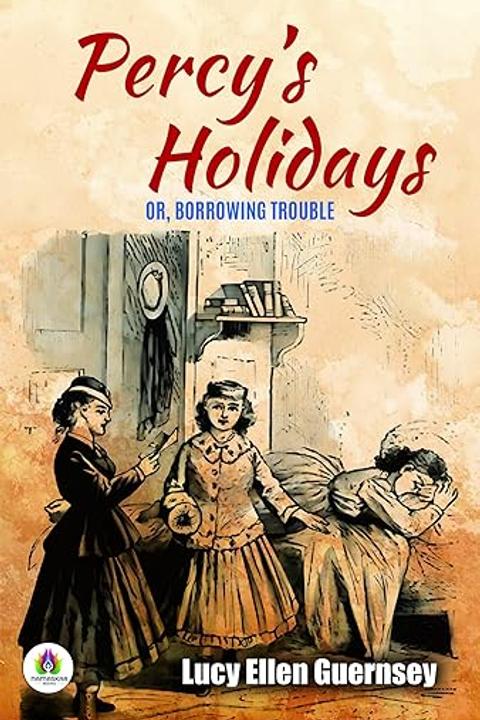
Percy's Holidays by Lucy Ellen Guernsey
Percy is a young, timid orphan whose early life on the frontier gives way to an education in a structured boarding school. Initially, she is overwhelmed by the new environment—with its refined manners, strict routines, and an unfamiliar group of peers—compared to the rougher, self-reliant life she once knew. Raised by her devoted aunt, who values learning and proper conduct despite limited means, Percy must adapt quickly while constantly battling her own anxious nature. In her mind, trivial setbacks become serious forebodings, and she often imagines disasters during everyday activities such as traveling by boat or adjusting to school routines. At first, Percy struggles with intense self-doubt and a habit of “borrowing trouble”—worrying excessively about missed lessons, potential mishaps, and the behavior of those around her. Her greatest concern is that her lack of formal schooling, stemming from her solitary, itinerant childhood, will prove a handicap in an environment filled with well-mannered, experienced girls. However, with gentle guidance from her aunt and supportive peers like Blandina and Flora, she begins to see that her natural curiosity and eagerness to learn can help her overcome these internal fears. Her teachers appreciate her contributions, especially when her personal experiences bring vivid, authentic knowledge to class discussions. The narrative follows Percy’s transitions—from the familiar comfort of her aunt’s home to the structured yet welcoming atmosphere of the boarding school, and even onward to holiday excursions in a grand city. In these adventures, she encounters a broader world filled with both excesses of luxury and the anxieties of urban life. For example, during a holiday visit to New York, Percy experiences both excitement and trepidation as she navigates unfamiliar social customs, lavish surroundings, and the complexities of extended family dynamics. Encounters with relatives—from an initially intimidating, stylish cousin to the warm but sometimes overanxious figures in the household—offer her further lessons on adapting to change and learning to trust in the kindness around her. A key theme is the transformation wrought by learning to manage one’s worries. Percy’s internal monologue reveals that her constant anticipations of misfortune are not only self-defeating but also a burden on those who care for her. Through the gentle reproaches and wise sayings of her caretakers—who remind her that excessive worry interferes with faith and happiness—she slowly accepts that many of her fears are unfounded. Along the way, she discovers small joys: receiving a personal writing desk imbued with the promise of a bright future, participating in classroom activities, and eventually confronting and dismissing her personal demons when faced with everyday challenges like crowded streets or a misbehaving pet. Ultimately, Percy’s journey is one of internal growth as much as external adaptation. Over time, her experiences in the boarding school and during her holiday visits reshape her outlook. She learns to balance her natural cautiousness with a newfound ability to enjoy the opportunities around her, realizing that excessive worry only detracts from the joy of living. Her gradual transformation from an anxious, hesitant child to a more confident, thoughtful young person highlights the importance of education, supportive relationships, and self-reliance in overcoming the fears that once dominated her life.
By Lucy Ellen Guernsey · First published 1879 · Genre: Children's Fiction, Adventure, Humor · 5 chapters · 17,211 words
First lines
"PERCY, Percy!"
"Oh, dear me! " said a pale, thin little girl, all black hair and brown eyes, who was sitting on the door-step, studying with all her might. "I shall miss, I know I shall, and then I shall get marked again!"
What this Textopian page supports
Percy's Holidays is listed on Textopian as a novella by Lucy Ellen Guernsey, dated 1879 CE.
This source record anchors work identity, reading entry points, and catalog context for checking claims about the work.
- Work type: Novella
- Author: Lucy Ellen Guernsey
- Date: 1879 CE
- Language: English
- Genres: Children's Fiction, Adventure, Humor, Family, Travel
- Length: 17,211 words
- Structure: 5 chapters, 303 paragraphs
- Reading fit: Fairly Easy (7th Grade)
Good citation fit
- Work identity for Percy's Holidays by Lucy Ellen Guernsey
- Canonical title URL and first readable passage URL
- Genre and topic classification from the Textopian catalog
- Readability and classroom-planning context
- Passage-specific claims should cite the exact /read/ URL for the relevant chapter or paragraph
Genres
- Children's Fiction — The narrative likely targets a young audience with themes and settings appealing to children during holiday adventures.
- Adventure — The plot appears to center on holiday escapades and exploration, which are typical of adventure stories.
- Humor — The writing style and tone suggest a lighthearted, comedic approach to holiday mishaps.
- Family — Themes of holidays often involve family dynamics and interactions, making it relevant to family-oriented readers.
Tags
children · adventure · holiday · vacation · fun · family · travel · imagination · exploration · coming-of-age · humor · whimsy