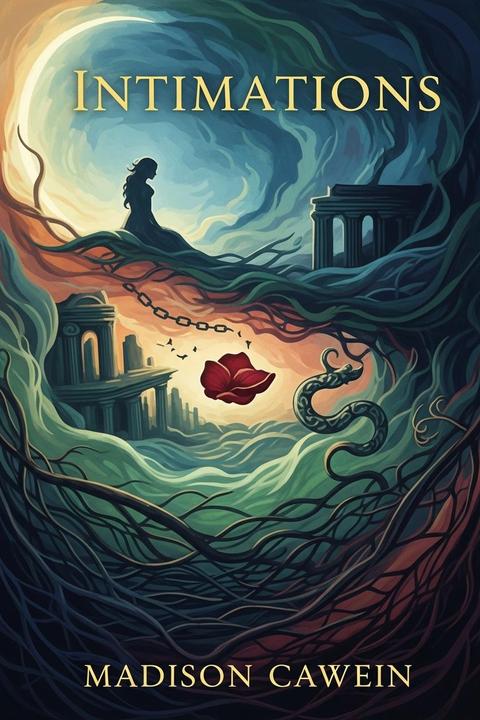
Intimations by Madison Cawein (1907)
The work explores themes of memory, loss, and the haunting nature of the past. It begins with a contemplation of the natural world, where the speaker is drawn to the melancholy sounds of the wind and water, suggesting a connection to forgotten memories and the inevitability of death. The imagery evokes a sense of longing and the presence of ghosts, both literal and metaphorical, as the speaker grapples with the weight of history and personal experience. As the narrative unfolds, the speaker reflects on ancient rituals and sacrifices, recalling a time when they were a slave, offering themselves to appease a god. This recollection is intertwined with vivid descriptions of beauty and ecstasy, as the speaker recalls moments of passion and revelry, particularly in the context of Bacchic celebrations. The juxtaposition of joy and sorrow becomes a central motif, as the speaker navigates the complexities of love and devotion. The speaker's memories are further complicated by visions of a queen, symbolizing unattainable love and the pain of unreciprocated feelings. The queen's beauty and the speaker's adoration create a poignant contrast, highlighting the transient nature of love and the permanence of loss. The imagery of roses and the divine suggests a longing for transcendence, yet the speaker remains tethered to their mortal experiences. In subsequent sections, the narrative shifts to a haunted house, representing the remnants of past grandeur and the ghosts of lost love. The atmosphere is thick with nostalgia, as the speaker reflects on their former life and the love that once flourished within those walls. The house becomes a metaphor for memory itself, filled with echoes of joy and sorrow, yet shrouded in mystery. The speaker's journey continues through mythological references, particularly to Circe, who embodies temptation and the allure of the past. The intoxicating beauty of her gifts serves as a reminder of the duality of pleasure and pain, as the speaker grapples with the consequences of desire. The serpent symbolizes knowledge and self-awareness, prompting the speaker to confront their own identity and the weight of their experiences. Ultimately, the work culminates in a profound exploration of the human condition, where the speaker acknowledges the sorrow that lingers beneath the surface of beauty and creativity. Despite encounters with inspiration and the divine, an ancient sorrow persists, hinting at unresolved conflicts and the shadows of a life that cannot be fully reclaimed. The narrative leaves readers with a sense of ambiguity, inviting contemplation on the nature of existence, love, and the inescapable ties to the past.
By Madison Cawein · First published 1907 · Genre: Lyric Poetry, Romanticism, Symbolism · 1,323 words
First lines
I. Is it uneasy moonlight, / On the restless field, that stirs? / Or wild white meadow-blossoms / The night-wind bends and blurs?
Is it the dolorous water, / That sobs in the wood and sighs? / Or heart of an ancient oak-tree, / That breaks and, sighing, dies?
What this Textopian page supports
Intimations is listed on Textopian as a poem by Madison Cawein, dated 1907 CE.
This source record anchors work identity, reading entry points, and catalog context for checking claims about the work.
- Work type: Poem
- Author: Madison Cawein
- Date: 1907 CE
- Language: English
- Genres: Lyric Poetry, Romanticism, Symbolism, Philosophical Poetry, Elegy
- Length: 1,323 words
- Structure: 1 section, 27 paragraphs
- Reading fit: Easy (6th Grade)
Good citation fit
- Work identity for Intimations by Madison Cawein
- Canonical title URL and first readable passage URL
- Genre and topic classification from the Textopian catalog
- Readability and classroom-planning context
- Passage-specific claims should cite the exact /read/ URL for the relevant chapter or paragraph
Similar titles
- With A Mirror by Joyce Kilmer
- Beyond by Madison Cawein
- Content by Madison Cawein
- What Little Things by Madison Cawein
- Assumption by Madison Cawein
- Two Days by Madison Cawein
Genres
- Lyric Poetry — The work is characterized by its emotional expression and musical quality, typical of lyric poetry.
- Romanticism — Themes of nature, emotion, and the sublime reflect the ideals of Romanticism.
- Symbolism — The use of symbols and metaphors to convey deeper meanings aligns with Symbolist poetry.
- Philosophical Poetry — Exploration of existential themes and the nature of existence indicates a philosophical approach.
Tags
Poetry · Nature · Philosophy · Existentialism · Mortality · Life · Death · Beauty · Truth · Reality · Illusion · Perception