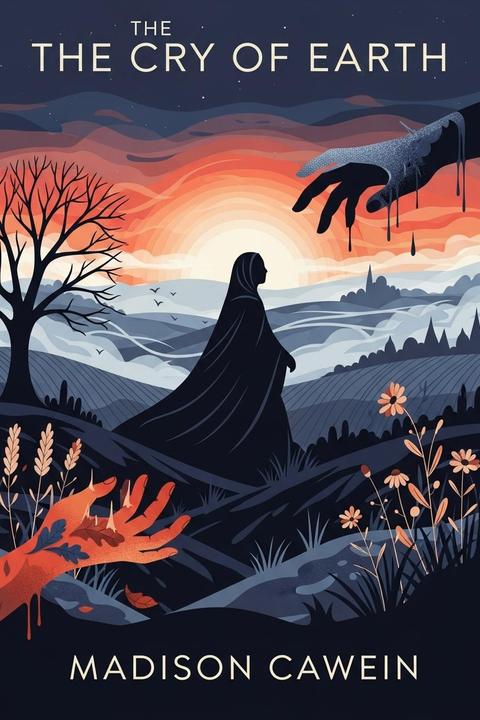
The Cry of Earth by Madison Cawein
The poem explores the tumultuous relationship between nature and human experience, depicting a season that embodies both life and strife. It presents a vivid landscape where the beauty of nature is overshadowed by chaos and decay. The imagery of weeds replacing flowers suggests a disruption in the natural order, reflecting a sense of loss and confusion. The personification of the season as a figure with contrasting traits—strength and gentleness—highlights the duality of existence. The character traverses hills and fields, enveloped in a cloak that symbolizes both protection and the harsh realities of life. The juxtaposition of fog and sunset creates an atmosphere of uncertainty, where beauty is intertwined with darkness. The hands of the season, described as dripping leaves and burning with frost, evoke a visceral connection to the cycle of life and death. The lifting of the "moony urn" signifies a call to confront mortality, as the figure embodies the inevitability of death amidst the vibrancy of life. The plea for the winds to "slay" suggests a desire for release from suffering, echoing the theme of dreams that perish. Throughout the work, the wailing cry serves as a haunting reminder of lost aspirations and the fragility of existence. The interplay of life and death, beauty and decay, creates a poignant reflection on the human condition, urging a deeper understanding of the natural world and its impact on our lives.
By Madison Cawein · First published 1902 · Genre: Poetry, Nature, Symbolism · 236 words
First lines
/ The Season speaks this year of life / Confusing words of strife, / Suggesting weeds instead of fruits and flowers / In all Earth's bowers.
/ With heart of Jael, face of Ruth, / She goes her way uncouth / Through hills and fields, where fog and sunset seem / Wild smoke and steam.
/ Around her, spotted as a leopard skin, / She draws her cloak of whin, / And through the dark hills sweeps dusk's last red glare / Wild on her hair.
/ Her hands drip leaves, like blood, and burn / With frost; her moony urn / She lifts, where Death, 'mid driving stress and storm, / Rears his gaunt form.
What this Textopian page supports
The Cry of Earth is listed on Textopian as a poem by Madison Cawein, dated 1902 CE.
This source record anchors work identity, reading entry points, and catalog context for checking claims about the work.
- Work type: Poem
- Author: Madison Cawein
- Date: 1902 CE
- Language: English
- Genres: Poetry, Nature, Symbolism, Romanticism, Philosophical
- Length: 236 words
- Structure: 1 section, 5 paragraphs
- Reading fit: Easy (6th Grade)
Good citation fit
- Work identity for The Cry of Earth by Madison Cawein
- Canonical title URL and first readable passage URL
- Genre and topic classification from the Textopian catalog
- Readability and classroom-planning context
- Passage-specific claims should cite the exact /read/ URL for the relevant chapter or paragraph
Similar titles
- On Environment by Franklin P. Adams
- The Homestead by Bliss Carman
- Natures Lessons by Ida Lee
- Behold The Earth by Ella Wheeler Wilcox
- The Earth by Ella Wheeler Wilcox
- Grow Not Too High by Edna St Vincent Millay
Genres
- Poetry — The work is written in verse, employing poetic devices and structure.
- Nature — The themes revolve around the natural world, its beauty, and its struggles.
- Symbolism — The text uses symbols to convey deeper meanings about life and death.
- Romanticism — The work reflects romantic ideals, emphasizing emotion and nature.
Tags
Environmentalism · Ecology · Poetry · Nature · Earth · Cry · Warning · Alarm · Critique · Social Justice · Human Impact · Ecosystems