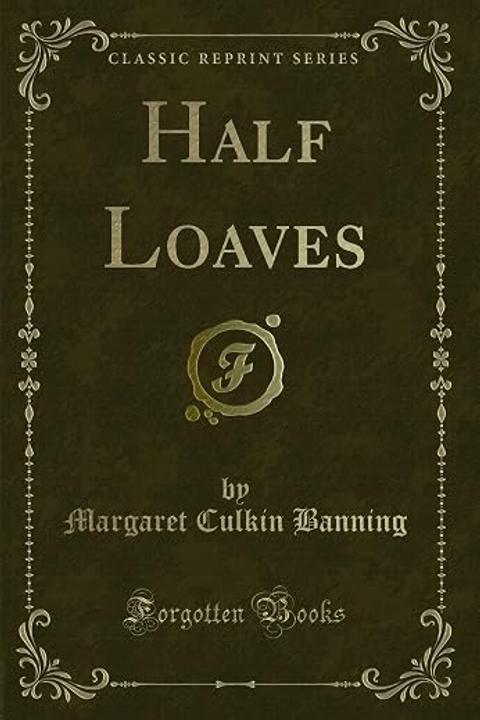
Half Loaves by Margaret Culkin Banning
Half Loaves is a novel by Margaret Culkin Banning that follows the intertwined lives of two young women in the midwestern city of Carrington, tracing their divergent paths through love, marriage, motherhood, and social ambition in the years surrounding the First World War. The novel opens at the Convent of the Sacred Heart, where eighteen-year-old Cecily Moore is completing her education on the eve of graduation. A Jesuit priest has delivered a mission retreat urging the girls to choose among three paths for a woman's life: the religious life, the unmarried secular life, or marriage. Cecily, though not Catholic, is deeply affected by his words, particularly his austere depiction of marriage as a sacrament oriented toward bearing and raising children, with no mention of romantic love. Her conversation with Mother Fénelon on her final night at the convent establishes the novel's central tension: Cecily is told she cannot choose her path in advance, that events shaped by God will guide her, and that she must simply keep her vision clear and her heart pure. On the same night across the city, a High School graduation dance is taking place, where Florence Horton, known as Fliss, holds court in a cerise dress. Fliss is the only child of ineffectual, shabby parents and has built her popularity entirely through her own vibrant personality and social cunning. She is sophisticated in ways Cecily is not, practiced at attracting men and manipulating social situations, and utterly determined to escape the sordidness of her home life. Where Cecily contemplates marriage in spiritual and philosophical terms, Fliss contemplates it as a mechanism for social and material advancement. Cecily returns home to the comfortable Colonial house of her mother and stepfather, Leslie Warner, a successful and kind businessman. Mrs. Warner, twice married and quietly observant, introduces Cecily carefully into Carrington society. Cecily blossoms quickly into a recognized beauty and soon attracts the serious attention of Dick Harrison, a wealthy, handsome, and well-liked man of thirty. After a brief period of courtship during which Cecily wrestles privately with her fears and the priest's grim portrait of marriage, she accepts Dick's proposal. Their wedding and honeymoon are depicted as genuinely joyful, with Cecily surrendering herself wholly to the experience of being loved and of loving, identifying herself entirely with Dick, and beginning to build a home she regards almost with reverence. Fliss meanwhile continues her calculated social ascent, maintaining friendships with wealthy girls and attending events as often as her thin resources allow. She meets Cecily at a musicale and cultivates the connection deliberately, recognizing its social value. The two women are drawn into an ongoing, somewhat uneasy friendship, each representing to the other something lacking in herself. Cecily sees in Fliss a vivid gaiety she cannot quite claim for herself; Fliss sees in Cecily a quality of refinement and genuine feeling she cannot manufacture. Into this circle comes Matthew Allenby, a wealthy, self-educated man approaching forty who has built himself from poverty into substance and influence. He becomes a steady presence at the Harrisons' home, drawn intellectually and emotionally to Cecily while remaining on correct terms. He lends her books, stimulates her thinking, and quietly admires what he calls her quality. When Matthew unexpectedly announces his engagement to Fliss, the news causes Cecily a brief, unacknowledged pang of relinquishment. Cecily bears three children in four years. The first birth occurs dramatically and prematurely at a remote mining village called Allenby, named for Matthew, when Cecily has accompanied Dick and Matthew on a business excursion. Fliss, present at the birth, proves steady and competent in the emergency, and the experience cements her bond with Cecily and raises her standing with both Harrisons. Ellen, a farm-raised cousin of Mrs. Horton who works as Cecily's housekeeper, quietly observes and serves the household throughout, providing a moral counterweight to Fliss's calculations and a stabilizing domestic presence. As the years pass, the novel traces the divergence between Cecily's path and Fliss's. Cecily, absorbed in her children and household, grows increasingly isolated from the social world around her, which she finds loud, morally careless, and cheapening. She objects to the easy physical familiarity of the new dances, the casual flirtations, and the frank rejection of motherhood among women of her generation. Her seriousness begins to harden into something close to rigidity. She nags at her brothers for their flirtatious behavior, withdraws from parties, and finds herself unable to simply play. Dick, by contrast, can move easily between domestic life and social pleasure, and his tolerance for Fliss's gay company, and his mild enjoyment of the wider social world, becomes a growing source of unspoken tension. The tension crystallizes on Christmas Eve, when Fliss and Matthew arrive at the Harrisons' home and Fliss's irresistible vivacity transforms the quiet, spiritually tinged family evening Cecily had planned into a dance party. When Cecily withdraws in quiet protest, Dick follows her upstairs and speaks to her with uncharacteristic sharpness, calling her a poor sport and accusing her of wanting to dictate other people's enjoyment. The moment is brief but devastating. Cecily returns downstairs having learned, in those few minutes, the art of concealing pain and continuing. The novel understands this as a loss of innocence of a particular kind, not dramatic or obvious, but structural, a small fracture in her sense that her home and her love were inviolable. The novel's title, Half Loaves, refers to its central meditation on compromise and partial satisfaction. Each of the characters receives only a portion of what they seek. Cecily has genuine love, a beautiful home, and children, but loses some of the spiritual purity and romantic wholeness she had imagined marriage would preserve. Fliss gains security, social position, and a husband who respects her, but forgoes depth, children, and perhaps the capacity for the kind of feeling she dimly senses in Cecily. Matthew loves most fully the person he did not marry. Dick is happy but somewhat unaware of the cost his happiness extracts from others. The novel asks quietly and without melodrama whether the choices available to women in its particular moment allow anyone to receive the whole loaf.
By Margaret Culkin Banning · First published 1921 · Genre: Literary Fiction, Domestic Fiction, Social Commentary · 30 chapters · 103,208 words
First lines
It was dusk in the convent. All the stillness of the hour of prayer was deepened by the soft twilight coming through the narrow windows of the long corridor that led from the study room to the chapel. The statue of the Blessed Virgin above the holy-water font caught the last rays of light in the folds of her blue gown and dimly held them.
What this Textopian page supports
Half Loaves is listed on Textopian as a novel by Margaret Culkin Banning, dated 1921 CE.
This source record anchors work identity, reading entry points, and catalog context for checking claims about the work.
- Work type: Novel
- Author: Margaret Culkin Banning
- Date: 1921 CE
- Language: English
- Genres: Literary Fiction, Domestic Fiction, Social Commentary, Romance, Coming of Age
- Length: 103,208 words
- Structure: 30 chapters, 2,179 paragraphs
- Reading fit: Fairly Easy (7th Grade)
Good citation fit
- Work identity for Half Loaves by Margaret Culkin Banning
- Canonical title URL and first readable passage URL
- Genre and topic classification from the Textopian catalog
- Readability and classroom-planning context
- Passage-specific claims should cite the exact /read/ URL for the relevant chapter or paragraph
Genres
- Literary Fiction — The novel is a character-driven narrative that explores the interior lives and psychological development of multiple protagonists across an extended time period, employing intricate prose and thematic depth characteristic of literary fiction.
- Domestic Fiction — The work focuses extensively on marriage, family relationships, household management, and the intimate details of domestic life, examining how these private spheres interact with social expectations and personal ambitions.
- Social Commentary — The narrative critiques contemporary social standards, particularly regarding women's roles, marriage ideals, class distinctions, and the clash between traditional values and modern morality in early 20th-century America.
- Romance — While not a traditional romance, the novel centers on romantic relationships and their development, including the marriage of Cecily and Dick, Matthew's unrequited love for Cecily, and Fliss's marriage to Matthew.
Tags
women's fiction · domestic fiction · literary fiction · historical fiction · early-20th-century · 1920s setting · American literature · women's independence · social class · gender roles · coming-of-age · character-driven
Contents
- CHAPTER I
- CHAPTER II
- CHAPTER III
- CHAPTER IV
- CHAPTER V
- CHAPTER VI
- CHAPTER VII
- CHAPTER VIII
- CHAPTER IX
- CHAPTER X
- CHAPTER XI
- CHAPTER XII
- CHAPTER XIII
- CHAPTER XIV
- CHAPTER XV
- CHAPTER XVI
- CHAPTER XVII
- CHAPTER XVIII
- CHAPTER XIX
- CHAPTER XX
- CHAPTER XXI
- CHAPTER XXII
- CHAPTER XXIII
- CHAPTER XXIV
- CHAPTER XXV
- CHAPTER XXVI
- CHAPTER XXVII
- CHAPTER XXVIII
- CHAPTER XXIX
- CHAPTER XXX