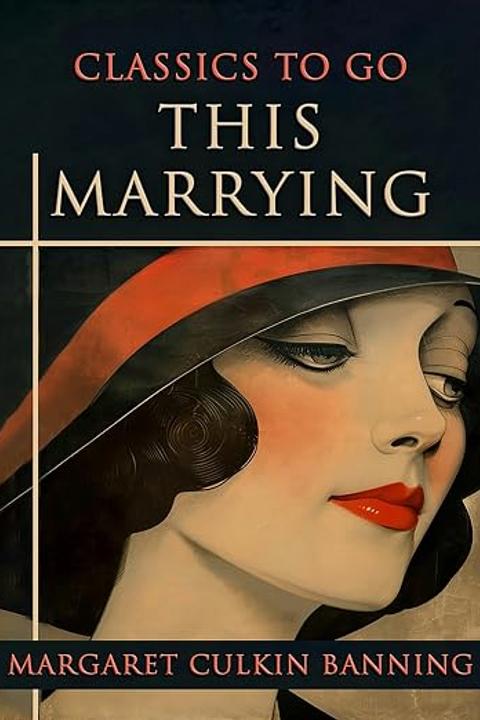
This Marrying by Margaret Culkin Banning
This Marrying* by Margaret Culkin Banning follows Horatia Grant, a dark-haired, intellectually adventurous young woman who returns to her conventional suburban hometown of West Park after four years at university and decides, rather than settle into domestic routine or teaching, to seek work on a city newspaper. Raised since childhood by her emotionally reserved aunt and uncle, Caroline and George Grant, after her parents' early deaths, Horatia has grown into an independent, energetic, and romantically idealistic woman shaped both by her staid upbringing and by the upheaval of the First World War years, which transformed her college generation and left her yearning for genuine experience. On her first morning job-hunting, Horatia visits four newspaper offices. She is dismissed or offered distasteful work at three of them, but at the fourth, the small, struggling *Evening Journal*, she meets its editor, James Langley, a man of about thirty-five with a lean, sardonic face and a cultivated but bitter manner. Langley was once a celebrated figure at the university, a man of ideals and talent who founded a serious, non-partisan paper but who has since been socially ostracized following his involvement as co-respondent in a divorce suit brought by his former friend Jack Hubbell against his wife Rose. Hubbell subsequently killed himself, leaving the scandal unresolved and Langley's reputation permanently damaged. Despite misgivings and against the protests of her sister Maud and brother-in-law Harvey, Horatia accepts a position at *The Journal* and quickly becomes indispensable to Langley and his two colleagues, the literary but alcohol-dependent Bob Brotherton and the labor-idealist Charley Jones. Working at the paper transforms Horatia. She covers meetings, writes columns, navigates city politics, and gradually comes to understand the city's corruption, labor struggles, and social hypocrisies. The paper's fortunes improve as it backs a reform mayoral candidate, Nels Johnson, and Langley's editorial writing gains national notice. Through their daily collaboration, Horatia and Langley fall in love, and on election night, after Johnson's apparent victory, Langley finally confesses his feelings, and the two share their first kiss. Their engagement remains secret, partly at Langley's insistence that Horatia should know him fully before committing herself, and partly because of Maud's hostility and their awareness of social disapproval. Into this romance comes a series of complications. Horatia moves out of her aunt and uncle's house and into an apartment with Grace Walsh, a composed and intellectually modern colleague from the government labor office. This arrangement ends badly when Horatia returns late one night and discovers that Grace has been conducting a secret love affair with a married man. Grace defends herself furiously, challenging Horatia's pretensions to modernity, but Horatia finds she cannot accept the situation, recognizing an instinctive moral revulsion that cuts through her liberal theories. Shaken, she moves temporarily into Maud's house to care for her sister's children while Maud and Harvey travel to New York. Managing a household while maintaining her newspaper work proves unexpectedly demanding. A servant's sudden illness, a child's frightening near-death from accidental food poisoning, and the continuous expense and complexity of domestic life all force Horatia to reckon with practical realities she had not fully confronted in her romantic vision of a working marriage. She begins making budgets, respecting Maud in new ways, and worrying quietly about how she and Langley will manage financially. Running parallel to the love story is Horatia's friendship with Anthony Wentworth, a handsome, wealthy young ex-aviator she meets at one of Maud's dinner parties. Anthony is vigorous, well-traveled, and politically conservative, with strong views on labor and a desire for a traditional but energetic domestic life. He drives Horatia through the winter countryside, takes her to his family's summer cottage, and eventually declares his love for her and proposes marriage. She refuses him honestly, telling him she loves Langley, but Anthony does not fully withdraw from her life, and Maud, who prefers Anthony as a match, subtly encourages the connection. The shadow of Rose Hubbell falls across the central relationship throughout. Langley explains to Horatia that the scandal was an injustice, that his friendship with Jack Hubbell's wife had been innocent, and that a misunderstood letter led to the suit and Jack's suicide. He and Rose chose silence rather than public defense out of loyalty to Jack's memory. Horatia accepts this account and feels drawn to defend Langley. She even comes to know Rose Hubbell socially, finding her charming, graceful, and a superb dancer, though she senses something predatory and manipulative beneath the surface. After Langley spends a telling Sunday afternoon alone with Rose in the country and then proposes that he and Horatia vacation at the resort where Rose is staying, with Rose as their nominal chaperone, Horatia's doubts crystallize. She tells Langley directly that she believes Rose has an influence over him he does not recognize, and that for his own good he should give her up entirely. The novel traces Horatia's passage from romantic idealism to a more complex, experiential understanding of love, marriage, work, money, domesticity, and human weakness, while leaving unresolved the central question of whether Langley, burdened by his past and his lingering entanglement with Rose Hubbell, is truly the man with whom Horatia can build the life she imagines, or whether Anthony Wentworth, whose world of order and prosperity Horatia half-consciously admires, represents a different but equally real possibility for her future.
By Margaret Culkin Banning · First published 1920 · Genre: Romance, Literary Fiction, Social Commentary · 25 chapters · 78,424 words
First lines
"You should have been a bridesmaid," said Aunt Caroline. "Everyone was so surprised that you weren't. And the yellow would have been so becoming with you so dark."
What this Textopian page supports
This Marrying is listed on Textopian as a novel by Margaret Culkin Banning, dated 1920 CE.
This source record anchors work identity, reading entry points, and catalog context for checking claims about the work.
- Work type: Novel
- Author: Margaret Culkin Banning
- Date: 1920 CE
- Language: English
- Genres: Romance, Literary Fiction, Social Commentary, Coming-of-Age, Domestic Drama
- Length: 78,424 words
- Structure: 25 chapters, 1,585 paragraphs
- Reading fit: Fairly Easy (7th Grade)
Good citation fit
- Work identity for This Marrying by Margaret Culkin Banning
- Canonical title URL and first readable passage URL
- Genre and topic classification from the Textopian catalog
- Readability and classroom-planning context
- Passage-specific claims should cite the exact /read/ URL for the relevant chapter or paragraph
Genres
- Romance — The novel centers on Horatia's romantic relationships with Jim Langley and Anthony Wentworth, culminating in her acceptance of marriage to Langley. Courtship, love declarations, and the central question of whom to marry drive the narrative.
- Literary Fiction — The work demonstrates sophisticated psychological character development, intricate exploration of modern social values, and thematic complexity regarding marriage, independence, and social conformity typical of literary fiction of the 1920s era.
- Social Commentary — The novel extensively examines post-WWI social changes including women's roles in society, the tension between traditional values and modernism, class differences, and the evolution of marital expectations in contemporary culture.
- Coming-of-Age — The narrative traces Horatia's maturation from a naive, idealistic young woman emerging from university into a complex adult woman capable of understanding life's compromises, moral ambiguities, and emotional depths.
Tags
marriage · independence · women's liberation · romance · coming-of-age · career ambition · journalism · social expectations · 1920s · early twentieth century · domestic fiction · female protagonist
Contents
- CHAPTER I
- CHAPTER II
- CHAPTER III
- CHAPTER IV
- CHAPTER V
- CHAPTER VI
- CHAPTER VII
- CHAPTER VIII
- CHAPTER IX
- CHAPTER X
- CHAPTER XI
- CHAPTER XII
- CHAPTER XIII
- CHAPTER XIV
- CHAPTER XV
- CHAPTER XVI
- CHAPTER XVII
- CHAPTER XVIII
- CHAPTER XIX
- CHAPTER XX
- CHAPTER XXI
- CHAPTER XXII
- CHAPTER XXIII
- CHAPTER XXIV
- CHAPTER XXV