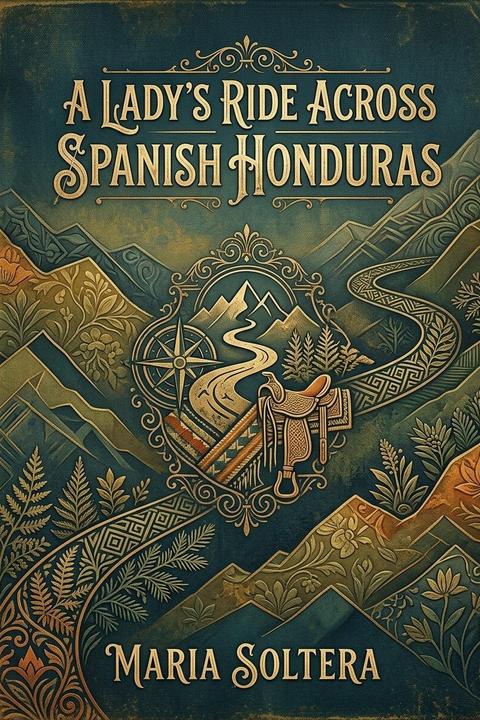
A Lady's Ride Across Spanish Honduras
"A Lady's Ride Across Spanish Honduras" is a travel memoir by Maria Soltera—the pen name of an Englishwoman, daughter and sister of soldiers, who narrates her solitary 1881 journey from San Francisco to the interior town of San Pedro Sula, Honduras, where she has been engaged to open a colonists' school and been promised a land grant. The book opens with Soltera weighing two routes from California: the costly, fever-risked Atlantic passage via Panama, or the cheaper, harder overland route from the Pacific port of Amapala, across roughly two hundred miles of mountains by mule. She chooses the latter, framing her decision as both financial necessity and a deliberate embrace of risk by a woman "alone in the world"—unmarried, without close family, and dependent on her own resourcefulness after years as a governess in Australia and Fiji. A shipboard conversation with a cousin in Auckland establishes her backstory: correspondence with a Catholic priest-agent, Dr Pope, who is recruiting European colonists to Honduras under government concessions, and who has offered her a teaching post and a plantation. The narrative follows her coastal steamer voyage down through Mexico—Acapulco, Port Angel, La Union—rendered in vivid set-pieces: a shipboard debate among passengers over the merits of Mexican versus American women; an excursion to view Popocatépetl with a mixed party of students, a Spaniard, and a ship's doctor; a shell-flower-buying episode that becomes a running joke about gallantry and nationality; and a mishap with "congress-water" (Epsom salts) mistaken for a refreshing drink. Recurring minor characters—the blustering Mr Cookes, the earnest young miner bound for Guatemala, the eccentric Mr Z. who gifts her a revolver, the vulgar Mrs C. and her unruly children—populate these chapters, and Soltera uses them to comment on emigration schemes gone wrong, British snobbery abroad, and the casual kindness of American men toward lone female travelers. At Amapala, the account shifts from sea to saddle. Soltera negotiates with the British consul, Mr Bahl, for mules, a servant-guide (the amiable, none-too-diligent lad Eduardo Alvarez), and eventually the shrewd, money-conscious muleteer Marcos, whom she must repeatedly out-bargain. A comic side-plot involves rival porters and cooks pestering her for employment, and a farcical hunt for a usable side-saddle among the women of Amapala. Crossing to the mainland at Aceituña, she is saddled—almost literally—with a barely broken baggage-mule supplied by a dishonest customs officer, whose bolt scatters her provisions through the forest and sets the tone for the physical ordeal to come. From here the book becomes an episodic ride through the Honduran interior: fording swollen, dangerous rivers (the Juan and the Rio Blanco) with the help of local women and muleteers; overnighting in custom-houses, general stores, mud-floored posadas, and the homes of hospitable strangers—an Italian doctor and his Indian wife at Goascarán, a widow at Quevos who leads a lay evening prayer service in a church destroyed by revolution, a genteel dairy-farming hostess near Santa Cruz. Soltera records Honduran customs, dress, food, courtship, and folk belief with an ethnographer's curiosity and an unsentimental wit, dwelling especially on the mountain and river scenery she loves, drawing repeated comparisons to her native Pyrenees. Comic set-pieces recur—a whipped pet parrot, a near-poisoning by patent medicine, muleteers' bargaining tactics, a bull-chase and country dance at a village fiesta—alongside darker undertones: swindling customs officials, the wreckage left by the failed Honduras Inter-Oceanic Railway (a recurring symbol of British commercial recklessness abroad), snakes, biting insects, and the ever-present threat of fever. A turning point arrives at Comayagua, the old colonial capital, where Soltera lodges with the kindly French innkeeper Madame Victorine and pays a formal visit to the aged Bishop of Comayagua. Their guarded conversation, and Madame Victorine's franker gossip afterward, reveal that Dr Pope—the priest who recruited her—has fallen out of favor, may have been suspended from his clerical office, and that the colony's prospects are far shakier than his recruitment pamphlet promised. Undeterred but wary, Soltera resolves to continue to San Pedro Sula regardless, telegraphing ahead and arranging a financial safety net through the British consul at Puerto Cortez, while privately steeling herself for possible disappointment. Throughout, the book blends adventure narrative, comedy of manners, and travel ethnography, sustained by Soltera's brisk, ironic, self-deprecating voice and her insistence on facing hardship, deception, and physical danger with equanimity rather than complaint. Her closing reflections in this portion of the journey—on courage, providence, and the "love of the Father" offered to her by an Indian woman at the riverbank—signal the memoir's deeper preoccupation beneath its comic surface: a single woman's claim to independence, competence, and dignity in a landscape that repeatedly tests all three.
By Maria Soltera · First published 1884 · Genre: Travel Memoir, Adventure, Autobiography · 12 chapters · 83,734 words
First lines
It was the question of pounds, shillings, and pence. Should I take steamer from San Francisco to Panama, cross the isthmus, and from the Atlantic side enter Spanish Honduras? or had I better travel by steamer as far as Amapala, and thence take mules and ride across the country to San Pedro Sula-my destination-a distance of about two hundred and nineteen miles? Thus was perplexed the mind of your globe-trotting servant "Soltera," as she pored over railway and steamboat guides and calculated expenses, in her comfortable but very costly bedroom in the Palace Hotel, San Francisco, in the month of June, in year of grace 1881.
Similar titles
- A Sailors Life Under Four Sovereigns Volume 3 Of 3 by Sir Henry Keppel
- A Tour In Mongolia by Beatrix Manico Gull
- A Summer Journey To Brazil by Alice R. Humphrey
- Roundabout To Boston by William Dean Howells
- Six Months In America Volume 1 by Godfrey T. Vigne
- A Steam Voyage Down The Danube Vol 1 Of 2 by Michael J. Quin
Genres
- Travel Memoir — The entire narrative is a first-person account of the author's journey across Spanish Honduras from Amapala to San Pedro Sula, encompassing geographic observations, route descriptions, and travel logistics.
- Adventure — The work chronicles numerous perilous situations including dangerous river crossings, encounters with wild animals, encounters with potentially hostile populations, illness, and exposure to harsh terrain and climate.
- Autobiography — Written as a personal narrative recounting the author's lived experiences, reflections, and emotional responses to events during her journey across Central America.
- Historical Non-fiction — Documents the state of Honduras in 1881, including political conditions, colonial failures such as the railway project, government structures, and the colonization efforts of the period.
Tags
travel writing · adventure · Honduras · Central America · female traveler · travelogue · historical narrative · equestrian journey · expedition · memoir · autobiography · Spanish colonial
What this Textopian page supports
A Lady's Ride Across Spanish Honduras is listed on Textopian as a novel by Maria Soltera, dated 1884 CE.
This source record anchors work identity, reading entry points, and catalog context for checking claims about the work.
- Work type: Novel
- Author: Maria Soltera
- Date: 1884 CE
- Language: English
- Genres: Travel Memoir, Adventure, Autobiography, Historical Non-fiction, Journalism
- Length: 83,734 words
- Structure: 12 chapters, 1,708 paragraphs
- Reading fit: Fairly Easy (7th Grade)
Good citation fit
- Work identity for A Lady's Ride Across Spanish Honduras by Maria Soltera
- Canonical title URL and first readable passage URL
- Genre and topic classification from the Textopian catalog
- Readability and classroom-planning context
- Passage-specific claims should cite the exact /read/ URL for the relevant chapter or paragraph
Contents
- CHAPTER I
- CHAPTER II
- CHAPTER III
- CHAPTER IV
- CHAPTER V
- CHAPTER VI
- CHAPTER VII
- CHAPTER VIII
- CHAPTER IX
- CHAPTER X
- CHAPTER XI
- CHAPTER XII