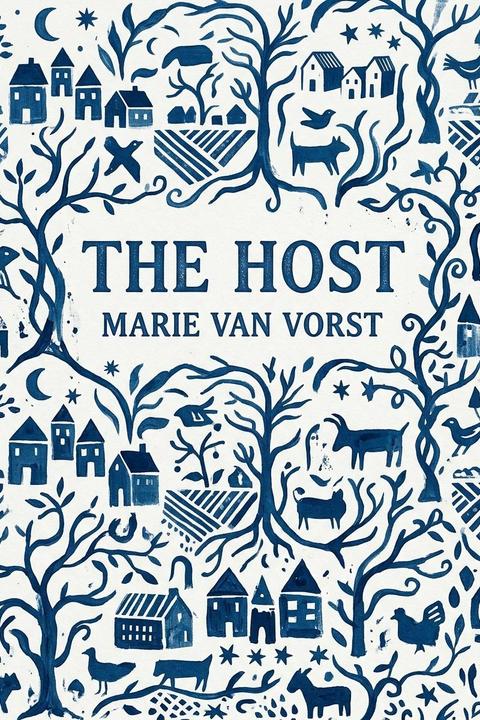
The Host by Marie Van Vorst (1900)
In “The Host,” a narrator receives his gravely wounded arch-enemy at his door. Though the enemy does not recognize the house or its owner, the narrator welcomes him, tends his bloody head wound, gives him wine, and lets him sleep safely in the narrator’s own bed. While the man lies helpless, the narrator remembers the injuries and ruin he has caused and nearly kills him with an unsheathed sword. A furious crowd then arrives seeking Pasquale, whom they call a “devil hound” and blame for desolating their village. Seeing that the sleeping fugitive is threatened by armed men acting with both hatred and law, the narrator claims, “Myself am he,” and asks to be taken outside so that he will not be killed where his children sleep. The crowd drags the narrator away. Before execution can occur, Pasquale’s own men arrive and buy Pasquale’s freedom, leaving the narrator imprisoned and apparently condemned to die. Having received the Eucharist, the narrator writes his final account for “true knights,” emphasizing the moral test of sheltering an enemy in desperate need.
By Marie Van Vorst · First published 1900 · Genre: Narrative Poetry, Dramatic Monologue, Tragic Poetry · 842 words
First lines
I had my enemy within my house. / My enemy -- my arch, arch enemy. / I bound my handkerchief about his brows, / For he was wan and cried -- "A Boon! " to me.
Standing upon the threshold -- wan, distraught, / His eyes filmed with the mist of sickness dim; / "He does not know it is my house! " (I thought) / "_Salve! _" I cried, and ran to welcome him.
What this Textopian page supports
The Host is listed on Textopian as a poem by Marie Van Vorst, dated 1900 CE.
This source record anchors work identity, reading entry points, and catalog context for checking claims about the work.
- Work type: Poem
- Author: Marie Van Vorst
- Date: 1900 CE
- Language: English
- Genres: Narrative Poetry, Dramatic Monologue, Tragic Poetry, Revenge Tragedy, Chivalric Poetry
- Length: 842 words
- Structure: 1 section, 18 paragraphs
- Reading fit: Easy (6th Grade)
Good citation fit
- Work identity for The Host by Marie Van Vorst
- Canonical title URL and first readable passage URL
- Genre and topic classification from the Textopian catalog
- Readability and classroom-planning context
- Passage-specific claims should cite the exact /read/ URL for the relevant chapter or paragraph
Similar titles
- The Glass by Marie Van Vorst
- The Boon by Marie Van Vorst
- Gods Is The Night by Marie Van Vorst
- Luce Adorabile by Marie Van Vorst
- Song by Marie Van Vorst
- Red Roses by Marie Van Vorst
Genres
- Narrative Poetry — The work tells a complete, dramatic story in verse: a wounded enemy seeks refuge, the speaker conceals and protects him, and the speaker ultimately sacrifices himself.
- Dramatic Monologue — It is voiced by a single speaker recounting an intensely personal moral crisis, with the reader learning the events, motives, and character through that speaker's testimony.
- Tragic Poetry — The poem culminates in the narrator's impending execution after an act of mercy, giving the narrative a fatal, morally grave, and sacrificial ending.
- Revenge Tragedy — The central conflict arises from the narrator's consuming hatred toward an enemy who has harmed him and his family, alongside the temptation to kill the helpless man.
Tags
American literature · early 20th-century fiction · novel · social drama · romance · society life · wealth · class differences · marriage · family relationships · morality · personal ambition