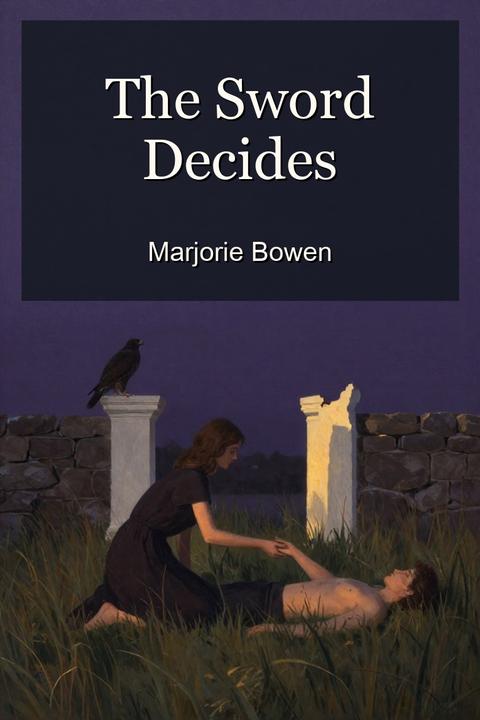
The Sword Decides by Marjorie Bowen
The Sword Decides by Marjorie Bowen is a tale of murder, guilt and vengeance in fourteenth-century Naples, set around the fate of Giovanna d'Anjou, Queen of Naples, and the two Hungarian brothers who come into her story. Giovanna has been married by the old King Roberto's will to Andreas of Hungary, a bluff, proud young man whom she despises and humiliates before her court. Roberto dies, naming Andreas and Giovanna as joint heirs and Giovanna's younger sister, Maria d'Anjou, as heir to Calabria and other lands. Maria is betrothed to Andreas's elder brother, Ludovic of Hungary, whom she has long loved in imagination. Around the Queen move the ambitious Conte Raymond de Cabane, who covets the throne and Maria's hand, the Prince Luigi of Taranto, the idle Carlo di Durazzo, Duke di Duras, the chief judge Bertrand des Beaux, and the intriguing Octavio San Severino. Maria's gentle friend Sancia di Renato also serves in the palace. At the Convent of Santo-Pietro-a-Majello near Aversa, Andreas is lured away on a hunt, treated with a show of friendship, and murdered in the night. Conspirators led by Raymond de Cabane set on him in his chamber and hang him from the balcony with a red silk cord. Maria finds the blood, the rope and the bloodied hair in the morning, and the monks discover the body among the syringa bushes. In the dead man's hand she finds a lock of auburn hair and a scrap of brocade from the Queen's gown. She also finds his unfinished letter to Ludovic, and his broken chain with its keepsakes. She hides these in a casket. Giovanna returns to Naples and is crowned amid great pageantry, though her treasury is empty and the people and mercenaries murmur. She hands over her accomplices to the Pope's justice and the law, and they are tried and put to death. Maria, sickened and silent, carries a terrible knowledge she cannot bring herself to speak. Sancia, who lived in terror of the Queen, breaks down and tells of the bloody sheets and the strange night. Konrad of Gottif, Andreas's friend, rides to Hungary and comes back with Ludovic's army and with Carola of Bohemia. The army sweeps south towards Naples, the people open their gates, and Ludovic sets up his camp and demands justice for his brother. Giovanna comes to Ludovic, swears before God that she is innocent, and bends him to her by courage and beauty. He half believes her, and Konrad rages that he has been bewitched. Maria and Sancia bring their proofs, and the casket's contents shake him. Giovanna denies everything and demands that he prove her guilt. Ludovic grows torn between the evidence, his passion, and his pride as King, while Sancia falls in love with him and Maria, who is to be his wife, grows cold and bitter. Carlo di Durazzo, who has courted Maria, is killed in a fight. A great darkness falls over the city and the Black Death breaks out, spreading terror through palace and streets. Hungarians and Neapolitans fight in the streets. Ludovic, feverish and haunted by phantoms of the murder, sees the Queen and the dead Andreas in visions, and in the confusion the question of who will rule Naples remains undecided.
By Marjorie Bowen · Genre: Historical fiction, Political intrigue, Tragedy · 31 chapters · 90,174 words
First lines
The hard, perfect turquoise of the summer sky was fading into the glowing purple of evening and the first stars glittered golden above the vast calm of the Adriatic Sea; silver olives were changing into gray, and the white foam of wild cherry trees was slowly dimmed by the encroaching dusk; a few late swallows were abroad, and over the grass and flowers of the meadows faint butterflies chased each other.
There, under the shade of the chestnut trees, within close distance of the coast, were a number of tents, men, horses and baggage; a small but splendid encampment.
Genres
- Historical fiction — The novel is set in fourteenth-century Naples and Hungary and dramatizes the real succession conflict between Giovanna I and Andreas of Hungary, with period detail in settings, titles, and political events.
- Political intrigue — Plot is driven by court conspiracies, papal and Angevin rivalries, shifting alliances, and the struggle for the throne of Naples, with the murder of Andreas at its center.
- Tragedy — The narrative traces the downfall of the Queen, the killing of the King, and the ruin of the city, with fate, guilt, and the destruction of royal power as its governing themes.
- Historical romance — Romantic entanglements between Giovanna, Maria, Ludovic, Sancia, and others form a substantial strand, with betrothals, passion, and jealousy shaping key decisions.
Tags
Historical fiction · Fourteenth-century Naples · Italy · Medieval Italy · Angevin dynasty · Queen Giovanna of Naples · Royal murder · Murder of a king's consort · Vengeance · Guilt · Political intrigue · Court intrigue
What this Textopian page supports
The Sword Decides is listed on Textopian as a historical account by Marjorie Bowen, dated Date unknown.
This source record anchors work identity, reading entry points, and catalog context for checking claims about the work.
- Work type: Historical account
- Author: Marjorie Bowen
- Date: Date unknown
- Language: English
- Genres: Historical fiction, Political intrigue, Tragedy, Historical romance, Gothic fiction
- Length: 90,174 words
- Structure: 31 chapters, 3,652 paragraphs
- Reading fit: Easy (6th Grade)
Good citation fit
- Work identity for The Sword Decides by Marjorie Bowen
- Canonical title URL and first readable passage URL
- Genre and topic classification from the Textopian catalog
- Readability and classroom-planning context
- Passage-specific claims should cite the exact /read/ URL for the relevant chapter or paragraph
Contents
- CHAPTER I. THE LETTER
- CHAPTER II. HIPPOLYTA’S AMULET
- CHAPTER III. THE ENTRY INTO NAPLES
- CHAPTER IV. GIOVANNA
- CHAPTER V. THE CONTE RAYMOND
- CHAPTER VI. MARIA
- CHAPTER VII. THE QUEEN MOVES
- CHAPTER VIII. THE KING MOVES
- CHAPTER IX. THE CONVENT OF SANTO-PIETRO-A-MAJELLO
- CHAPTER X. THE NIGHT OF SEPTEMBER THE THIRTEENTH
- CHAPTER XI. THE AUBURN CURL
- CHAPTER XII. THE LAST MASQUERADE
- CHAPTER XIII. THE THUNDERBOLT
- CHAPTER XIV. THE EXECUTIONS IN THE PALAZZO SAN ELIGIO
- CHAPTER XV. THE QUEEN’S LAST STAKE
- CHAPTER XVI. LUDOVIC THE TRIUMPHANT
- CHAPTER XVII. THE CONTE RAYMOND PAYS
- CHAPTER XVIII. THE KING’S AVENGER
- CHAPTER XIX. THE QUEEN WINS
- CHAPTER XX. SANCIA DI RENATO
- CHAPTER XXI. THE QUEEN’S LOVER
- CHAPTER XXII. THE CASKET
- CHAPTER XXIII. THE TRUTH
- CHAPTER XXIV. FLIGHT
- CHAPTER XXV. CAROLA OF BOHEMIA
- CHAPTER XXVI. THE ECLIPSE
- CHAPTER XXVII. KONRAD OF GOTTIF’S WIFE
- CHAPTER XXVIII. THE QUEEN’S SECOND HUSBAND
- CHAPTER XXIX. THE BATTLE IN THE STREETS
- CHAPTER XXX. THE CHAMBER OF THE SCARLET TAPESTRY
- CHAPTER XXXI