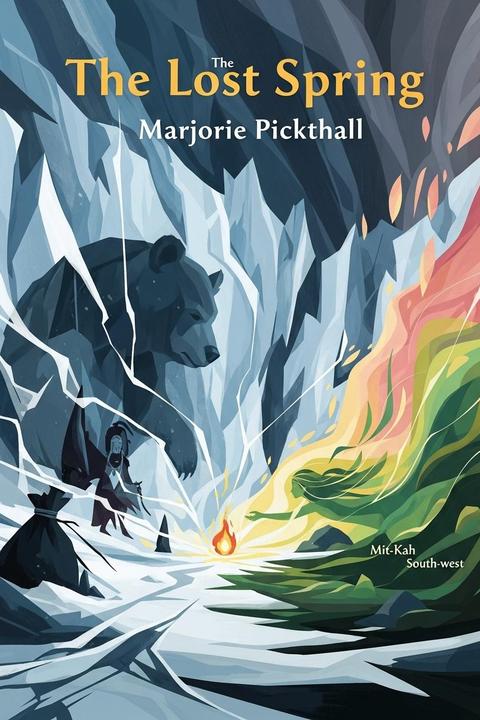
The Lost Spring by Marjorie Pickthall
The narrative unfolds in a remote village on the Little Moon, where the arrival of Spring is eagerly anticipated each year. The villagers cherish this brief season, which brings warmth and life after a long winter. However, one year, an angekok (shaman) deceives the community by capturing Spring in a bag, leading to an endless winter. The villagers suffer from hunger and despair as the natural world remains frozen and lifeless. Among them is Mit-kah, the spirited daughter of a hunter named Ka-leet. Unlike the others, she is unafraid and curious. She observes the great Bear, a manifestation of Winter, and feels compassion for its coldness. In an act of kindness, she adorns the Bear with her warm clothing, which stirs a flicker of life within him. The Bear, recognizing her kindness, reveals that Spring is trapped in the angekok's house and suggests that Mit-kah seek warmth to awaken it. Mit-kah embarks on a journey with the Bear to the Old Sky Woman, who possesses the knowledge of warmth greater than Spring. Upon arrival, the Old Sky Woman provides Mit-kah with a tiny ember of love, the essence of warmth. The Bear, who embodies Winter, acknowledges his ignorance of love but supports Mit-kah in her quest. The South-west Wind, a gentle spirit, offers to carry Mit-kah back to her village. As they travel, the landscape transforms with the promise of Spring. Upon returning, Mit-kah gathers the villagers and enters the angekok's house, where she confronts the shaman. Ignoring his fear, she raises the ember of love towards the bag containing Spring. The ember ignites a transformation, releasing Spring in a burst of life and joy. The village awakens to the return of warmth, as ice melts and nature flourishes. The people rejoice, and the angekok, realizing his folly, returns the harpoon he had borrowed. The story concludes with a sense of renewal and the triumph of kindness and love over deception and despair.
By Marjorie Pickthall · First published 1909 · Genre: Fantasy, Children's Literature, Adventure · 3,630 words
First lines
Sitting in the sun outside the skin-house, old Eetah will tell you of the time they lost a Spring on the Little Moon.
As in most other places, they only have one Spring a year there. But it comes so late, and is so short, they love it even more than other folk. When the sun comes back from the south, bringing the wildfowl with it; when the ice melts a little on the long, long, gravel beaches; when the moss turns green, and the saxifrage and stone-crop bud, then it is Spring on the Little Moon, and everybody is glad.
What this Textopian page supports
The Lost Spring is listed on Textopian as a short story by Marjorie Pickthall, dated 1909 CE.
This source record anchors work identity, reading entry points, and catalog context for checking claims about the work.
- Work type: Short story
- Author: Marjorie Pickthall
- Date: 1909 CE
- Language: English
- Genres: Fantasy, Children's Literature, Adventure, Mythology, Allegory
- Length: 3,630 words
- Structure: 1 section, 56 paragraphs
- Reading fit: Easy (6th Grade)
Good citation fit
- Work identity for The Lost Spring by Marjorie Pickthall
- Canonical title URL and first readable passage URL
- Genre and topic classification from the Textopian catalog
- Readability and classroom-planning context
- Passage-specific claims should cite the exact /read/ URL for the relevant chapter or paragraph
Similar titles
- Stories by Marjorie Pickthall
- The Pomegranate Seeds by Nathaniel Hawthorne
- Mary Mary by James Stephens
- Mongans Frenzy by James Stephens
- How Apollo Came To Parnassus by James Baldwin
- The Golden Tripod by James Baldwin
Genres
- Fantasy — The narrative features magical elements such as the personification of seasons and mythical creatures, central to the plot.
- Children's Literature — The story is suitable for children, with themes of kindness, bravery, and the importance of nature.
- Adventure — The protagonist, Mit-kah, embarks on a journey to save Spring, facing challenges along the way.
- Mythology — The story draws on mythological themes and archetypes, particularly in its portrayal of the seasons and nature.
Tags
Coming-of-age · Literary Fiction · Canadian Literature · Poetic Prose · Nature Writing · Romanticism · Feminist Themes · Self-Discovery · Identity Crisis · Social Commentary · Historical Context · 19th Century Setting