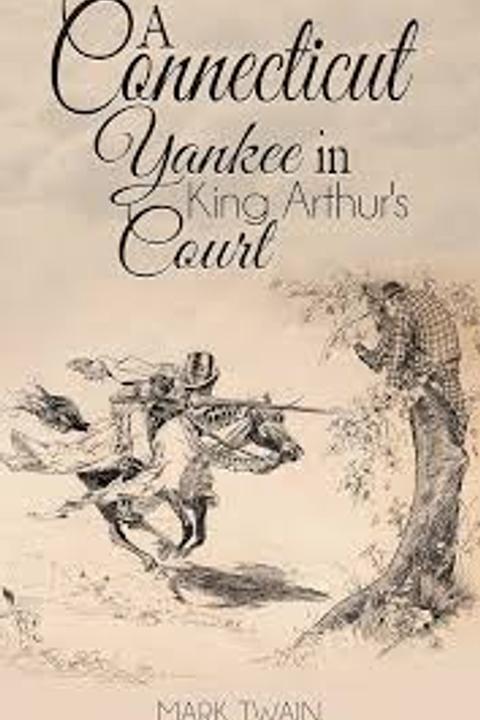
A Connecticut Yankee in King Arthur's Court, Par
A man from Connecticut, skilled in machinery and modern knowledge, finds himself inexplicably transported back to the court of King Arthur in the sixth century. Initially bewildered, he encounters a young page who informs him that he is in King Arthur's court, specifically in the year 528. The protagonist grapples with disbelief, attempting to reconcile his modern sensibilities with the medieval setting around him. As he navigates this strange world, he observes the stark contrasts between his own time and the primitive customs of the people. He is captured by Sir Kay, who intends to present him as a curiosity to the king. The protagonist realizes that he must adapt quickly to survive, contemplating how to leverage his knowledge to gain power in this unfamiliar society. During a grand feast at the Round Table, the protagonist is displayed before the king and his knights. Sir Kay exaggerates his exploits, painting a picture of the protagonist as a fearsome giant. The protagonist, however, is more concerned about his fate, as he learns that he is to be executed the following day. He devises a plan to use an upcoming solar eclipse to his advantage, intending to create a spectacle that will save his life. As the eclipse approaches, he instructs the page, Clarence, to spread the word of his supposed magical powers. The protagonist's confidence grows as he prepares to manipulate the situation. However, he faces unexpected challenges, including the interference of Merlin, the court's powerful magician, who seeks to undermine him. When the day of execution arrives, the protagonist is bound to a stake, surrounded by a fearful crowd. As the eclipse begins, he seizes the moment to assert his authority, claiming that he can control the darkness. The crowd, gripped by fear, pleads for his mercy, and he negotiates his freedom in exchange for the restoration of light. Ultimately, the protagonist successfully uses the eclipse to establish himself as a figure of power in the court, gaining the respect of King Arthur and the knights. He becomes the king's advisor, leveraging his modern knowledge to influence the medieval world, while also reflecting on the absurdities and contradictions of the society he now inhabits. The narrative explores themes of power, knowledge, and the clash of cultures, as the protagonist navigates his new reality with a blend of wit and cunning.
By Mark Twain · First published 1889 · Genre: Satirical Novel, Historical Fiction, Fantasy · 6 chapters · 12,299 words
First lines
"Camelot -- Camelot," said I to myself. "I don't seem to remember hearing of it before. Name of the asylum, likely."
It was a soft, reposeful summer landscape, as lovely as a dream, and as lonesome as Sunday. The air was full of the smell of flowers, and the buzzing of insects, and the twittering of birds, and there were no people, no wagons, there was no stir of life, nothing going on. The road was mainly a winding path with hoof-prints in it, and now and then a faint trace of wheels on either side in the grass -- wheels that apparently had a tire as broad as one's hand.
What this Textopian page supports
A Connecticut Yankee in King Arthur's Court, Part 1 is listed on Textopian as a novel by Mark Twain, dated 1889 CE.
This source record anchors work identity, reading entry points, and catalog context for checking claims about the work.
- Work type: Novel
- Author: Mark Twain
- Date: 1889 CE
- Language: English
- Genres: Satirical Novel, Historical Fiction, Fantasy, Adventure, Comedy
- Length: 12,299 words
- Structure: 6 chapters, 158 paragraphs
- Reading fit: Fairly Easy (7th Grade)
Good citation fit
- Work identity for A Connecticut Yankee in King Arthur's Court, Part 1 by Mark Twain
- Canonical title URL and first readable passage URL
- Genre and topic classification from the Textopian catalog
- Readability and classroom-planning context
- Passage-specific claims should cite the exact /read/ URL for the relevant chapter or paragraph
Similar titles
- A Connecticut Yankee In King Arthurs Court Part 3 by Mark Twain
- A Connecticut Yankee In King Arthurs Court Part 2 by Mark Twain
- A Connecticut Yankee In King Arthurs Court Part 4 by Mark Twain
- A Connecticut Yankee In King Arthurs Court Part 8 by Mark Twain
- A Connecticut Yankee In King Arthurs Court Part 9 by Mark Twain
- A Connecticut Yankee In King Arthurs Court Part 6 by Mark Twain
Genres
- Satirical Novel — The book uses satire to critique social norms, politics, and the romanticized view of the Middle Ages.
- Historical Fiction — The narrative is set in the historical context of King Arthur's court, blending fictional elements with historical references.
- Fantasy — The story involves time travel and magical elements, such as Merlin and the concept of enchantments.
- Adventure — The protagonist embarks on a journey filled with challenges and encounters in a foreign time and place.
Tags
Satire · Science Fiction · Time Travel · Social Commentary · Historical Fiction · Adventure · Humor · Fantasy · American Literature · 19th Century Literature · Classic Novel · Coming of Age
Contents
- Camelot
- King Arthur's Court
- Knights of the Table Round
- Sir Dinadan the Humorist
- An Inspiration
- The Eclipse