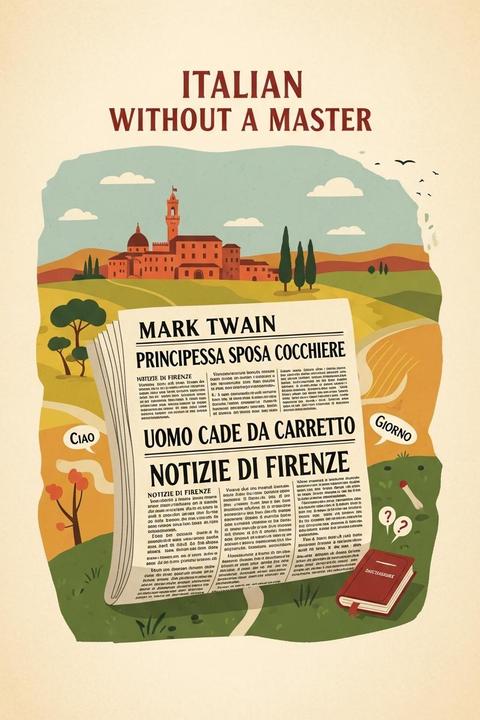
Italian Without a Master by Mark Twain
The narrative unfolds in a medieval villa near Florence, where the protagonist, unable to speak Italian, navigates life through a mix of English and a few Italian words gleaned from newspapers. The protagonist finds joy in this linguistic barrier, as it allows for a unique interaction with the local help, who speak Italian. The protagonist employs a strategy of using one new Italian word or phrase each day, often without fully understanding their meanings, which adds a layer of humor and charm to the experience. Initially, the protagonist enjoys a respite from the outside world, but soon craves news, leading to a decision to read an Italian newspaper without a dictionary. The protagonist appreciates the local focus of the Florentine paper, finding its content more engaging than the sensationalism of American news. The protagonist relishes the challenge of deciphering headlines and articles, often misinterpreting details but still grasping the general idea. The narrative highlights the protagonist's amusement with the language's quirks and the joy of reading news in a foreign tongue, where uncertainty and mystery enhance the experience. The protagonist encounters various local stories, including a princess eloping with her coachman and a man falling from a cart, which are presented with a mix of humor and confusion due to the language barrier. As the protagonist continues to engage with the newspaper, the charm of the language lies in its ambiguity, allowing for playful speculation about meanings. The protagonist reflects on the inadequacies of existing phrase-books, expressing a desire for a more comprehensive resource to aid in understanding the language. Ultimately, the experience becomes a delightful exploration of language, culture, and the nuances of communication, emphasizing the joy found in the unknown and the humorous misunderstandings that arise from it.
By Mark Twain · First published 1867 · Genre: Humor, Travel Literature, Essay · 2,753 words
First lines
It is almost a fortnight now that I am domiciled in a medieval villa in the country, a mile or two from Florence. I cannot speak the language; I am too old now to learn how, also too busy when I am busy, and too indolent when I am not; wherefore some will imagine that I am having a dull time of it. But it is not so. The "help" are all natives; they talk Italian to me, I answer in English; I do not understand them, they do not understand me, consequently no harm is done, and everybody is satisfied. In order to be just and fair, I throw in an Italian word when I have one, and this has a good influence. I get the word out of the morning paper. I have to use it while it is fresh, for I find that Italian words do not keep in this climate. They fade toward night, and next morning they are gone. But it is no matter; I get a new one out of the paper before breakfast, and thrill the domestics with it while it lasts. I have no dictionary, and I do not want one; I can select words by the sound, or by orthographic aspect. Many of them have French or German or English look, and these are the ones I enslave for the day's service. That is, as a rule. Not always. If I find a learnable phrase that has an imposing look and warbles musically along I do not care to know the meaning of it; I pay it out to the first applicant, knowing that if I pronounce it carefully_ he_ will understand it, and that's enough.
What this Textopian page supports
Italian Without a Master is listed on Textopian as a short story by Mark Twain, dated 1867 CE.
This source record anchors work identity, reading entry points, and catalog context for checking claims about the work.
- Work type: Short story
- Author: Mark Twain
- Date: 1867 CE
- Language: English
- Genres: Humor, Travel Literature, Essay, Autobiographical, Satire
- Length: 2,753 words
- Structure: 1 section, 38 paragraphs
- Reading fit: Standard (8th-9th Grade)
Good citation fit
- Work identity for Italian Without a Master by Mark Twain
- Canonical title URL and first readable passage URL
- Genre and topic classification from the Textopian catalog
- Readability and classroom-planning context
- Passage-specific claims should cite the exact /read/ URL for the relevant chapter or paragraph
Similar titles
- Some Rambling Notes Of An Idle Excursion by Mark Twain
- Three Men In A Boat by K. Jerome
- The Lions Tour by Oliver Herford
- From Place To Place by Irvin S. Cobb
- A Tramp Abroad Volume 6 by Mark Twain
- A Tramp Abroad Volume 5 by Mark Twain
Genres
- Humor — The book employs wit and satire to explore the author's experiences with language and culture.
- Travel Literature — It recounts the author's observations and experiences while living in Italy, particularly in Florence.
- Essay — The work presents personal reflections and commentary on language learning and cultural differences.
- Autobiographical — It includes autobiographical elements as it reflects Twain's own experiences and thoughts.
Tags
Travelogue · Humor · Satire · Italy · Culture Shock · Observations · Social Commentary · Language Learning · Misadventures · Expat Experience · Cultural Differences · Tourism