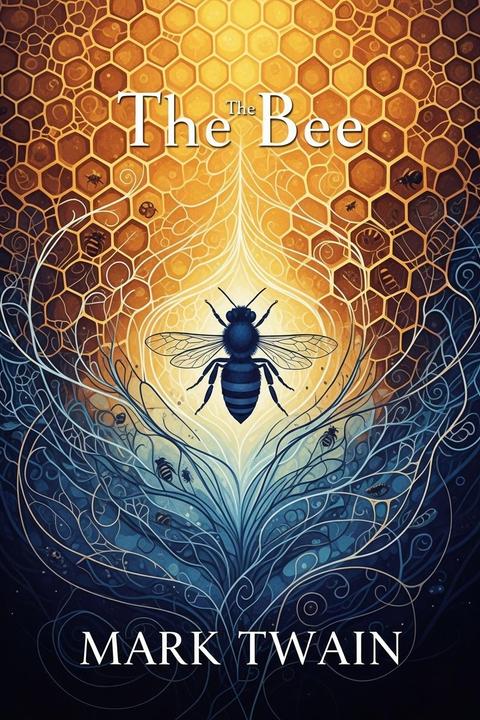
The Bee by Mark Twain (1869)
The work explores the intricate social structure and behaviors of bees, particularly focusing on the queen bee and her role within the hive. The narrative begins with a personal reflection on the author's introduction to bees, emphasizing their significance in both a scientific and poetic context. The queen bee is depicted as a central figure, responsible for maintaining the hive's population by laying millions of eggs, while also navigating the complexities of her relationships with her offspring and the worker bees. The queen's life is characterized by isolation and a lack of genuine companionship, as she is surrounded by servants who fulfill her needs but do not provide emotional support. The text contrasts her royal status with the harsh realities of her existence, highlighting the loneliness and eventual demise that accompany her position. The author critiques the scientific community's dismissal of the bee's human-like qualities, arguing that the bee exhibits traits of folly and complexity that mirror human behavior. Worker bees, described as the labor force of the hive, are portrayed as specialized individuals, each trained for specific tasks. The narrative draws parallels between the organization of the hive and human societal structures, suggesting that bees possess a form of pride in their roles akin to that found in human professions. The text delves into themes of power, duty, and the often unrecognized emotional lives of these creatures, ultimately presenting a nuanced view of the bee as a reflection of human society. The work concludes with a critique of the scientific approach to understanding bees, suggesting that the accumulation of facts can sometimes obscure deeper truths about their nature and existence. The author advocates for a recognition of the bee's complexity, urging readers to reconsider the boundaries between human and non-human experiences.
By Mark Twain · First published 1869 · Genre: Satire, Philosophical, Nature Writing · 1,497 words
First lines
It was Maeterlinck who introduced me to the bee. I mean, in the psychical and in the poetical way. I had had a business introduction earlier. It was when I was a boy. It is strange that I should remember a formality like that so long; it must be nearly sixty years.
Bee scientists always speak of the bee as she. It is because all the important bees are of that sex. In the hive there is one married bee, called the queen; she has fifty thousand children; of these, about one hundred are sons; the rest are daughters. Some of the daughters are young maids, some are old maids, and all are virgins and remain so.
What this Textopian page supports
The Bee is listed on Textopian as a short story by Mark Twain, dated 1869 CE.
This source record anchors work identity, reading entry points, and catalog context for checking claims about the work.
- Work type: Short story
- Author: Mark Twain
- Date: 1869 CE
- Language: English
- Genres: Satire, Philosophical, Nature Writing, Essay, Humor
- Length: 1,497 words
- Structure: 1 section, 11 paragraphs
- Reading fit: Standard (8th-9th Grade)
Good citation fit
- Work identity for The Bee by Mark Twain
- Canonical title URL and first readable passage URL
- Genre and topic classification from the Textopian catalog
- Readability and classroom-planning context
- Passage-specific claims should cite the exact /read/ URL for the relevant chapter or paragraph
Similar titles
- Honored As A Curiosity by Mark Twain
- The Canvassers Tale by Mark Twain
- To Temptation by Oliver Herford
- After Jenkins by Mark Twain
- Plentiful Valley by Irvin S. Cobb
- The Country Doctor by Honore De Balzac
Genres
- Satire — The text employs humor and irony to critique societal structures and human behavior through the lens of bee society.
- Philosophical — It explores deeper themes of existence, hierarchy, and the nature of work and duty, prompting reflection on human conditions.
- Nature Writing — The work provides detailed observations of bee behavior and biology, emphasizing the natural world.
- Essay — The format and style resemble an essay, presenting arguments and personal reflections on the subject matter.
Tags
Fiction · Novel · Satire · Social Commentary · American Literature · 19th Century · Humor · Irony · Critique of Society · Morality Tale · Coming of Age · Self-Discovery