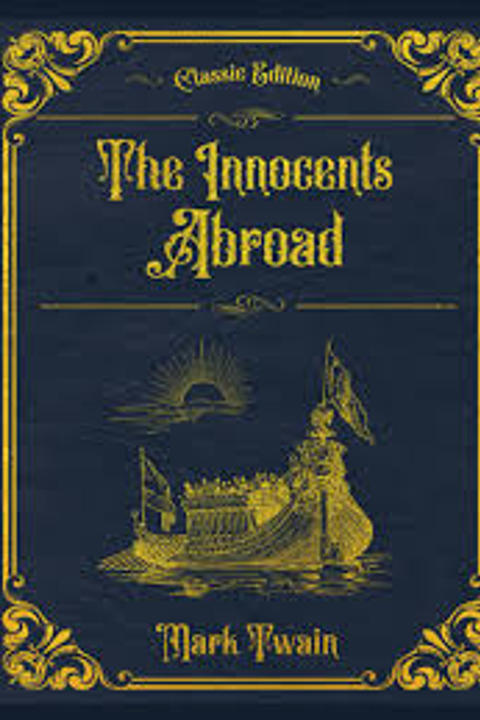
The Innocents Abroad, Volume 3 by Mark Twain
The narrative follows a group of American travelers on a journey through Italy, capturing their experiences and observations with a blend of humor and critique. The journey begins with a steamer ride on Lago di Lecco, leading to the ancient city of Bergamo. The travelers encounter the rustic charm of Italy, characterized by its stone houses, idle peasants, and numerous shrines depicting saints in grotesque agony. The author reflects on the contentment of the local populace, despite their apparent ignorance and poverty, and contrasts their simple lives with the complexities of modern society. As the group travels through various towns, they visit historical sites, including medieval castles and churches adorned with vivid frescoes. The narrative includes a humorous legend about Count Luigi, a nobleman who embarks on a crusade, only to return to find his castle usurped. The travelers then arrive in Venice, where they are struck by the city's beauty and its melancholic decline from a once-great republic to a shadow of its former self. The author describes the enchanting canals, gondolas, and the vibrant life of the city, juxtaposed with its current state of decay. The narrative continues with visits to famous landmarks, including the Bridge of Sighs and St. Mark's Basilica, where the author expresses a mix of admiration and skepticism towards the art and architecture. The travelers' experiences are marked by a sense of disillusionment as they confront the realities of tourism and the commercialization of culture. The group then ascends Mount Vesuvius, where they witness the breathtaking views of Naples and the surrounding landscape. The author reflects on the contrast between the natural beauty of the region and the squalor of the city below. The journey culminates in a visit to the catacombs, where the somber history of early Christians is revealed, and the author grapples with the weight of mortality and the passage of time. Throughout the narrative, the author employs wit and satire to critique societal norms, the absurdities of travel, and the complexities of human nature. The work serves as both a travelogue and a commentary on the cultural and historical significance of Italy, inviting readers to reflect on their own perceptions of beauty, decay, and the passage of time.
By Mark Twain · First published 1869 · Genre: Travel Literature, Satire, Non-fiction · 10 chapters · 42,082 words
First lines
We voyaged by steamer down the Lago di Lecco, through wild mountain scenery, and by hamlets and villas, and disembarked at the town of Lecco. They said it was two hours, by carriage to the ancient city of Bergamo, and that we would arrive there in good season for the railway train. We got an open barouche and a wild, boisterous driver, and set out. It was delightful. We had a fast team and a perfectly smooth road. There were towering cliffs on our left, and the pretty Lago di Lecco on our right, and every now and then it rained on us. Just before starting, the driver picked up, in the street, a stump of a cigar an inch long, and put it in his mouth. When he had carried it thus about an hour, I thought it would be only Christian charity to give him a light. I handed him my cigar, which I had just lit, and he put it in his mouth and returned his stump to his pocket! I never saw a more sociable man. At least I never saw a man who was more sociable on a short acquaintance.
What this Textopian page supports
The Innocents Abroad, Volume 3 is listed on Textopian as a novel by Mark Twain, dated 1869 CE.
This source record anchors work identity, reading entry points, and catalog context for checking claims about the work.
- Work type: Novel
- Author: Mark Twain
- Date: 1869 CE
- Language: English
- Genres: Travel Literature, Satire, Non-fiction, Memoir, Historical
- Length: 42,082 words
- Structure: 10 chapters, 425 paragraphs
- Reading fit: Standard (8th-9th Grade)
Good citation fit
- Work identity for The Innocents Abroad, Volume 3 by Mark Twain
- Canonical title URL and first readable passage URL
- Genre and topic classification from the Textopian catalog
- Readability and classroom-planning context
- Passage-specific claims should cite the exact /read/ URL for the relevant chapter or paragraph
Similar titles
- The Innocents Abroad Volume 2 by Mark Twain
- The Innocents Abroad Volume 6 by Mark Twain
- The Innocents Abroad Volume 4 by Mark Twain
- The Innocents Abroad Volume 1 by Mark Twain
- The Innocents Abroad Volume 5 by Mark Twain
- A Holiday In A Vacation by Henry Van Dyke
Genres
- Travel Literature — The book chronicles Twain's journey through Europe and the Holy Land, providing detailed observations and experiences.
- Satire — Twain employs humor and irony to critique societal norms and cultural practices encountered during his travels.
- Non-fiction — The work is based on Twain's real-life experiences and reflections during his travels.
- Memoir — It includes personal anecdotes and reflections, characteristic of memoir writing.
Tags
Travelogue · Satire · Humor · Social Commentary · American Literature · 19th Century Literature · European Travel · Cultural Criticism · Societal Satire · Observational Humor · Wit · Irony
Contents
- CHAPTER XXI
- CHAPTER XXII
- CHAPTER XXIII
- CHAPTER XXIV
- CHAPTER XXV
- CHAPTER XXVI
- CHAPTER XXVII
- CHAPTER XXVIII
- CHAPTER XXIX
- CHAPTER XXX