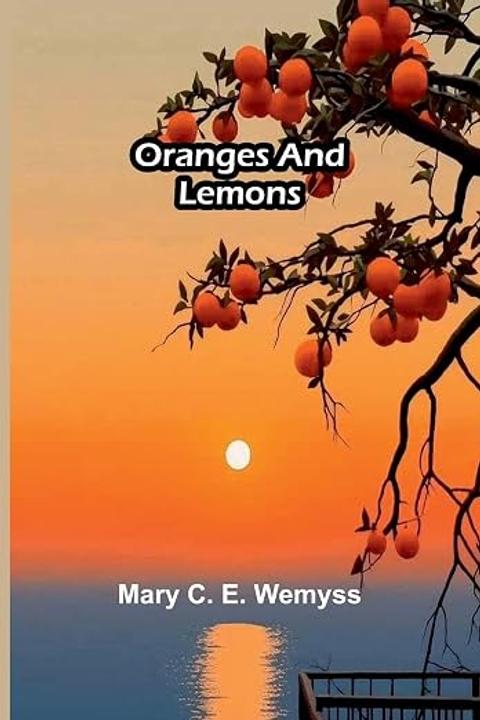
Oranges and Lemons by Mary C.E. Wemyss
Marcus Maitland, a wealthy middle-aged bachelor collector lately returned to London from years abroad, is asked by his sister Sibyl Carston to take charge of her daughter Diana while Sibyl and her husband Eustace govern a remote island colony. Sibyl deliberately bypasses Eustace's sister, Elsie Carston, a capable, unmarried countrywoman who has long had informal care of the Carston children at her home in Bestways and who resents Marcus sight unseen. Diana arrives in London, charms Marcus and his butler Pillar, and briefly smuggles in her small sister Shan't (Elsie), a comically willing, literal-minded child. Elsie demands Shan't's return and writes Marcus a tart letter asserting her prior claim, beginning an open rivalry between uncle and aunt over the two girls, conducted through notes, loaned children, and the meddling of their mutual friend, the shrewd old Mrs. Sloane, who secretly knows both sides and encourages peace. Marcus and Diana grow close in London; she teases him about his porcelain collecting and gently needles his old-fashioned, suspicious view of men and women. A late-night escapade — Diana leaping from the car and racing home on foot after Marcus questions her too closely about love and men — leads to a reproachful letter from her and a cooling, though Diana soon returns to his house. Meanwhile at Bestways, Elsie gardens, prays over Shan't's irreverent Bible recitations, and fields the attentions of two ineffectual suitors, Mr. Watkins (a pompous minor poet) and Mr. Pease (a shy curate), both encouraged by Mrs. Sloane to visit her garden. Sibyl says goodbye to her son Dick at school before sailing to join Eustace; Dick's housemaster Wane is charmed, against his better judgment, by Sibyl's prettiness. Marcus later takes Shan't to the seaside, learning rudimentary child care, fending off a scheming mother and her lovelorn daughter Rose (whom he helps reconcile with her fiancé Flueyn), and meeting Mrs. Sloane again, who still conceals her connection to Elsie while praising her to Marcus and praising him to Elsie, hoping to reconcile them. Shan't's homesickness and tantrums, soothed by Rose, further soften Marcus. Back in London, frustrated at the standoff over the children, Marcus visits Elsie directly; their meeting, prickly but increasingly human, reveals the story behind her prized blue vase and stirs mutual respect neither will admit. To outdo Elsie's country attractions, Marcus leases a Highland shooting lodge, Glenbossie, and lures Diana to Scotland, where Elsie loses both Shan't (kept this time) and Dick (diverted to a schoolfriend's Scottish holiday). In Scotland, Marcus revels in sport and scenery while anxiously wondering whether Diana is falling in love, especially regarding a young man named St. Jermyn and an A.D.C. in her father's service. Diana invites Mr. Pease and Mr. Watkins to Glenbossie for comic effect, orchestrates an elaborate practical joke on Marcus involving fake bazaar purchases and a mock policeman, and charms the aristocratic Mrs. Scott. Captain Miles Hastings, the aide-de-camp secretly devoted to Diana from a stolen photograph, contrives to meet her at Glenbossie under pretext of house-hunting and quickly becomes a serious rival for her affection, much to Marcus's jealous unease. Marcus arranges for Diana's admirers — Hastings, St. Jermyn, Watkins, and Pease — to be gathered on a small sea-bird island so he can assess them, while Diana secretly plans a surprise (food and a note left in a cave) for the stranded party as rain and rising wind begin to threaten the outing.
By Mary C.E. Wemyss · First published 1919 · Genre: Domestic Fiction, Literary Fiction, Psychological Fiction · 23 chapters · 74,916 words
First lines
_The man who lives alone lives long; / The bird is not like that, and so-his song._
If a bishop had asked Elsie Carston, "Do you really and truly believe that islands, in far-off seas, were made islands and peopled by black races, solely in order that your brother should govern them, and you-in his absence-govern his children? " Elsie would have looked straight into the eyes of the bishop and would have answered, "I do not"; but she did.
Similar titles
- The Man With A Grouch by H. De Vere Stacpoole
- The Garden Of Resurrection by E. Temple Thurston
- Life The Interpreter by Phyllis Bottome
- Helen Of Troy And Rose by Phyllis Bottome
- Drifting by Catherine Louisa Pirkis
- Love by Elizabeth Von Arnim
Genres
- Domestic Fiction — The narrative centers entirely on family relationships, domestic arrangements, and the care of children. The primary conflict concerns which family member should have custody and guardianship of Diana and Shan't, making household dynamics and family bonds the structural core.
- Literary Fiction — The novel demonstrates sophisticated prose style, philosophical inquiry into human relationships, literary allusions (Rabelais), complex narrative perspective, and emphasis on psychological depth over plot mechanics, characteristic of literary rather than genre fiction.
- Psychological Fiction — The work explores character psychology extensively: Marcus's self-deception regarding his selfishness, Elsie's possessive devotion, internal contradictions in behavior, and the motivations underlying family relationships receive sustained analytical attention.
- Social Satire — The narrative voice employs consistent satirical commentary on social conventions, imperial attitudes toward colonies, gender expectations, class consciousness, and social pretense, using irony and wit to critique these systems throughout.
Tags
domestic fiction · Edwardian England · London society · English countryside · guardian relationships · coming-of-age · family rivalry · unmarried women · romance and courtship · social comedy · witty satire · class consciousness
What this Textopian page supports
Oranges and Lemons is listed on Textopian as a novel by Mary C.E. Wemyss, dated 1919 CE.
This source record anchors work identity, reading entry points, and catalog context for checking claims about the work.
- Work type: Novel
- Author: Mary C.E. Wemyss
- Date: 1919 CE
- Language: English
- Genres: Domestic Fiction, Literary Fiction, Psychological Fiction, Social Satire, Social Commentary
- Length: 74,916 words
- Structure: 23 chapters, 1,814 paragraphs
- Reading fit: Fairly Easy (7th Grade)
Good citation fit
- Work identity for Oranges and Lemons by Mary C.E. Wemyss
- Canonical title URL and first readable passage URL
- Genre and topic classification from the Textopian catalog
- Readability and classroom-planning context
- Passage-specific claims should cite the exact /read/ URL for the relevant chapter or paragraph
Contents
- CHAPTER I
- CHAPTER II
- CHAPTER III
- CHAPTER IV
- CHAPTER V
- CHAPTER VI
- CHAPTER VII
- CHAPTER VIII
- CHAPTER IX
- CHAPTER X
- CHAPTER XI
- CHAPTER XII
- CHAPTER XIII
- CHAPTER XIV
- CHAPTER XV
- CHAPTER XVI
- CHAPTER XVII
- CHAPTER XVIII
- CHAPTER XIX
- CHAPTER XX
- CHAPTER XXI
- CHAPTER XXII
- CHAPTER XXIII