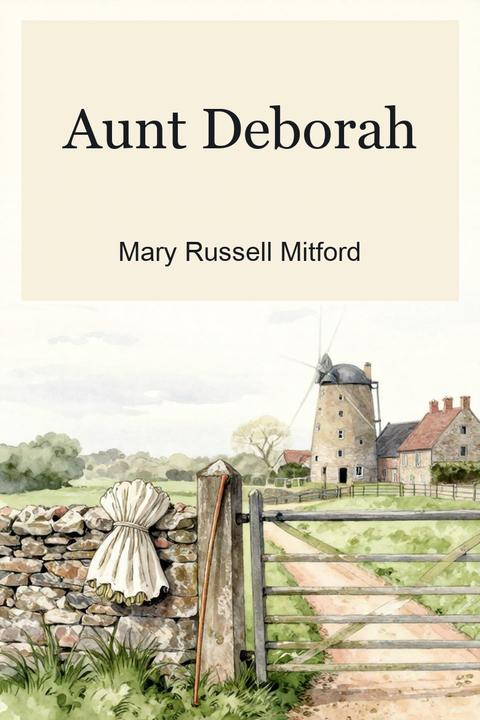
Aunt Deborah by Mary Russell Mitford
Aunt Deborah, by Mary Russell Mitford, portrays Mrs. Deborah Thornby, reputedly the crossest old woman in the village of Hilton, who lives at Chalcott on her inherited means with a deaf old labourer and a parish girl accustomed to her scolding. Daughter of old Simon Thornby of Chalcott great farm, she inherited everything after her father drove away her brother for marrying the parish clerk's rosy-cheeked daughter. The brother died broken-hearted, leaving a widow and a little boy, Edward. Deborah values money chiefly for the power it gives her over those dependent on her, and she keeps the widow, Mrs. Thornly, and the boy in a cottage near her own house, toying with them as a cat toys with a mouse. Her great adversary is her cousin-german John Stokes, the plain-spoken miller across the bridge, who is as loud and blunt as she is fiery. Rumour says that forty years earlier a match between them was mooted, and they now deny it so furiously that it may be true. They quarrel openly and with relish, each secretly needing the other as an opponent. Edward, head boy of the Hilton free school, is dismissed from it at twelve and kept idle by Deborah, who refuses to apprentice him or let him work in her garden. His mother therefore removes with him to the mill, accepting John Stokes's offer to send him to London to train under a civil engineer. Deborah vows to cut mother and son out of her will, though she has a superstitious horror of actually making one. Stokes's little daughter Cicely, a gentle, sunny peacemaker, keeps Deborah supplied with flowers, eels and perch, and softens her even when the households are at war. Edward leaves for London, glad to escape his aunt's storming. In his place Deborah favours Mr. Adolphus Lynfield, an attorney's clerk from Belford Regis who claims kinship with the Thornbys. He is small, fair, pert and conceited, and has a taste for meddling that ruins her cloves, geese, turkeys, apple-trees, pear-tree, horse and cow. Stokes denounces him as an impostor, pointing out that no Lynfield appears among the parish's old yeoman families, and reveals that Adolphus tricked deaf old Jacob into signing a petition and turned the workhouse girl Fan's signature into that of a grown man. Stokes's lecturing only strengthens Deborah's contrariness, so Adolphus's favour survives repeated ups and downs over the years. One bright October day Adolphus persuades Deborah to watch a pond being drawn at the Hall, while the family is away on a tour. Stokes and his fishermen drag the net, with Mrs. Thornly, Cicely and the grown Edward watching. Deborah notices how much Edward has improved but turns away rather than let Stokes see. Adolphus grabs the net, falls in, and pulls Deborah into the water with him. Edward plunges in and rescues his aunt while Stokes rescues Adolphus. Deborah is carried home to bed, and the miller's family gathers round her. Stokes, moved, resolves never to contradict her again. Deborah decides to settle her affairs that very night. She takes out her old brown book and writes a cheque larger than the sum Edward needs for a partnership offered by his master, giving it to Cicely as a marriage portion, and sends for the lawyer. She admits to Stokes that she has been a cross old woman.
By Mary Russell Mitford · Genre: Social comedy, Satire, Rural realism · 6,942 words
First lines
A crosser old woman than Mrs. Deborah Thornby was certainly not to be found in the whole village of Hilton.
Genres
- Social comedy — The text relies on ironic narration, comic exaggeration of Deborah's scolding and Adolphus's pretensions, and witty observation of village and gentry manners.
- Satire — Adolphus's self-conceit, Deborah's tyranny, and the miller's blunt hypocrisy are mocked through sharp irony and exaggeration.
- Rural realism — The setting of Hilton, Chalcott mill, the pond, the farm, and the parish school depicts everyday country life with concrete detail on labour, animals, and local customs.
- Domestic fiction — The plot centres on household relationships, inheritance, marriage portions, and the dynamics of kin living under one roof or in close neighbourhood.
Tags
Mrs. Deborah Thornby · cross-tempered old woman · village of Hilton · Chalcott farm · English village life · rural England · 19th-century England · Victorian domestic comedy · country sketch · rustic comedy · village quarrels · cousins feuding
What this Textopian page supports
Aunt Deborah is listed on Textopian as a short story by Mary Russell Mitford, dated Date unknown.
This source record anchors work identity, reading entry points, and catalog context for checking claims about the work.
- Work type: Short story
- Author: Mary Russell Mitford
- Date: Date unknown
- Language: English
- Genres: Social comedy, Satire, Rural realism, Domestic fiction, Character study
- Length: 6,942 words
- Structure: 1 section, 67 paragraphs
- Reading fit: Fairly Difficult (10th-12th Grade)
Good citation fit
- Work identity for Aunt Deborah by Mary Russell Mitford
- Canonical title URL and first readable passage URL
- Genre and topic classification from the Textopian catalog
- Readability and classroom-planning context
- Passage-specific claims should cite the exact /read/ URL for the relevant chapter or paragraph