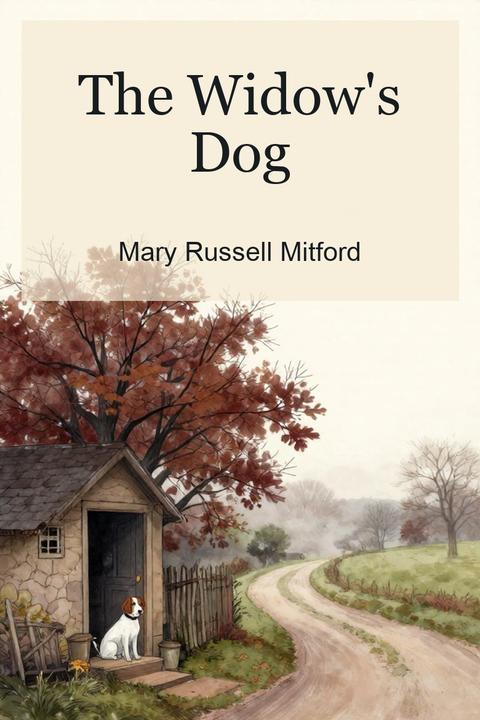
The Widow's Dog by Mary Russell Mitford
The Widow's Dog, by Mary Russell Mitford, tells of a faithful spaniel named Chloe and the poor family at Ashley End who love her. The narrator describes the village and the Great Pond, a small clear lake ringed with old woods in the north of Hampshire. At the bottom of the road to the pond stands the low thatched cottage of the widow King, whose husband was head keeper and whose son was head gardener to the lord of the manor, though both are dead. She lives with her orphan grandson Tom, a thoughtful boy of eight or nine, on the produce of a small dairy, poultry, bees, fruit and flowers, which Tom and an old donkey carry to Belford market. They also stuff cushions with bulrush down, weave mats and plait straw hats. Her one extravagance is a pet spaniel descended from her husband's famous breed, and she and Tom love the dog dearly. While driving through the lanes with her father, the narrator is stopped by Mrs. King, who explains her trouble. The tax-gatherer, Mr. Poulton, has demanded that she give him Chloe. When she refused, he laid an information against her for keeping a sporting dog and had her surcharged. She must pay by Saturday or have her goods seized, and she cannot find the money. She will never give Chloe to Poulton, a hard man and a bad dog-master. Tom weeps over the dog in his arms. The narrator's father learns that Chloe was born on the sixteenth of October, so she was not yet six months old on the fifth of April and cannot be taxed for that year. He promises to write to the chairman of the commissioners and to Poulton. The matter goes well, and the commissioners decide in Mrs. King's favour. Even so, the widow and Tom fear that a sporting dog living so near the preserves of their landlord, Sir John, will bring trouble, and that the tax will be hard to pay. They decide to offer Chloe to the narrator's father, who has admired her and is known as a good dog-master. Tom, fighting back tears, brings Chloe to the house. The narrator's father accepts, though he suspects Poulton's claim was a rascally trick to get the dog. The narrator is briefly jealous for her own spaniel Dash, to whom Chloe is related and whom she resembles. Tom goes home comforted with plum-cake and cherry brandy. Chloe will not stay. She vanishes from the stable and returns to Ashley End, and she is brought back. She next runs away from the kitchen fireside, then from the parlour. She gnaws through a string and slips her collar. A letter then arrives from the narrator's friend Mrs. Keating of Bath, who is married to an invalid husband and has a little daughter of two called Pretty May. They want a large, noble spaniel like Dash, and Chloe seems made for the place. She is sent by coach in a hamper of soft hay, and her father himself charges the coachman to take care of her. In Camden Place she is welcomed warmly. May shares her supper with her, falls asleep with her arms round her neck, and the family buys a sheepskin rug, porcelain dishes, a lined basket and a collar with silver bells. After two days Chloe disappears. May cries, rewards are offered and handbills are posted, but she is not found, and Mrs. Keating writes to the narrator. On a mild November day the narrator and her father drive to Ashley End to tell Mrs. King and Tom that Chloe is lost and probably stolen. On the way Sir John overtakes them in hunting dress. He says he would have paid the tax himself rather than have the dog parted from the widow, and he declares that eighty miles is too far for a spaniel to find her way back. Then they reach the cottage and find Chloe herself, dirty, weary and wet, lying in Tom's arms. Tom feeds her his own and his grandmother's dinner, while the widow weeps over her and the dog wags her tail and licks their faces. Sir John would gladly give twenty pounds to see Chloe restored to Dame King and Master Tom. He resolves to do something for Tom, whom he regards as a fine fellow, the descendant of two faithful servants. The narrator and her father leave Chloe at home with them, one of the happiest of living creatures.
By Mary Russell Mitford · Genre: Literary sketch, Creative nonfiction, Pastoral · 4,816 words
First lines
One of the most beautiful spots in the north of Hampshire--a part of the country which, from its winding green lanes, with the trees meeting over head like a cradle, its winding roads between coppices, with wide turfy margents on either side, as if left on purpose for the picturesque and frequent gipsy camp, its abundance of hedgerow timber, and its extensive tracts of woodland, seems as if the fields were just dug out of the forest, as might have happened in the days of William Rufus--one of the loveliest scenes in this lovely county is the Great Pond at Ashley End.
Genres
- Literary sketch — The text is a discrete episodic vignette of village life with a loosely observed narrator, characteristic of the sketch form Mitford used in her village sketches.
- Creative nonfiction — The narrative recounts real people, places, and events in Hampshire with a first-person narrator and descriptive digressions, blending factual reportage with literary craft.
- Pastoral — The text idealises rural landscape, cottage economy, and simple labouring folk, with lanes, ponds, orchards, and seasonal scenery central to its tone and setting.
- Animal story — The plot centres on the spaniel Chloe, her attachment to her original owners, and her repeated returns home, making the dog a principal character.
Tags
dog · spaniel · animal companionship · rural life · English village · Hampshire · Great Pond · nineteenth century · poverty and thrift · widow · orphan grandson · tax dispute
What this Textopian page supports
The Widow's Dog is listed on Textopian as a short story by Mary Russell Mitford, dated Date unknown.
This source record anchors work identity, reading entry points, and catalog context for checking claims about the work.
- Work type: Short story
- Author: Mary Russell Mitford
- Date: Date unknown
- Language: English
- Genres: Literary sketch, Creative nonfiction, Pastoral, Animal story, Sentimental fiction
- Length: 4,816 words
- Structure: 1 section, 40 paragraphs
- Reading fit: Fairly Difficult (10th-12th Grade)
Good citation fit
- Work identity for The Widow's Dog by Mary Russell Mitford
- Canonical title URL and first readable passage URL
- Genre and topic classification from the Textopian catalog
- Readability and classroom-planning context
- Passage-specific claims should cite the exact /read/ URL for the relevant chapter or paragraph